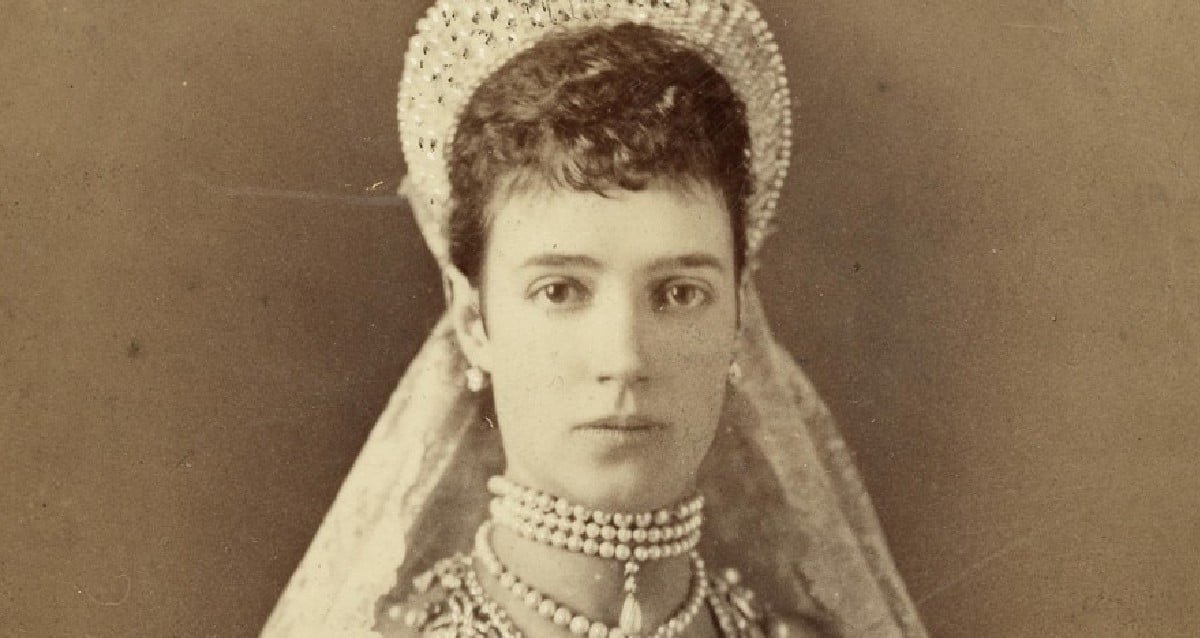

Empress Maria Feodorovna, born Princess Dagmar of Denmark, was the last dowager empress of the Russian Empire. Her life was defined by a series of personal losses and the eventual collapse of the Romanov dynasty. After witnessing the execution of her son, Tsar Nicholas II, and his family in 1918, she spent her final years in exile in Denmark, where she died on October 13, 1928, at the age of 80.
Early Life and Transition to the Russian Throne
Born on November 26, 1847, into a minor noble family in Denmark, her status changed significantly in 1863 when her father, Christian IX, became the King of Denmark. This elevation transformed her into a Danish princess and opened paths to several European thrones. Her brother eventually became the King of Greece, and her sister, Alexandra, married the future King of England.
As a teenager, Dagmar was engaged to Nicholas Alexandrovich, the heir to the Russian throne. However, this union was cut short when Nicholas died of cerebrospinal meningitis in April 1865 at the age of 21. Following his dying wish, Dagmar married his brother, Alexander, on November 9, 1866, at the Winter Palace in St. Petersburg, officially becoming Maria Feodorovna of Russia.
Role as Empress and Political Influence
Upon her arrival in Russia, Maria Feodorovna quickly integrated into the culture and gained the respect of the Russian people. A Russian diplomat noted that she won the hearts of the populace by embracing the identity of a Russian woman. In May 1868, she gave birth to her son and heir, the future Nicholas II.
Her transition to Empress occurred in 1881 after the assassination of Tsar Alexander II. During her time as Empress, she served as a key advisor to her husband, Alexander III. According to a 1927 report by The New York Times, she possessed one of the most acute minds for international politics in Europe at the time.
The Decline of Influence under Nicholas II
Following the death of Alexander III from kidney disease in 1894, her son Nicholas II ascended the throne at age 26. While he initially sought his mother’s guidance, his governance was increasingly influenced by his wife, Alexandra, and the mystic Grigori Rasputin. Maria Feodorovna found herself marginalized from the center of power, despite her efforts to urge her son to exercise stronger leadership.
The Russian Revolution and the Fall of the Romanovs
The pressures of World War I and internal unrest led to the Russian Revolution. In March 1917, Nicholas II was forced to abdicate, and shortly thereafter, he and his family were placed under house arrest. Maria Feodorovna shared a final goodbye with her son during this period, marking the last time they would see each other.
While the Romanov family faced captivity, Maria Feodorovna initially remained in Crimea, hoping to stay close to her son and maintaining secret correspondence with him. However, the communication ceased in the summer of 1918. On July 17, 1918, Nicholas II, his wife, and their five children were executed in Yekaterinburg.
Survival and Life in Exile
Despite the reports of the massacre, Maria Feodorovna refused to believe that her son and grandchildren had been killed. In letters to her nephew, she expressed her belief that the rumors were false and that the family had been moved to a place of safety. This perspective is detailed in the biography Little Mother of Russia: A Biography of Empress Marie Feodorovna.
In 1919, she was forced to flee Russia. Her nephew, King George V of England, dispatched a British battleship to rescue her. She spent the remainder of her life in Denmark, clinging to the hope that Nicholas II had escaped and would one day reappear.
Frequently Asked Questions About the Dowager Empress
What happened to Maria Feodorovna after the Russian Revolution?
After the revolution, she initially stayed in Crimea but was eventually evacuated by a British battleship in 1919. She lived the rest of her life in Denmark as an exile.
Did Dowager Empress Maria survive the Romanov executions?
Yes, she survived because she was not held in the same location as Nicholas II and his immediate family during the final stages of their captivity. She outlived the Russian Empire and died of natural causes in 1928.
What was the cause of death of Maria Feodorovna?
Maria Feodorovna died on October 13, 1928, at the age of 80, in Denmark, following a life marked by the loss of nearly all her immediate family members.
Who was Maria Feodorovna’s husband?
Her husband was Tsar Alexander III of Russia, whom she married in 1866 after the death of her first fiancé, Nicholas Alexandrovich.
Summary of the Romanov Family Tree and Losses
- Fiancé: Nicholas Alexandrovich (died 1865)
- Husband: Tsar Alexander III (died 1894)
- Son: Tsar Nicholas II (executed 1918)
- Grandchildren: Five children of Nicholas II (executed 1918)