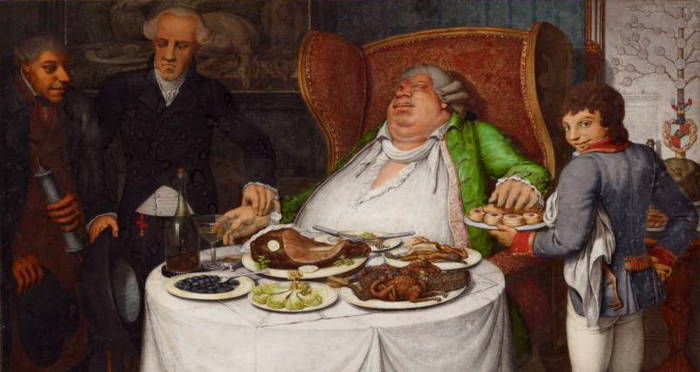

Tarrare was a French showman who captivated audiences in the 18th century with his extraordinary appetite. His insatiable hunger became legendary, drawing crowds eager to witness his seemingly impossible feats of consumption. Tarrare could devour vast quantities of food, easily surpassing the intake of fifteen average individuals. This wasn’t just limited to ordinary meals; he would swallow live animals whole, including cats and eels, alongside seemingly indigestible objects like stones and corks.
His condition began in childhood, leading his parents to expel him due to the sheer volume of food he consumed. This unusual affliction followed him throughout his life, transforming him into a traveling performer who showcased his ability to eat anything and everything. His insatiable hunger became both his source of fame and misfortune. While it initially brought him attention and notoriety, it ultimately led to a tragic end.
Despite receiving quadrupled rations during his time in the French Revolutionary Army, Tarrare’s appetite remained unyielding. He would scavenge for food even with ample provisions, emitting a foul odor so repulsive that it was described as “fetid beyond all conception.” His story is a fascinating and disturbing glimpse into the extremes of human physiology, raising questions about the limits of appetite and the consequences of unchecked hunger. Ultimately, Tarrare’s extraordinary tale serves as a reminder that even the most remarkable abilities can have devastating consequences, culminating in his untimely demise from tuberculosis. The autopsy performed after Tarrare’s death revealed an enlarged stomach and wide gullet, but the overpowering stench emanating from his body forced the doctors to prematurely abandon the examination.
Tarrare’s Insatiable Appetite
Tarrare’s appetite was so extreme that it defied all known explanations. He possessed an unquenchable thirst for food, consuming quantities that seemed impossible for a human being. Accounts from his time describe him devouring meals meant for fifteen people, leaving nothing but scraps behind. His insatiable hunger extended beyond normal fare; he would eat live animals whole, including cats and eels, with apparent ease.
Even stones, corks, and other indigestible objects failed to satiate his craving. There are chilling accounts of Tarrare consuming hospital waste and even swallowing raw flesh. This relentless pursuit of food became a defining characteristic of his life, shaping his every action and ultimately leading to his downfall. Despite the constant consumption, he always seemed hungry, perpetually searching for more sustenance. This relentless drive fueled his journey from a childhood outcast to a traveling showman and finally to a tragic figure consumed by his own insatiable desires.
His condition wasn’t merely about quantity; it was also characterized by an intense craving for variety. He would devour anything presented to him, regardless of taste or texture. Some historians speculate that Tarrare’s condition might have been a result of a metabolic disorder or hormonal imbalance, but the exact cause remains a mystery.
A Life of Performance and Excess
Tarrare’s extraordinary appetite quickly transformed him from a shunned child into a spectacle for public view. His parents, unable to cope with the sheer volume of food he consumed, ultimately rejected him, forcing him onto the path less traveled. He became a traveling performer, showcasing his ability to eat anything and everything to captivated audiences. The crowds flocked to witness his feats of consumption, eager to see if there was truly nothing that could satisfy his insatiable hunger.
He would devour live animals, including cats and eels, in front of awestruck onlookers. Stones, corks, and even pieces of wood were swallowed with apparent ease, further cementing his reputation as a man beyond ordinary limits. While some viewed him with fascination, others saw him as an object of curiosity or even disgust. Regardless of their perception, Tarrare’s unique talent became his means of survival, providing him with food and shelter in a world that couldn’t quite comprehend his condition.
As he traveled from town to town, his fame grew, leading him to the French Revolutionary Army, where his appetite continued to baffle doctors. Despite receiving quadrupled rations, he would still scavenge for additional food, emitting a foul odor described as “fetid beyond all conception.” This constant hunger, coupled with his bizarre behavior, ultimately led to Tarrare’s downfall, marking the tragic end of a life consumed by **his insatiable appetite.
Medical Mystery and Espionage
Tarrare’s time in the French Revolutionary Army saw him thrust into a peculiar blend of medical mystery and espionage. His relentless hunger baffled physicians who struggled to understand the root cause of his condition. Theories ranged from digestive disorders to parasitic infestations, but none could fully explain the sheer volume he consumed.
Despite receiving quadruple rations compared to other soldiers, Tarrare would still scavenge for additional food, leaving a trail of discarded scraps and an unbearable stench in his wake. His insatiable appetite became a source of both fascination and concern among his fellow soldiers and superiors alike. Recognizing his unique ability, General de Beauharnais tasked him with a daring espionage mission. He entrusted Tarrare with swallowing a secret message encased inside a box, hoping to deliver it undetected to enemy lines.
However, the mission tragically failed when Tarrare was captured by Prussian forces. Under duress and torture, he revealed the plot, leading to his own capture and imprisonment. This unfortunate turn of events highlighted the precarious position Tarrare found himself in – caught between a medical enigma and the harsh realities of war, ultimately serving as a tragic reminder of the human cost of conflict.
Cannibalism and Final Days
Tarrare’s final days were marked by a descent into darkness and desperation. His extraordinary appetite, once a source of spectacle and intrigue, became a terrifying obsession. With his health already failing, he turned to increasingly disturbing acts of consumption. Reports emerged of him devouring hospital patients’ blood and even corpses, driven by an insatiable hunger that defied all reason.
This macabre turn of events horrified those around him, revealing the tragic depths of Tarrare’s condition. He became a pariah, feared and shunned by society, his once-captivating talents now viewed as monstrous aberrations. His descent into cannibalism serves as a chilling reminder of how far unchecked hunger can lead a person, shattering the boundaries of human decency in pursuit of an insatiable desire.
Ultimately, Tarrare succumbed to tuberculosis, a disease that ravaged his already weakened body. His death marked the end of a life consumed by *tarrare’s extraordinary appetite*, leaving behind a legacy of fascination, horror, and unanswered questions about the limits of human physiology.
The Enigma of Tarrare Remains
Tarrare’s story continues to captivate and intrigue historians, medical professionals, and the general public alike. Despite extensive documentation of his life and extraordinary feats, many questions surrounding his condition remain unanswered. Was his insatiable appetite a result of a rare genetic disorder, a physiological anomaly, or perhaps something more sinister?
The lack of definitive answers fuels endless speculation and debate. Some believe that Tarrare’s case may have been a manifestation of pica, a disorder characterized by an insatiable craving for non-nutritive substances. Others propose that hormonal imbalances or metabolic disturbances could have played a role in his condition. However, without access to modern medical technology and diagnostic tools, it is impossible to arrive at a conclusive explanation for Tarrare’s unique case.
His story stands as a testament to the enduring mystery surrounding the human body and its capacity for both extraordinary feats and inexplicable phenomena. Even centuries after his death, Tarrare’s legacy serves as a reminder that there are still many facets of our existence that remain shrouded in enigma.