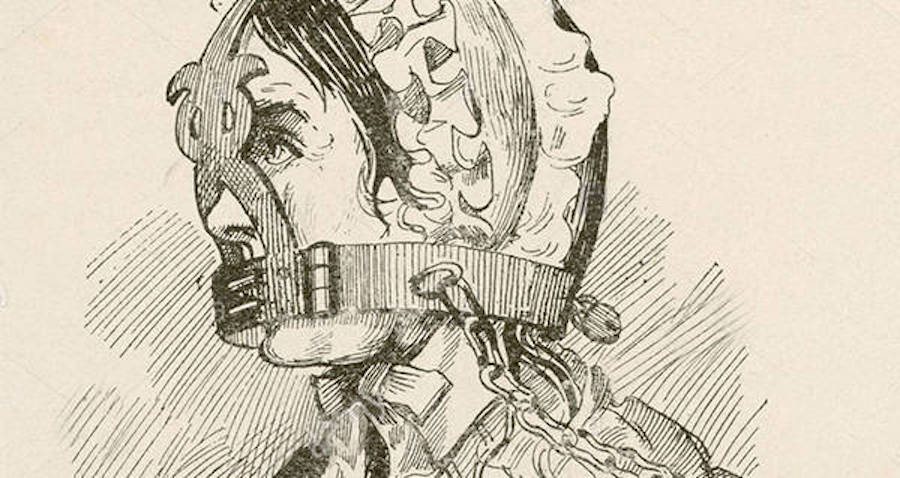

Let’s delve into the fascinating and often disturbing history of silencing women through these peculiar devices. Imagine a time when simply speaking your mind could land you in hot water, literally! From the 16th to the 19th century, certain societies harbored a deep fear of outspoken women, labeling them as troublemakers or threats to social order.
These fears manifested in various ways, but one particularly chilling method involved the use of a witches bridle, also known as a scolds’ bridle. This was a metal contraption designed to literally clamp down on a woman’s ability to speak. Picture this: a heavy iron mask with a gag fashioned to prevent any sound from coming out. Some versions even included spikes that could potentially inflict pain on the wearer’s tongue if they dared to attempt speech.
The scolds bridle mask, often crafted with intricate details and sometimes adorned with religious symbols, served as a public spectacle of shame and punishment. It was designed not only to silence these women but also to serve as a potent warning to others who dared to challenge societal norms.
Scolds Bridle: Design and Function
The design of a scolds bridle was as chilling as its purpose. It typically consisted of a metal mask that covered the wearer’s head and mouth, often featuring an iron gag to prevent speech. Imagine a rigid structure, crafted from unforgiving metal, designed to force its victims into silence. The gag itself varied in design; some had simple bars, while others incorporated spikes or even pointed teeth aimed at deterring any attempts to speak by inflicting pain upon the tongue.
Adding to the torment, these bridles weren’t just about muffling voices. Many included protruding metal pieces that pressed against the wearer’s cheeks and jaw, further restricting movement and causing discomfort. The entire contraption was secured with a strong lock at the back of the head, ensuring there was no escape from the restrictive embrace of the scolds bridle.
Its use wasn’t limited to just suppressing speech; it served as a tool to humiliate and ostracize women deemed unruly or disruptive. The very sight of someone forced to wear this device served as a warning to other women who might dare to step out of line.
Historical Context and Usage
The historical context surrounding the use of scold’s bridles is a complex and unsettling one. During the 16th to 19th centuries, societies often viewed outspoken women as threats to social order and patriarchal control. Women who dared to challenge authority, speak out against injustice, or simply engage in lively debate were frequently branded as troublemakers or witches.
The use of these scolds bridles wasn’t confined to a single region or time period; they appeared sporadically across Europe and some parts of America during this era. They were used to punish women accused of gossiping, quarreling excessively, blasphemy, or even having loose morals – essentially any behavior deemed disruptive or inappropriate by the prevailing social norms. The severity of these punishments varied depending on the region and the perceived offense, but the common thread was the aim to silence and shame these women into submission.
It’s important to remember that these bridles weren’t just tools for physical punishment; they were also symbols of power and control. By enforcing silence upon women, authorities aimed to maintain social order and reinforce the patriarchal structures of their time.
Evolution and Decline of the Punishment
While scold’s bridles were used throughout the 16th to 19th centuries, their popularity waned as societies progressed and attitudes towards women began to shift. By the Victorian Era, their use had largely fallen out of fashion. Think of it like this: as time moved forward, people started to recognize the barbarity and absurdity of such a punishment.
The rise of Enlightenment ideals and growing awareness of human rights contributed to this decline. The very notion of silencing women through physical force became increasingly unacceptable in the face of evolving social norms. It’s fascinating to see how historical context can shape the trajectory of such practices.
Although the scolds bridle itself faded into obscurity, its legacy continues to serve as a chilling reminder of how societies have historically attempted to control and silence dissenting voices, particularly those of women. It stands as a stark reminder of the importance of fighting for freedom of speech and challenging oppressive social norms whenever we encounter them.
Alternative Punishments for “Scolding” Women
Interestingly, the practice of punishing “scolding” women wasn’t confined to just the use of a scolds bridle. Other equally bizarre and cruel methods were employed to enforce social order and silence those deemed unruly.
One such punishment involved the notorious cucking stool – a chair that was publicly paraded through towns and villages, with the woman tied to it and often subjected to ridicule and humiliation. Another chilling example is the ducking stool, which literally dunked women into water as a form of “treatment” for their perceived transgressions. In some cases, these dunkings were fatal, serving as a brutal reminder of the consequences of speaking out against authority.
These alternative punishments highlight the desperation with which societies tried to control female voices and maintain patriarchal dominance. It’s a sobering reminder that throughout history, women have faced extraordinary challenges in expressing themselves freely.
The Legacy of Silence
The legacy of these instruments of silence extends far beyond their historical use. Though thankfully relegated to the annals of history, they serve as a potent reminder of how societies have historically sought to control and suppress dissenting voices, particularly those of women.
Even today, we see echoes of this silencing in various forms – from gender stereotypes that discourage women from speaking up to online harassment that aims to shut down female voices. The fight for genuine equality requires ongoing vigilance and a commitment to ensuring that all individuals, regardless of gender, feel empowered to express themselves freely.
Understanding the history of the legacy of silence helps us recognize these patterns and actively work towards dismantling them. It’s crucial to remember that every voice deserves to be heard, and silencing someone simply because they are different or challenge the status quo is never acceptable.