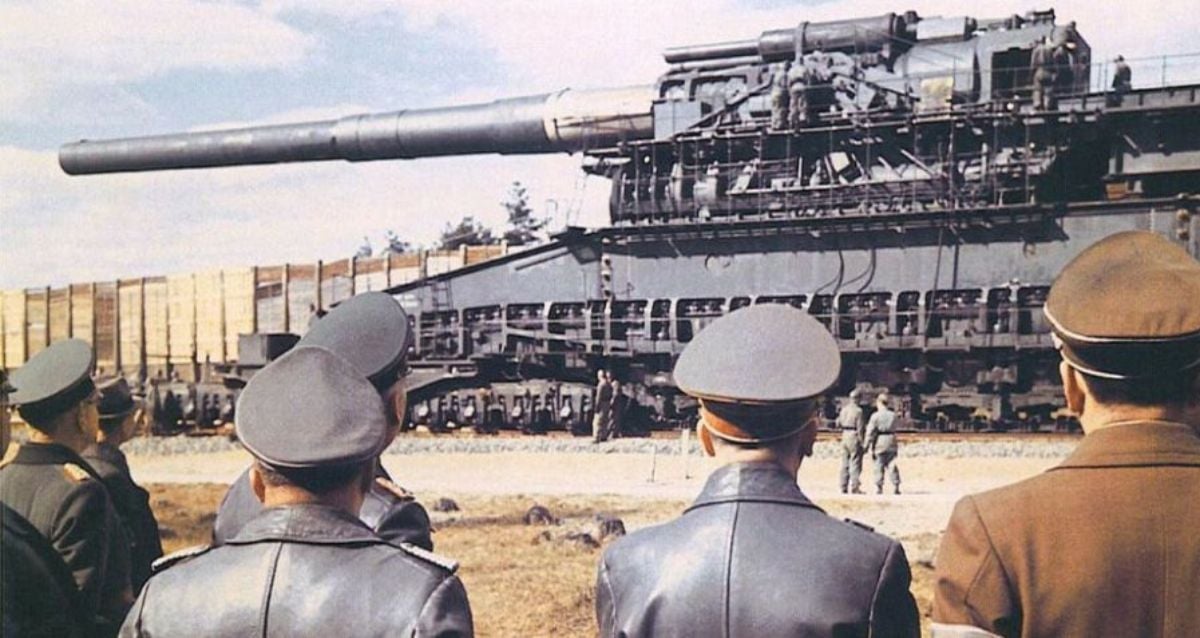
The annals of military history are replete with tales of awe-inspiring weaponry, each designed to outmaneuver and overpower its adversaries. However, few firearms have captured the imagination quite like the Schwerer Gustav, a behemoth of artillery that stands as a testament to both human ingenuity and the destructive potential of technology. This massive railway gun, conceived by Krupp in 1941, was intended as a formidable deterrent against the French Maginot Line, a network of fortifications designed to thwart any German invasion.
Though its original deployment strategy proved obsolete when the Nazis bypassed the Maginot Line in May 1940, the Schwerer Gustav ultimately saw action during World War II. With its imposing stature reaching nearly four stories high and weighing an astounding 1,490 tons, this war machine was a sight to behold. Moreover, it boasted a truly terrifying capability: firing shells weighing a staggering 7 tons up to a distance of 30 miles. This made the Schwerer Gustav the undisputed king of artillery, earning its place as the biggest gun ever constructed.
The sheer scale and power of this weapon were undeniably impressive; however, the practicalities of deploying such a colossal instrument proved to be highly challenging. The Schwerer Gustav’s size and weight rendered it incredibly vulnerable during transport, requiring extensive logistical planning and support. Furthermore, its operational costs were exorbitant, demanding a significant investment of resources that could have been allocated elsewhere. While the Schwerer Gustav inflicted considerable damage during its deployment in the siege of Sevastopol, its subsequent engagements proved less successful. Ultimately, its impracticalities likely led to its scrapping by the Nazis in 1944, leaving behind a legacy both awe-inspiring and cautionary.
The Design and Specifications of The Schwerer Gustav
The Schwerer Gustav was more than just a big gun; it was a marvel of engineering, meticulously designed to deliver devastating firepower. Its creators at Krupp spared no effort in ensuring its complexity and power. The gun itself was a masterpiece of construction, boasting a massive 80 cm barrel capable of launching shells weighing an astonishing 7 tons. This colossal projectile could reach targets up to 30 miles away, making the Schwerer Gustav a truly fearsome long-range weapon.
To manage this immense force, the gun required a robust and intricate system of hydraulics, gears, and levers. Its recoil mechanism was particularly ingenious, employing counterweights and powerful springs to absorb the shock of each discharge. This ensured stability and accuracy even when firing such heavy shells. The entire assembly rested upon a massive steel frame that was then mounted onto a specially designed railway platform.
This platform, itself weighing over 1,000 tons, served as both its transportation system and its base of operation. It featured extensive tracks for movement and powerful hydraulic jacks to elevate the gun into firing position. The Schwerer Gustav’s design reflected not only its destructive capability but also the meticulous planning and engineering prowess required to bring such a colossal weapon to life.
Intended Use and Initial Deployment Plans
The Schwerer Gustav was conceived with a specific objective in mind: to breach the formidable defenses of the French Maginot Line. This sprawling network of fortifications, stretching along the Franco-German border, was designed to withstand any attack and had become a symbol of France’s military strength.
Nazi strategists believed that a weapon of such immense power could overcome these obstacles, paving the way for a swift and decisive victory in Western Europe. The plan was to deploy the Schwerer Gustav behind enemy lines, targeting key choke points and fortifications within the Maginot Line. Its devastatingly powerful largest artillery shell would be capable of tearing through concrete and steel alike, potentially crippling French defenses before they could offer any resistance.
Unfortunately for the Germans, their blitzkrieg campaign proved highly successful, bypassing the Maginot Line entirely in May 1940. This rendered the Schwerer Gustav’s intended use obsolete at that time. While its initial deployment strategy was effectively nullified, it still played a limited role during World War II, albeit with less dramatic results.
Action in World War II: Siege of Sevastopol
Despite its initial deployment plans being rendered obsolete by the rapid German advance through France, the Schwerer Gustav eventually saw action in World War II, albeit on a different front. The brutal siege of Sevastopol, a strategically vital port city in Crimea, became the stage for this massive artillery piece to unleash its destructive potential.
Facing fierce Soviet resistance within the heavily fortified city, German forces sought to break through the defenses by utilizing the Schwerer Gustav’s unparalleled firepower. The gun was deployed on rail lines extending close to the besieged city, firing a barrage of 7-ton shells directly at Soviet positions. Each detonation sent shockwaves reverberating throughout Sevastopol, causing significant damage to fortifications and inflicting heavy casualties upon the defenders.
The strategic impact of the Schwerer Gustav’s involvement in the siege was undeniable. Its presence significantly weakened Soviet defenses, contributing to the eventual capture of the city after months of relentless fighting. While its deployment in Sevastopol demonstrated the weapon’s destructive capabilities, it also highlighted the logistical challenges and vulnerability inherent in operating such a massive piece of equipment.
Limited Success and Logistics Challenges
Following its deployment in the Siege of Sevastopol, the Schwerer Gustav was moved to other theaters of war, primarily targeting Leningrad and Poland. However, its effectiveness in these subsequent engagements proved significantly less impactful. The challenges inherent in transporting and deploying such a massive weapon began to outweigh its tactical advantages.
Its sheer size made it incredibly vulnerable during movement, susceptible to enemy air raids and ground attacks. The logistical demands were equally daunting: specialized rail lines and extensive support infrastructure were required for every deployment, tying up valuable resources that could have been allocated elsewhere. Furthermore, the Schwerer Gustav’s effectiveness was often hampered by its limited range compared to newer artillery systems being developed by both sides.
Ultimately, the strategic value of the Schwerer Gustav in these later campaigns proved to be questionable. Its impracticalities and heavy operational costs outweighed its tactical benefits, leading to a gradual decline in its usage. By 1944, it was deemed too cumbersome and expensive to maintain, likely resulting in its scrapping by the Nazi regime.
Legacy and Final Disposition
The Schwerer Gustav’s story ultimately serves as a reminder that technological advancement alone does not guarantee strategic success. While it represented a pinnacle of engineering achievement and possessed undeniable destructive power, its logistical limitations and impracticalities proved to be its undoing.
Its legacy is complex, simultaneously embodying both the ambition and the folly of war. While the exact fate of the Schwerer Gustav remains shrouded in some mystery, most accounts suggest that it was scrapped by the Nazis in 1944 due to its inherent impracticalities. Its massive size, high operational costs, and vulnerability during transportation made it a liability rather than an asset in the waning years of World War II.
Despite its limited operational lifespan, the Schwerer Gustav continues to fascinate historians and military enthusiasts alike. It stands as a testament to human ingenuity and the lengths to which nations will go to gain a technological edge on the battlefield. Its story serves as a cautionary tale about the potential consequences of prioritizing brute force over strategic adaptability in the face of evolving warfare.