
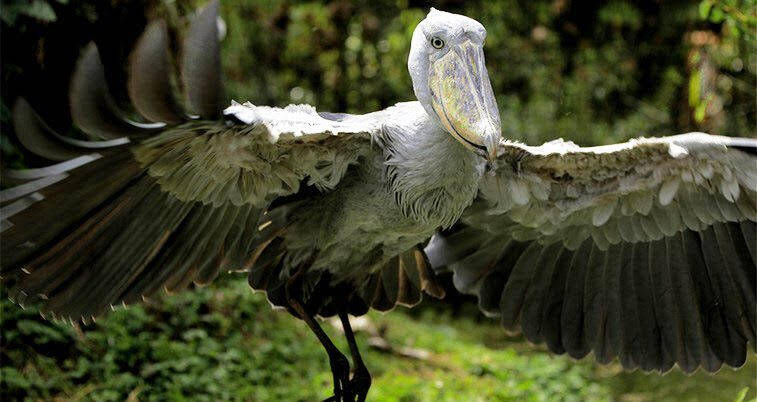

The shoebill stork is a bird that seems to have stepped straight out of prehistoric times. With its massive, seven-inch beak resembling a Dutch clog – hence the name – it’s one of the most distinctive birds on Earth. But don’t let its lumbering gait and somewhat awkward appearance fool you; this gentle giant is a formidable hunter.
Imagine a scene in an African swamp: sunbeams dappling through the dense foliage, the humid air thick with life. A shoebill patiently waits, half-submerged in the murky water, its shoebill teeth hidden beneath its beak. Suddenly, a lungfish surfaces for a breath of air – and that’s when lightning strikes. The shoebill’s beak snaps shut with bone-crushing force, ending the lungfish’s life in an instant.
This remarkable bird isn’t just a fearsome predator; it’s also a fascinating enigma. It belongs to its own unique family, Balaenicipitidae, making it more closely related to pelicans than storks, despite its outward appearance.
Shoebill Appearance and Habitat
Standing up to 4 feet tall and weighing up to 15 pounds, the shoebill is a truly imposing creature. Its most striking feature, of course, is that massive beak – pale gray with a hint of yellow at its tip – that can span almost seven inches. Beneath those powerful jaws are sharp, hooked shoebill teeth used for tearing flesh and crushing bones. But the shoebill’s size isn’t just about intimidating prey; it also plays a role in regulating its temperature. They rely on a fascinating process called urohydrosis – essentially sweating through their legs – to keep cool in the sweltering African swamps.
These swamps, with their dense vegetation and murky waters, are the shoebill’s preferred habitat. They thrive in East Africa, particularly in countries like Uganda, South Sudan, and Kenya. The shoebill is a creature of solitude, often spending its days wading through the shallows, patiently waiting for unsuspecting prey to come within striking distance. Their gray-brown plumage provides excellent camouflage amongst the reeds and branches.
Hunting Strategies and Prey
Shoebills are ambush predators, masters of patience and calculated strikes. They spend long hours motionless at the water’s edge, their keen eyesight scanning for movement. Unlike other birds that flit about or dive in pursuit, a shoebill prefers to wait for its prey to come within striking distance.
Their preferred meals consist mainly of lungfish, but they are opportunistic hunters and will also take down Tilapia, catfish, frogs, snakes, and even baby crocodiles. A lunge from the shoebill is swift and powerful; their massive beak delivers a bone-crushing blow that can decapitate larger prey. While some might consider this brutal, it’s simply nature’s way – a reminder of the raw power and efficiency found in the wild.
Conservation Status and Threats
Sadly, these magnificent birds are facing an uncertain future. Listed as vulnerable by the IUCN, their numbers have been dwindling due to a combination of habitat loss and human encroachment. As agricultural fields expand and wetlands are drained for development, shoebills are losing their vital breeding grounds and hunting areas. This fragmentation isolates populations, making them more susceptible to disease and genetic decline.
Adding to their woes is the illegal wildlife trade. Shoebills are highly sought after as exotic pets, and their unique appearance makes them valuable trophies for collectors. This demand puts a constant pressure on wild populations, driving further exploitation and pushing these remarkable creatures closer to the brink.
Shoebill Reproduction and Behaviour
Despite their somewhat intimidating appearance, shoebills are actually quite devoted parents. Once a pair has bonded, they work together to build a nest atop floating vegetation in the swamp. The female lays one to three large eggs, which both parents diligently incubate for about 30 days.
After hatching, the chicks are completely dependent on their parents for food and protection. They’re surprisingly fluffy and vulnerable at first, but grow quickly and develop their characteristic beaks within a few months. Shoebills remain fiercely protective of their young, defending them from predators with fierce aggression – a reminder that even these seemingly prehistoric creatures have strong parental instincts.
The shoebill’s life cycle is a testament to the resilience and adaptability of nature. They’ve survived for millions of years, evolving into unique and captivating creatures. But their future depends on our efforts to protect them and their fragile habitats.
A Bird of Mystery and Intrigue
There’s something undeniably enigmatic about the shoebill stork. Perhaps it’s their prehistoric appearance, frozen in time and seemingly ripped from a dinosaur documentary. Or maybe it’s their solitary nature, hidden amidst the murky waters of the African swamps. Whatever the reason, these birds have captured the imaginations of scientists, birdwatchers, and nature enthusiasts alike.
Despite decades of study, there are still many unanswered questions about shoebills. Their complex social interactions, intricate hunting strategies, and unique adaptations remain areas of ongoing research. This sense of mystery adds to their allure, reminding us that even in this age of scientific advancement, there’s still so much to discover about the natural world.
Each encounter with a shoebill is a fleeting glimpse into a hidden world. It’s a reminder that nature is full of surprises and wonder – a testament to the enduring power of evolution and the beauty of biodiversity.