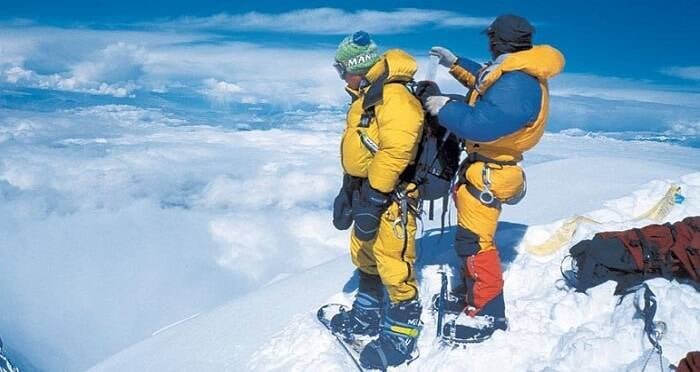

Approximately 300 people have died while attempting to summit Mount Everest, the highest peak on Earth. The mountain’s extreme environment, characterized by unpredictable weather and the lethal “Death Zone,” makes the recovery of bodies nearly impossible. It is estimated that more than 200 corpses remain on the slopes, often serving as grim landmarks for subsequent climbers.
The Impact of Increased Traffic on Everest
Control of Mount Everest is split between China (North side) and Nepal (South side). Nepal’s route is more popular, largely due to the government’s issuance of permits. This increase in climber volume has led to record-breaking numbers; for instance, in 2019, a record-breaking 891 people summited, though 11 of them perished during the expedition.
Hannelore Schmatz and the First Female Fatality
In 1979, German climber Hannelore Schmatz became the fourth woman to reach the summit of Mount Everest. She achieved this feat alongside her husband, Gerhard Schmatz, who became the oldest person to summit at the time. The couple had prepared for years, including a successful climb of Manaslu in 1973.
The tragedy occurred during their descent. After a blizzard forced a temporary retreat, the couple split up. Despite warnings from other climbers about dangerous conditions, Hannelore continued her ascent at 5 a.m. and successfully reached the peak. However, while descending, she and American climber Ray Genet were overcome by exhaustion in the Death Zone.
- Ray Genet: Died of hypothermia after attempting to build a shelter.
- Hannelore Schmatz: Became the first woman and first German national to die on Everest. Her final words were reported as “water… water” before she succumbed to exhaustion.
Unlike many other victims, Schmatz’s body was eventually swept off the Kangshung Face by the wind and was never recovered.
The Case of David Sharp and Climber Ethics
The death of British mountaineer David Sharp in 2006 remains one of the most controversial incidents on the mountain. Sharp was on his third attempt to summit when he became incapacitated near the peak on May 14, 2006.
As he lay dying, Sharp told fellow climbers that he just wanted to sleep. Despite being spotted by more than 40 climbers, including those who encountered him near the infamous “Green Boots” landmark, no rescue attempt was successfully executed. Some climbers reported that he waved them off, while others, such as Maxime Chaya, prayed with him but ultimately continued their descent due to the extreme risk to their own lives.
Did Marco Siffredi Ever Snowboard Down Everest
Among the most daring attempts on the mountain was that of Marco Siffredi, who sought to become the first person to snowboard down Mount Everest. Siffredi was an experienced snowboarder who had already completed a descent of Mount Everest in 2001, but he attempted a more direct and dangerous route from the summit in 2002.
Siffredi disappeared during this second attempt. To this day, the question of was Marco Siffredi ever found remains unanswered, as his body has never been recovered from the mountain. His disappearance highlights the extreme risks associated with non-traditional descents of the peak.
Common Questions About Everest Fatalities
What famous person died on Mount Everest?
While many professional climbers have perished, the mountain has claimed various high-profile adventurers and experienced mountaineers. The deaths are typically attributed to high-altitude cerebral edema (HACE), hypothermia, or falls.
Could Rob Hall have survived?
Rob Hall, the lead guide during the 1996 Everest disaster, perished during a descent in a severe storm. Whether he could have survived is a subject of debate among mountaineering experts, but the combination of extreme wind, plummeting temperatures, and the exhaustion of his clients made rescue operations impossible at that altitude.
The Reality of the Death Zone
The “Death Zone” refers to altitudes above 8,000 meters (26,247 feet), where oxygen levels are insufficient to sustain human life for extended periods. In this region, the body begins to consume its own resources to survive, leading to rapid physical and mental deterioration.
The difficulty of retrieving bodies from this zone is the primary reason why so many remain on the mountain. These corpses often become markers for other climbers, such as the Indian climber known as “Green Boots,” who served as a visual guide for years on the North Face.