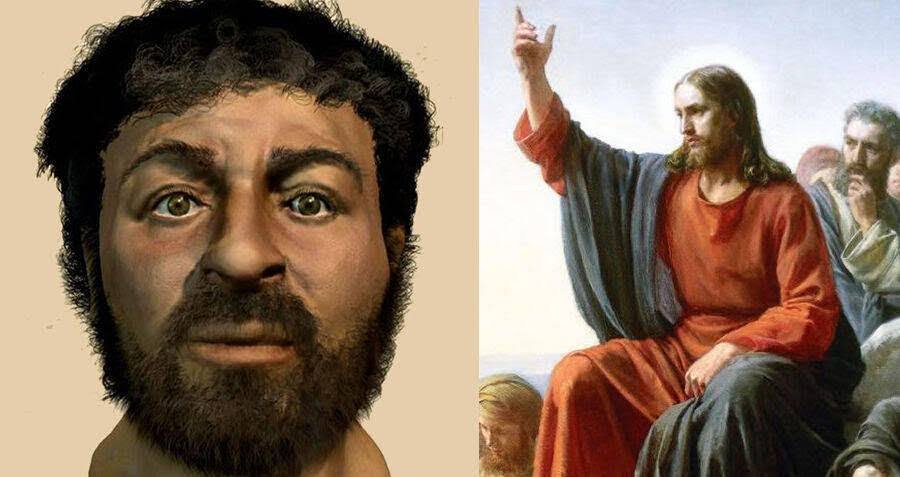

Introduction: The Elusive Appearance of Jesus
The life and teachings of Jesus Christ have captivated the imaginations of billions for centuries. His message of love, compassion, and redemption continues to inspire hope and guidance across cultures and religions. Yet, when it comes to his physical appearance, we encounter a fascinating paradox.
While the Bible offers profound spiritual insights, it provides surprisingly few details about Jesus’s looks. The emphasis is firmly placed on his inner qualities – his wisdom, his humility, his unwavering faith – rather than his outward appearance. This intentional vagueness has left room for centuries of artistic interpretations and speculation.
So how do we begin to piece together a picture of what Jesus actually looked like? Historians and artists alike have turned to a variety of sources – ancient manuscripts, archaeological findings, and even forensic analysis – to shed light on this enduring mystery.
Biblical Descriptions vs. Historical Evidence
The Bible itself offers limited physical descriptions of Jesus. We’re told he was a carpenter, had a gentle demeanor, and possessed captivating eyes that seemed to see into people’s souls. Descriptions like these focus on his character rather than his precise features. This lack of detail has naturally fueled countless artistic interpretations over the centuries.
Interestingly, the earliest known depictions of Jesus in Roman Catacombs from the 2nd century depict a shorter figure with dark hair and no beard. These images seem to reflect more realistic portrayals common in Jewish communities at that time. However, as art evolved, so did the image of Jesus. By the Middle Ages, he was often depicted with long hair and a full beard, influenced by prevailing Greek and Roman artistic traditions.
While these early depictions provide glimpses into how people visualized Jesus, it’s important to remember that they were heavily influenced by cultural norms and artistic conventions. This highlights the challenge of separating historical fact from artistic interpretation when trying to reconstruct Jesus actually looked like.
Early Depictions in Roman Catacombs
The Roman Catacombs, a labyrinthine network of underground burial chambers used by early Christians, offer a fascinating glimpse into how Jesus was initially portrayed. These catacombs, dating back to the 2nd century AD, are adorned with simple frescoes and carvings that depict scenes from the Bible, including some featuring Jesus.
What’s particularly striking about these early depictions is their realism. They show Jesus as a short, dark-haired man without a beard, a far cry from the long-haired, bearded image that became commonplace later. This suggests that the artists were striving for authenticity, reflecting how they believed Jesus would have appeared in his own time.
These early Roman Catacomb images provide valuable insights into how Christians in the first centuries envisioned Jesus. They highlight the importance of historical context and cultural influence when interpreting artistic representations. Remember, these depictions weren’t meant to be perfect likenesses but rather spiritual representations of Jesus within their specific cultural framework.
Forensic Reconstructions and DNA Analysis
In recent decades, scientists have turned to forensic techniques to attempt a more concrete reconstruction of Jesus’s appearance. By analyzing skulls from ancient Levantine populations dating back to the 1st century, they’ve created facial approximations based on skeletal structure and measurements.
These reconstructions often depict a man with olive skin, dark hair, dark eyes, a bushy beard, and a muscular build — characteristics typical of men in Judea during that era. The use of DNA studies further supports these findings, revealing that ancient Levantine populations shared many genetic traits common to people living in the Middle East today.
While forensic reconstructions offer intriguing insights, it’s crucial to remember that they are still interpretations based on limited evidence. They provide a plausible picture of how Jesus might have looked, but ultimately, we may never know for sure what Jesus actually looked like.
Cultural Influences on Artistic Representations
Artistic representations of Jesus have evolved significantly over time, reflecting the diverse cultures and artistic styles that have influenced them. In the early centuries, depictions tended to be more realistic, drawing on contemporary Jewish customs and traditions. However, as Christianity spread throughout Europe, Greek and Roman artistic influences became increasingly prominent, leading to portrayals of Jesus with long hair and beards.
The Renaissance brought a renewed focus on realism and anatomical accuracy, resulting in more lifelike representations of Jesus. Later periods saw even greater stylistic variation, from the idealized beauty of Baroque art to the emotional intensity of Romantic paintings. It’s fascinating to see how cultural shifts have shaped our visual understanding of Jesus throughout history.
These diverse interpretations reflect the fact that artistic representation is never purely objective. It’s always influenced by the context in which it’s created – the prevailing beliefs, social norms, and aesthetic trends of the time. Remembering this helps us appreciate the richness and complexity of Jesus actually looked like through the lens of art history.
Jesus Among His Contemporaries
While artistic depictions give us some clues, it’s important to remember that Jesus was a man who lived and moved within a specific time and place. He would have looked like his contemporaries – the men of Judea during the 1st century AD.
Imagine him walking alongside other Jewish men, their clothing simple and practical: robes, sandals, perhaps cloaks for protection from the elements. They likely shared similar physical characteristics – olive skin tones common in the region, dark hair, and beards that were becoming more prevalent among adult men at the time. Jesus wouldn’t have stood out as drastically different; he would have blended in with his community, a man of humble origins living an everyday life.
Ultimately, understanding how Jesus actually looked like means considering him within the broader context of his society, culture, and time period. He wasn’t a mythical figure divorced from reality but a real person who lived and interacted within a specific world.