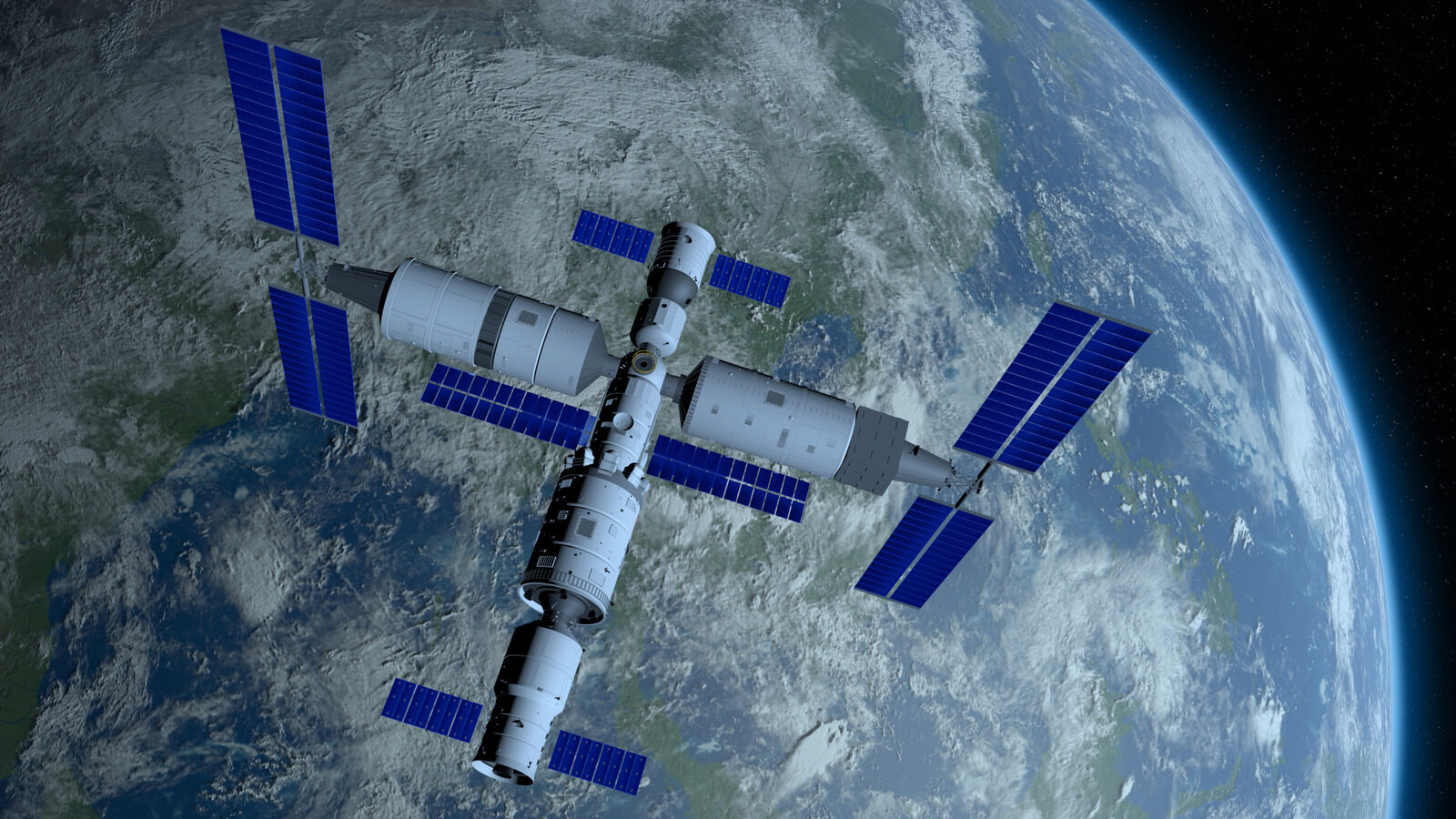

China is rapidly advancing its space ambitions, exemplified by the launch of the Tiangong space station. As a new contender in the cosmos, Tiangong is set to redefine our understanding of international space exploration and cooperation. This article dives deep into the intricacies of Tiangong, its historical context, its operational capabilities, and its strategic implications.
While the International Space Station (ISS) has long been the focal point for global space collaboration, Tiangong represents an independent effort by China to establish its presence in low-Earth orbit. This ambitious project not only showcases China’s technological prowess but also raises questions about the evolving dynamics of space exploration.
The history of Tiangong space station
The Tiangong space station is the latest chapter in China’s space exploration narrative, being the third iteration to carry the name “Tiangong,” which translates to “heavenly palace.” The journey began with Tiangong 1, launched in 2011, followed by Tiangong 2 in 2016. Both earlier models were instrumental in laying the groundwork for the current space station, despite their relatively short operational lifespans. Tiangong 1 was decommissioned in 2018, while Tiangong 2 followed suit in 2019, ultimately reentering the Earth’s atmosphere and disintegrating over the Pacific Ocean.
China’s decision to pursue an independent space station stems from geopolitical tensions. The ISS, managed cooperatively by countries such as the U.S., Russia, and several European nations, has excluded China due to legislative barriers like the Wolf Amendment. This law, passed by the U.S. in 2011, prohibits NASA from engaging in collaboration with China, prompting the country to forge its own path.
Understanding Tiangong’s structure and functionality
Tiangong currently consists of three interconnected modules arranged in a T formation. The central module, Tianhe, was launched in April 2021, marking the first phase of Tiangong’s assembly. The subsequent addition of two laboratory modules, Wentian and Mengtian, in 2022, allows for a variety of scientific experiments and research opportunities.
- Tianhe (Harmony of the Heavens): Central living quarters equipped with life support systems, including a filtration system that converts urine into potable water.
- Wentian: A laboratory module designed for conducting advanced research.
- Mengtian: Another lab module featuring an airlock and robotic arm for extravehicular activities.
Although Tiangong is significantly smaller than the ISS, with only three modules compared to the ISS’s sixteen, it integrates modern technology. Notably, Tiangong’s solar power arrays can rotate to maximize sunlight exposure, offering a more efficient energy collection method than the fixed solar panels used by the ISS.
China’s strategic goals for Tiangong
The China Manned Space Agency (CMSA) has ambitious plans for the Tiangong space station. The following initiatives are pivotal:
- Expansion: Plans to add three more modules, enabling the station to accommodate up to seven astronauts, matching the crew capacity of the ISS.
- Scientific Research: Tiangong will host various research projects, including a groundbreaking space telescope named Xuntian, expected to surpass the capabilities of both the James Webb and Hubble telescopes.
- International Collaboration: China is actively pursuing partnerships, with Pakistan set to join Tiangong in 2026.
The CMSA envisions Tiangong as a hub for scientific discovery and international cooperation, particularly in light of the ISS’s impending decommissioning in 2030. As NASA shifts towards privatizing its space operations, China’s strategic positioning may allow Tiangong to become the central node for future space exploration.
Comparing Tiangong with the International Space Station
When comparing Tiangong to the ISS, several key differences emerge:
- Size: The ISS is approximately twice the length of Tiangong and has a mass five times greater, housing a larger crew.
- Technology: Tiangong benefits from newer technology, including advanced solar arrays that enhance power efficiency.
- Operational Capacity: While the ISS typically supports seven astronauts, Tiangong’s current capacity is limited, though expansion is underway.
Despite its smaller size, Tiangong’s modern design and technology give it a unique edge, potentially allowing it to conduct experiments and research more effectively than its predecessor.
Are the U.S. and China in a new space race?
The unveiling of the Tiangong space station has sparked discussions about a possible new space race between the United States and China. This notion echoes the historical space race of the 1960s, characterized by intense competition between the two nations. Today, the dynamics have shifted, but the stakes remain high.
Recent developments, particularly NASA’s Artemis program aimed at returning humans to the moon, indicate a renewed American commitment to space exploration. However, while the U.S. maintains a lead in terms of historical achievements and budget allocation, China’s investment in space is growing steadily.
- China’s Growing Presence: With its increased funding for space initiatives, China aims to catch up and potentially surpass the U.S. in certain areas.
- Global Implications: The emergence of Tiangong raises questions about international collaboration in space and the potential for geopolitical tensions.
- Technological Advancements: Both nations are investing heavily in technology that could reshape our understanding of space exploration.
While it may be premature to declare a new space race, the competition between the U.S. and China is undeniably intensifying, with each nation striving to establish itself as a leader in the cosmos.