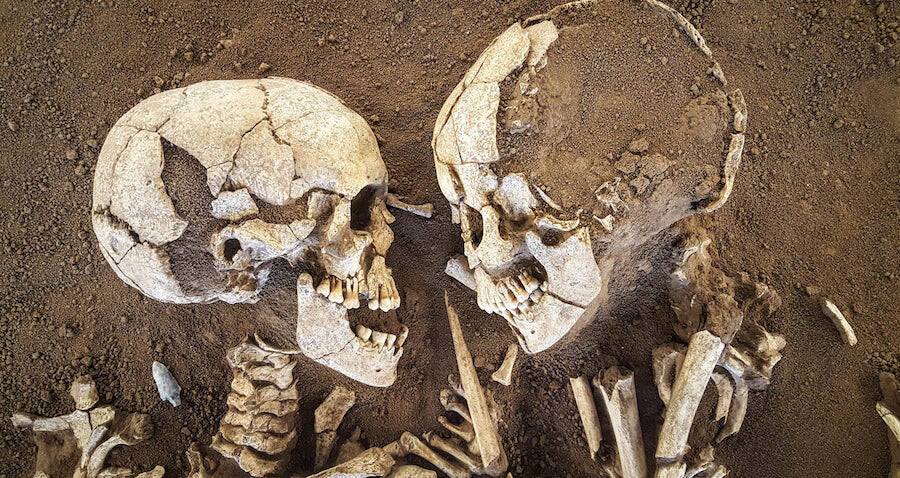
The ancient world often holds secrets that tantalize our imaginations. One such mystery emerged in 2007 near Mantua, Italy, when archaeologists unearthed a discovery that sent ripples through the academic community. Deep within a Neolithic tomb, they found the skeletal remains of a man and woman locked in an embrace. This wasn’t just any find; these lovers of valdaro, as they came to be known, appeared to have died around 6,000 years ago, their final moments frozen in time.
Initially, the scene seemed to point towards violence. Objects scattered near the skeletons fueled speculation about a tragic end. However, closer examination revealed no signs of trauma. It was as if these individuals had chosen to remain together even in death. Their unique burial position – a tender embrace – sparked countless theories. Some whispered of a passionate love story cut tragically short, while others envisioned a ritualistic sacrifice where eternal connection was paramount.
The discovery captivated the world’s attention, raising profound questions about ancient human relationships and their beliefs surrounding death. The lovers skeletons, as some called them, became a symbol of enduring love across millennia. This enigma continues to inspire research and debate, reminding us that even after thousands of years, the mysteries of the past can still hold us spellbound.
Lovers Found in Valdaro
The discovery site in Valdaro, Italy, became a focal point for archaeologists eager to unravel the secrets of these ancient individuals. The tomb itself was remarkably well-preserved, offering valuable clues about the burial practices of the Neolithic era. Inside, the skeletons of the man and woman lay intertwined, their arms wrapped around each other, their legs subtly touching. This intimate position suggested a deep connection, perhaps even romantic love, between them.
The meticulous examination of the remains revealed that both individuals were approximately 20 years old at the time of their deaths. The man was slightly taller than the woman, and they appeared to have been in good health. Tools and artifacts found near the skeletons provided further insights into their lives. These included flint tools, pottery fragments, and a small bone comb. While these objects offered glimpses into their daily routines, they shed little light on the circumstances surrounding their deaths or the reason for their unique burial placement.
Their story captivated the public imagination, fueled by speculation about whether they were the lovers of valdaro, bound by love or sacrifice. The discovery sparked a global conversation about ancient relationships, challenging our assumptions about romance and intimacy in a timelong past.
A Neolithic Embrace
The intimate embrace of the Valdaro lovers speaks volumes about their bond, yet it also raises intriguing questions. Were they united in life as well as death? Did their love story culminate in a tragic end, or was this a deliberate act of devotion, a public declaration of eternal connection? The answer remains elusive, lost to the sands of time, leaving us to ponder the complexities of human relationships across millennia.
This skeletons embrace, captured in stone and bone, offers a poignant reminder of the enduring power of love – even in its most enigmatic forms. It transcends cultural boundaries and speaks to our innate desire for connection, reminding us that the human need for intimacy is timeless.
Their story serves as a powerful testament to the profound impact relationships have on our lives. The image of these two individuals, forever entwined, evokes a sense of awe and wonder, prompting us to reflect on the nature of love, loss, and the enduring mysteries of the human experience.
 Stephen Hawking’s Warning on the Dangers of Artificial Intelligence
Unraveling the Mystery
Despite the captivating imagery and intriguing circumstances surrounding their discovery, the mystery of the Lovers of Valdaro remains largely unsolved. Scientists have been diligent in their efforts to piece together clues from the skeletal remains, the burial site, and the artifacts found alongside them. Yet, definitive answers about their identities, their cause of death, and the true nature of their relationship continue to elude researchers.
The lack of clear-cut answers has only fueled speculation and debate among archaeologists, anthropologists, and the public alike. Was this a genuine expression of love, a ritualistic offering, or something entirely different? Did they die accidentally, by suicide, or under more sinister circumstances? The ambiguity surrounding their story adds to its allure, prompting us to imagine various scenarios and ponder the complexities of human behavior in the distant past.
Unveiling the secrets of the neglect lovers may prove to be a long and challenging endeavor, requiring further archaeological exploration, advanced scientific techniques, and perhaps even a touch of luck. Until then, their story will continue to captivate our imaginations and serve as a reminder of the enduring mysteries that lie hidden beneath the surface of history.
The Lovers of Modena
Fast forward a couple of years after the discovery in Valdaro, another intriguing find emerged from Italian soil. This time, it was in Modena, where archaeologists unearthed a double burial featuring two skeletons buried hand-in-hand. The discovery of these the lovers of valdaro further fueled speculation about ancient human relationships and their significance in death rituals.
What made this discovery particularly fascinating was the application of a new technique analyzing dental enamel that allowed researchers to determine the sex of both individuals. This time, it was two men who were laid to rest together, adding another layer of complexity to the already intriguing narrative surrounding these ancient unions. The Modena find provided archaeologists with valuable comparative data, highlighting the diversity of burial practices and relationship dynamics in Neolithic Europe.
It seems that the practice of burying loved ones together wasn’t limited to romantic pairs, suggesting a broader societal value placed on interconnectedness and companionship even in death. These discoveries serve as powerful reminders that our ancestors held beliefs and practices about love, relationships, and mortality that continue to fascinate us today.
Ancient Connections
The discoveries in both Valdaro and Modena offer a glimpse into the complex social structures and beliefs of our Neolithic ancestors. While these findings are geographically separated by distance, they share a common thread: the profound importance placed on human connection even beyond death. The intimate burials suggest that love, companionship, and familial ties were deeply valued aspects of their lives.
These skeletons embrace, frozen in time, transcend cultural boundaries and speak to a universal human experience—the yearning for connection and the desire to leave behind a lasting legacy. Though separated by centuries, the stories of these individuals resonate with us today, reminding us that our shared humanity extends far beyond our own lifetimes.
The Lovers of Valdaro and Modena continue to fascinate and inspire researchers and the public alike. Their enduring mystery serves as a reminder that even after millennia, the past can offer profound insights into the human condition and our enduring desire for love, connection, and meaning.