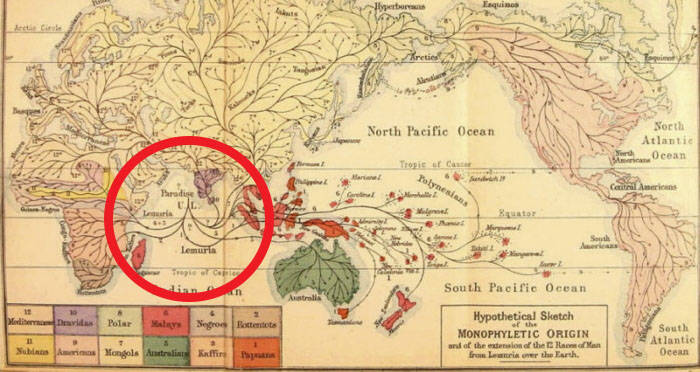
The idea of lost civilizations and hidden lands has always captivated our imaginations. Stories of ancient empires swallowed by the earth or forgotten continents shrouded in mystery have been whispered for centuries. One such tale that continues to spark debate and intrigue is the legend of Lemuria, a supposed lost continent situated in the vast Indian Ocean.
This concept, first proposed in the mid-1800s by British lawyer and zoologist Philip Lutley Sclater, aimed to explain the presence of lemurs in Madagascar, which seemed geographically isolated from other lemur populations. Sclater suggested that these primates once roamed a vast landmass called Lemuria, connecting Africa, India, and Madagascar. This idea resonated with the prevailing theories of land bridges connecting continents and the emerging understanding of evolution.
Later scientists, influenced by Darwin’s work and eager to weave a grand narrative about human origins, further embellished this theory. They envisioned Lemuria as the cradle of civilization, perhaps even the birthplace of humanity itself, home to an ancient race of four-armed, hermaphroditic humans. The notion captured the public imagination, finding its way into novels, movies, and comic books.
The Rise of Lemurian Theory
The concept of Lemuria gained significant traction in the late 19th and early 20th centuries, fueled by a confluence of factors. Scientific discoveries, while still tentative, seemed to support the idea of continents shifting and colliding over time. The discovery of fossils on different continents that resembled one another hinted at a shared past, lending credence to the notion of landmasses once connected. This resonated with public fascination for adventure and exploration, as well as a growing interest in ancient mysteries.
The burgeoning field of anthropology also contributed to the rise of Lemuria’s popularity. As scientists pieced together the puzzle of human evolution, they sought explanations for the diverse origins and migrations of our ancestors. Some researchers theorized that Lemuria might have served as a pivotal hub for early human migration, explaining the presence of distinct hominid fossils in seemingly disparate locations. This fueled speculation about an advanced civilization that thrived on this lost continent, leaving behind enigmatic clues and ruins waiting to be unearthed.
It’s important to remember that these were largely speculative theories, often lacking concrete evidence. Yet, they captured the public imagination, sparking a wave of interest in exploring uncharted territories and uncovering hidden secrets of the past. The legend of Lemuria became synonymous with adventure, lost civilizations, and the tantalizing allure of what remains unknown.
Geological Evidence and Evolutionary Connections
Despite its captivating allure, the theory of Lemuria faced significant challenges as geological and evolutionary understanding progressed. The discovery of plate tectonics in the mid-20th century provided a more robust explanation for continental drift and the distribution of fossils across the globe. The idea of continents slowly shifting over millions of years offered a compelling alternative to the sudden disappearance of a large landmass like Lemuria.
Moreover, paleontological evidence began to paint a clearer picture of primate evolution. Studies revealed distinct lineages of lemurs in Madagascar, suggesting a unique evolutionary history rather than a connection to a lost continent.
While the concept of Lemuria as a homeland for lemurs or an ancient human race ultimately fell by the wayside, the search for evidence continued. This quest led to fascinating discoveries, such as fragments of granite and 3-billion-year-old zircon found in the Indian Ocean south of India in 2013. These findings suggest the existence of a lost continent named Mauritia, which disappeared around 84 million years ago. While this discovery supports the idea of lost continents, it refutes theories about Lemuria as an ancestral home for lemurs or ancient humans due to the differing timelines. The story of Lemuria serves as a reminder of how scientific understanding evolves over time, and how even captivating mysteries can be reshaped by new evidence and discoveries.
 Stephen Hawking’s Warning on the Dangers of Artificial Intelligence
Challenging Lemuria: Modern Discoveries
As scientific understanding advanced in the 20th century, the theory of Lemuria began to face increasing scrutiny. The emerging field of plate tectonics provided a compelling alternative explanation for continental drift and the distribution of fossils across the globe. This revolutionary theory proposed that continents are not static landmasses but rather constantly shifting pieces of Earth’s crust, moving over millions of years.
The idea that Lemuria, a massive landmass, could have simply vanished without leaving any substantial geological trace became increasingly unlikely. Furthermore, advancements in paleontology offered a more nuanced understanding of primate evolution, revealing distinct lineages of lemurs in Madagascar that suggested they evolved independently rather than migrating from a common ancestor on a lost continent.
The weight of this mounting evidence gradually chipped away at the popular appeal of Lemuria. While it captured the imagination for decades with its promise of ancient mysteries and hidden civilizations, it eventually succumbed to the scrutiny of scientific inquiry. The story of Lemuria serves as a valuable reminder that our understanding of the world is constantly evolving, and even captivating theories can be challenged and reshaped by new discoveries.
Mauritia: A Lost Continent Emerges
While the idea of Lemuria faded from scientific favor, the search for lost continents continued. In 2013, a team of geologists made a groundbreaking discovery that brought a new contender to the forefront: Mauritia. Fragments of granite and 3-billion-year-old zircon were found in the depths of the Indian Ocean south of India, providing compelling evidence for a previously unknown landmass.
Analysis revealed that these fragments were remnants of an ancient continent that existed around 84 million years ago. This discovery reignited interest in lost continents, offering a tangible and scientifically supported example. Mauritia, as it was named, vanished beneath the waves long before Lemuria could have existed according to current geological models.
This finding doesn’t necessarily disprove the existence of other ancient landmasses but highlights the dynamic nature of Earth’s history. Continents rise and fall, collide and break apart over vast stretches of time, leaving behind clues that can be pieced together by modern geologists. The story of Mauritia reminds us that our understanding of the past is constantly evolving as new discoveries reshape our view of ancient landscapes and the continents that once existed.
Beyond Lemuria’s Myth
Although the legendary Lemuria ultimately faded from scientific acceptance, its enduring legacy continues to resonate in popular culture. From novels and movies to comic books and video games, the idea of a lost continent teeming with ancient mysteries persists as a source of fascination and inspiration. The allure of uncovering hidden civilizations, forgotten technologies, and extraordinary creatures continues to captivate our imaginations.
Perhaps the most valuable lesson we can glean from the Lemuria myth is the power of human curiosity and our insatiable desire to explore the unknown. It reminds us that scientific understanding is a journey of constant discovery and that even seemingly fantastical ideas can spark groundbreaking inquiries and lead to new perspectives. While Lemuria may have been relegated to the realm of mythology, its enduring legacy serves as a testament to the enduring power of imagination and the human quest for knowledge.
It also highlights the importance of critical thinking and scientific scrutiny in evaluating claims and separating fact from fiction. As we continue to explore our world and delve into its mysteries, the story of Lemuria serves as a reminder to approach new discoveries with both wonder and a healthy dose of skepticism.