Our existence on Earth is a fleeting miracle in the grand timeline of the universe. While we enjoy every breath of fresh air and sip of clean water, it’s crucial to acknowledge that this paradise is not eternal. As fascinating as our planet is, it is also subject to cosmic forces beyond our control. What does the future hold for humanity and the universe at large? Let’s delve into the astronomical perspectives on the potential endings of both our planet and the cosmos.
The fate of humanity when Earth is no more
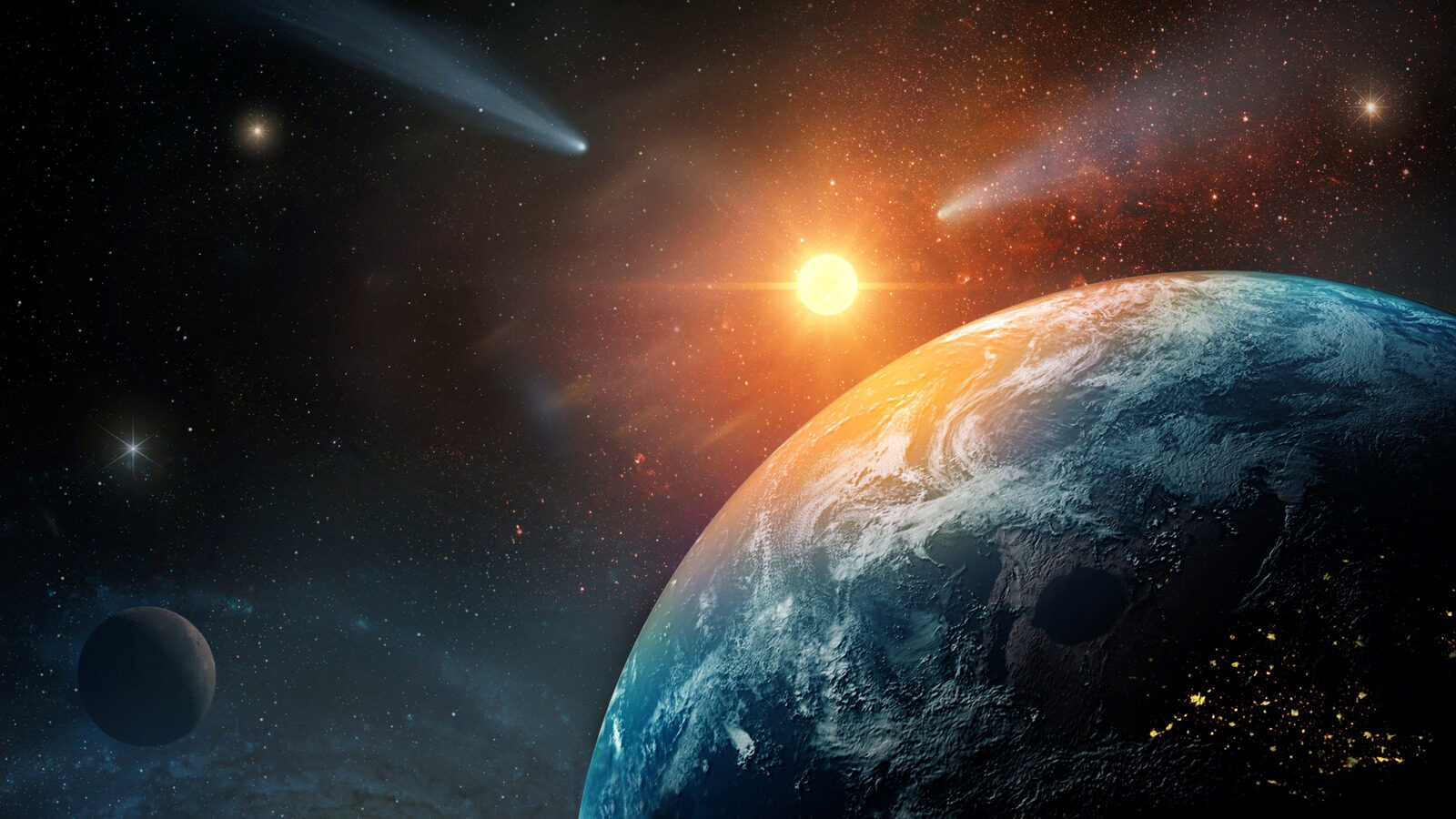
As we look towards the distant future, the survival of humanity beyond Earth becomes an increasingly pressing question. Current estimates suggest that in approximately 5 billion years, the Sun will transition into a red giant, expanding dramatically and ultimately engulfing Earth along with Mercury and Venus. This catastrophic event will force humanity to seek refuge far beyond our home planet.
While some may envision moving underground into high-tech bunkers to escape the sun’s growing intensity, such measures would only provide a temporary solution. In this regard, here are several possible alternatives for survival:
- **Colonization of Mars:** With ongoing advancements in space technology, Mars is seen as one of the most viable options for human colonization.
- **Terraforming other planets:** Transforming other celestial bodies to make them habitable could be a long-term strategy.
- **Exploring exoplanets:** The search for Earth-like planets in nearby star systems could yield new homes for humanity.
However, the challenges are immense. Long before we reach that 5 billion-year mark, our galaxy, the Milky Way, is expected to collide with the Andromeda galaxy. This collision, predicted to occur in about 4 billion years, could disrupt our solar system significantly. Depending on the dynamics of the merger, our solar system might be flung into intergalactic space or face catastrophic gravitational interactions with nearby celestial bodies.
Understanding the Degenerate Era
Once the immediate threats from the Sun and galactic interactions have passed, humanity would encounter the Degenerate Era, which is projected to begin around 1 quadrillion years from now. During this era, stars will exhaust their nuclear fuel, leading to a darkened universe filled with remnants like black holes, neutron stars, and white dwarfs.
Life, if it still exists, might adapt to these extreme conditions, possibly residing within a Dyson sphere—or similar megastructures—encircling a white dwarf, harnessing its remaining energy. Yet, even this existence is fleeting, as the energy sources would eventually dwindle, leading to even harsher living conditions.
What awaits at the end of the universe?
The question of what happens at the end of the universe presents an even more profound mystery. Current theories propose several potential scenarios, each depicting a dramatically different fate:
- **The Big Freeze:** As the universe continues to expand, it will eventually reach a state of thermal equilibrium where all stars burn out, leading to a cold, dark universe.
- **The Big Rip:** If dark energy continues to accelerate the expansion of the universe, it may eventually tear apart galaxies, stars, and even atoms.
- **The Big Crunch:** An alternative theory suggests that if there is not enough dark energy, the universe could eventually collapse back in on itself, potentially triggering a new Big Bang.
Each of these scenarios leads to a future where the universe as we know it ceases to exist. The timeline extends to a staggering 1 googol years into the future for scenarios involving proton decay and black hole evaporation, rendering all matter into a sea of subatomic particles.
Proton decay and the implications for the future
Proton decay is a theoretical process that suggests protons may not be as stable as once thought. If proton decay occurs, the implications for the universe would be catastrophic. Estimates suggest protons could begin decaying after 100 undecillion years, leading to a realm devoid of stable matter. This would drastically alter the fabric of reality as we know it.
 Key Reason Scientists Aim to Clone Cows
While current physics cannot definitively prove or disprove these theories, they highlight the fragility of existence in the universe. The prospect of relying on a rogue neutron star or black hole for sustenance in this distant future paints a picture of survival that is both intriguing and haunting.
The role of dark energy in cosmic evolution
Dark energy plays a crucial role in the fate of the universe. It is a mysterious force driving the accelerated expansion of the cosmos. Understanding its nature will be pivotal in predicting how the universe will evolve.
Depending on the properties of dark energy, one of the following outcomes might occur:
- **Continued expansion:** If dark energy remains constant, the universe will continue expanding indefinitely.
- **Dynamic dark energy:** If dark energy changes over time, it could lead to varying scenarios, including the Big Rip or Big Crunch.
- **Negative pressure:** Some theories suggest dark energy could eventually reverse, causing a halt to expansion and leading to a collapse.
Each of these scenarios emphasizes the unpredictable nature of our universe and the profound mysteries that lie ahead in cosmic evolution.
Humanity’s legacy in the cosmos
As we ponder the distant future and the potential endings of both Earth and the universe, it’s essential to consider humanity’s legacy. Will we be remembered as a species that ventured into the stars, or will we fade into obscurity along with our home planet?
Through advances in technology, exploration, and perhaps colonization of other worlds, humanity has the potential to transcend its limitations. The journey into space may be fraught with challenges, yet it also presents an opportunity for growth and evolution. The question remains: will we harness our ingenuity to continue our existence beyond Earth?