The thought of medieval torture instruments evokes a sense of dread and fascination. They paint a picture of a dark past where cruelty was commonplace, leaving us to wonder about the depths of human depravity. One such instrument, shrouded in mystery and rumor, is the anguish pear.
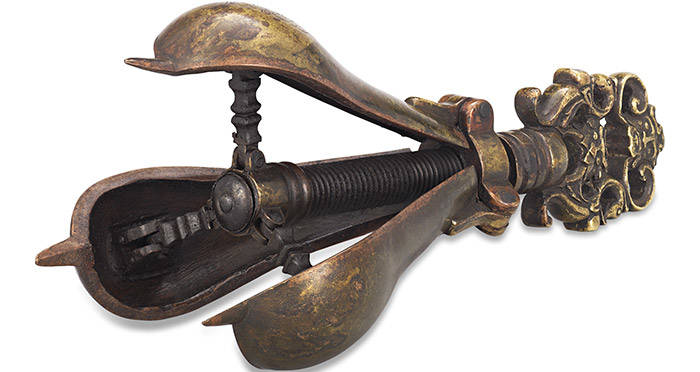
This alleged device, said to have been used in 17th-century Europe, is described as a metal contraption shaped like a pear with a bulbous head and a narrower stem containing a screw. The gruesome story goes that it was inserted into the rectum, and as the screw turned, the head expanded, causing unimaginable pain by stretching the anus and overloading nerve endings.
The idea of such a device is chilling indeed, leaving us to question the extent to which our imaginations can conjure up horrors that may or may not have actually existed. Nevertheless, despite its captivatingly horrific image, historical evidence suggests that the anguish pear might be more myth than reality.
The Pear Of Anguish: A Brutal Legend
The legend of the pear of anguish has persisted for centuries, often depicted in novels and movies as a symbol of medieval torture. It’s easy to see why this gruesome image captures our imagination – the idea of being stretched open by a metal device is undeniably terrifying. The sheer brutality implied, coupled with the evocative name, has cemented its place in popular culture as a quintessential example of medieval cruelty.
However, despite its enduring presence in our collective consciousness, historical evidence supporting the existence of the anguish pear as described remains elusive. Contemporary accounts from the period largely focus on different types of torture devices, such as the “choke pear,” a gag inserted into the mouth to silence victims. This suggests that the anguish pear, as depicted in modern media, might be a product of our fascination with macabre imagery rather than an accurate representation of historical practices.
It’s possible that whispers and exaggerations over time transformed these different instruments into a single, more horrifying entity – a testament to how stories can evolve and take on new, often more terrifying forms as they are passed down through generations.
Historical Evidence And Contemporary Accounts
When trying to separate fact from fiction surrounding historical torture devices, it’s crucial to examine the available evidence. Unfortunately, concrete proof of the anguish pear as described in popular culture is lacking. Historical records and accounts from the 17th century primarily focus on other instruments used for punishment and interrogation.
One such device was the “choke pear,” a gag inserted into the mouth to prevent victims from screaming or speaking. This suggests that while the idea of a device causing pain through internal expansion might have circulated, there’s little to suggest it was ever widely used as described in modern depictions. The absence of detailed descriptions or illustrations of the anguish pear in contemporary texts further strengthens this argument.
It’s possible that the legend evolved over time, fueled by rumors and embellishments passed down through generations. This highlights the importance of critically evaluating historical accounts and separating fact from fiction when exploring such sensitive topics.
Torture Devices In 17th Century Europe
The 17th century in Europe was a period marked by political upheaval and religious conflict, often leading to harsh punishments for those deemed criminals or dissenters. Torture methods were prevalent during this era, reflecting the brutality and lack of due process that characterized many legal systems of the time. While the anguish pear remains largely a debated topic, other torture devices were well documented and used throughout Europe.
The rack, a device designed to stretch victims’ bodies to breaking point, was widely employed for extracting confessions or punishing perceived enemies of the state. Instruments like the thumbscrew and iron maiden inflicted excruciating pain through pressure and confinement, respectively. These devices, alongside more common methods such as beatings and branding, served to both punish and intimidate populations into submission.
Despite their brutal nature, these torture devices were often seen as legitimate tools for upholding law and order during this period. It is important to remember that historical context plays a crucial role in understanding the prevalence and use of such practices, even though they remain abhorrent by modern standards.
Fact Or Fiction? Debunking The Myth
So, what’s the truth about the anguish pear? While its gruesome legend continues to capture our imaginations, historical evidence suggests it might be more myth than reality. The lack of concrete proof in contemporary accounts and the presence of other well-documented torture devices from that era point towards the possibility that the anguish pear, as depicted in popular culture, never truly existed.
It’s possible that exaggerated stories and rumors surrounding medieval torture practices contributed to the creation of this infamous device. The human fascination with the macabre and the desire to imagine the most horrific punishments likely fueled its enduring presence in our collective consciousness. Despite lacking historical backing, the pear of anguish remains a chilling symbol of the potential for cruelty and serves as a reminder to critically examine claims about historical events.
It’s important to separate fact from fiction when exploring such sensitive topics and to rely on credible sources and evidence-based research.
The Enduring Power Of Darkness
Even though the anguish pear might be more myth than reality, its enduring presence in popular culture speaks volumes about our fascination with darkness and the macabre. There’s a certain morbid curiosity that draws us to stories of torture and cruelty, perhaps as a way to confront our own capacity for darkness or to understand the extremes of human behavior.
This fascination isn’t unique to the pear of anguish; it manifests in countless horror films, books, and even historical reenactments. We seem drawn to exploring the darkest corners of human history, even if it makes us uncomfortable. Perhaps this stems from a desire to learn from past mistakes and ensure that such atrocities are never repeated. Or maybe it’s simply a testament to the enduring power of storytelling, where even fictional horrors can captivate our imaginations and leave a lasting impact.
Regardless of the reason, the anguish pear, whether real or imagined, continues to serve as a potent reminder of the capacity for both good and evil that exists within humanity.