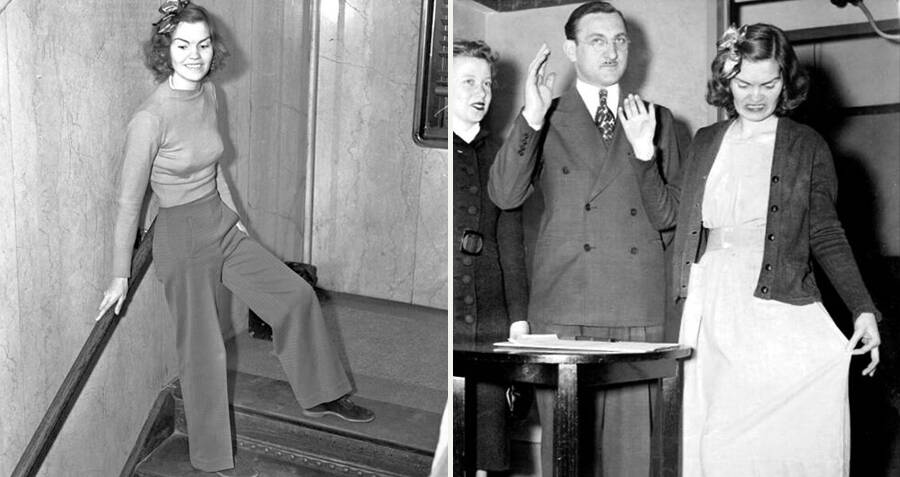
In 1938, a seemingly ordinary courtroom scene in America took an unexpected turn. Helen Hulicks, a kindergarten teacher and passionate advocate for the deaf, found herself at odds with Judge Arthur S. Guerin over an unconventional choice of attire. While testifying against two burglars, she chose to wear slacks instead of a dress, a decision that would spark a firestorm of controversy and ultimately become a symbol of women challenging societal norms.
Hulick’s defiance wasn’t born out of malice or disrespect; she simply preferred the comfort and practicality of trousers. Imagine yourself in her shoes – standing before a judge, determined to speak for justice while feeling confined by traditional expectations. Hulick refused to be silenced, choosing to express herself through her clothing as much as through her words.
This wasn’t just about fashion; it was about asserting individual choice and dismantling rigid societal rules that dictated how women should dress. The case of a woman arrested for wearing pants, as it came to be known, resonated far beyond the courtroom walls, igniting a debate about gender equality and the right to self-expression.
Helen Hulick: A Pioneer for Women’s Rights
Helen Hulick’s story goes beyond a simple courtroom battle; it reveals a woman deeply committed to social justice and challenging the status quo. Her passion for advocating for the deaf community was evident in her work as a kindergarten teacher, where she tirelessly championed their inclusion and right to equal opportunities. Imagine a time when accessibility wasn’t a given, and individuals with hearing impairments faced countless barriers in accessing education and everyday life. Hulick dedicated herself to breaking down those walls, paving the way for greater understanding and acceptance.
Her courage in defying Judge Guerin’s ruling wasn’t just about personal expression; it was a powerful statement against societal restrictions on women’s choices. By refusing to conform to expected norms, she inadvertently ignited a spark of rebellion that resonated with countless women who felt similarly constrained by rigid expectations. Hulick’s unwavering belief in equality and her willingness to stand up for what she believed in made her a true pioneer for women’s rights, paving the way for future generations to challenge gendered limitations.
Her legacy extends beyond the courtroom; it serves as a reminder that even seemingly small acts of defiance can have a profound impact on shaping societal norms. Hulick’s story continues to inspire us to question outdated rules and fight for a world where individuals are free to express themselves authentically, regardless of their gender or any other societal label.
Challenging Courtroom Etiquette
Judge Guerin’s reaction to Helen Hulick’s attire highlights a fascinating aspect of courtroom etiquette – the often unspoken rules surrounding dress and decorum. In that era, courts were steeped in tradition, with strict expectations for how individuals should appear and behave. For men, this typically involved formal suits, while women were expected to adhere to more restrictive standards, often requiring dresses or skirts. These regulations, though seemingly innocuous, served as a subtle yet powerful reinforcement of societal norms and hierarchies.
Hulick’s refusal to conform to these unwritten rules triggered a clash between individual choice and established protocol. It forced the court to confront the question: should personal expression be sacrificed at the altar of tradition? Judge Guerin, firmly entrenched in his belief that Hulick’s slacks were inappropriate for the courtroom, saw her defiance as a direct challenge to his authority and the sanctity of legal proceedings. His response – holding her in contempt of court – demonstrates how deeply ingrained these norms were, and the lengths to which they were enforced.
This incident raises important questions about the purpose and function of courtroom etiquette. While maintaining decorum is essential for a fair and respectful judicial process, should rigid dress codes be imposed? Should individuals be penalized for choosing attire that doesn’t conform to outdated expectations? Hulick’s case serves as a reminder that traditions, especially those concerning gender roles and expression, should be continually evaluated and challenged in the pursuit of fairness and equality.
Contempt of Court and Imprisonment
Judge Guerin’s decision to hold Helen Hulick in contempt of court was a dramatic escalation of the situation. Contempt of court is a serious legal charge, typically reserved for actions that directly obstruct justice or disrespect the authority of the court. In this case, Hulick’s refusal to change into a dress and her public statement challenging the judge’s order were deemed sufficient grounds for such a severe punishment. It’s hard to imagine facing a five-day jail sentence simply for choosing your clothes!
Being sent to jail for wearing pants was undoubtedly a humiliating and unjust experience for Hulick. She was forced to wear a denim dress during her incarceration, further emphasizing the absurdity of the situation. Imagine being stripped of your personal autonomy and subjected to such a demeaning restriction solely because of your attire. This injustice fueled public outrage and galvanized support for Hulick’s cause.
The case eventually reached the Appellate Court, which overturned Judge Guerin’s ruling. This victory was a significant milestone in challenging restrictive societal norms and establishing individual rights within the legal system. It demonstrated that even seemingly minor acts of defiance can lead to positive change when they are rooted in principles of justice and equality.
The Appellate Court Ruling
The Appellate Court’s decision to overturn Judge Guerin’s ruling was a pivotal moment in Helen Hulick’s case and a landmark victory for individual expression. This higher court recognized the absurdity of punishing someone for their clothing choices, particularly when those choices did not interfere with the legal proceedings. Imagine the relief Hulick must have felt when she learned that her conviction had been overturned – a testament to the power of appealing unjust rulings and seeking a fairer outcome.
The Appellate Court’s ruling wasn’t simply about pants versus dresses; it was about reaffirming the fundamental right to self-expression and challenging societal norms that sought to constrain individual freedom. This decision sent a powerful message: individuals should be free to present themselves authentically, without fear of legal repercussions based on outdated expectations.
The case also highlighted the importance of due process and ensuring fair treatment within the legal system. By overturning Judge Guerin’s ruling, the Appellate Court emphasized that even seemingly minor matters deserve careful consideration and a commitment to justice. This landmark decision continues to serve as a valuable reminder that our legal system should protect individual rights and promote equality for all.
The Legacy of a Pants-Wearing Protester
Helen Hulick’s story might seem like a distant footnote in history, but it carries profound implications that resonate even today. Her courage to challenge societal norms and fight for individual expression serves as an inspiration for anyone who has ever felt constrained by expectations. She reminds us that even seemingly small acts of defiance can have a ripple effect, sparking conversations and challenging the status quo.
Hulick’s case highlights how far we’ve come in terms of gender equality, while also reminding us that there is still work to be done. While women today are no longer subject to restrictive dress codes in courtrooms or other public spaces, societal pressures regarding appearance and expression persist. Hulick’s legacy encourages us to continue questioning these norms and advocating for a world where individuals are free to express themselves authentically, regardless of gender or any other societal label.
Her story serves as a powerful reminder that progress is often achieved through the courage of individuals who dare to challenge the status quo. Hulick’s willingness to stand up for what she believed in, even when facing opposition and potential consequences, makes her a true role model.