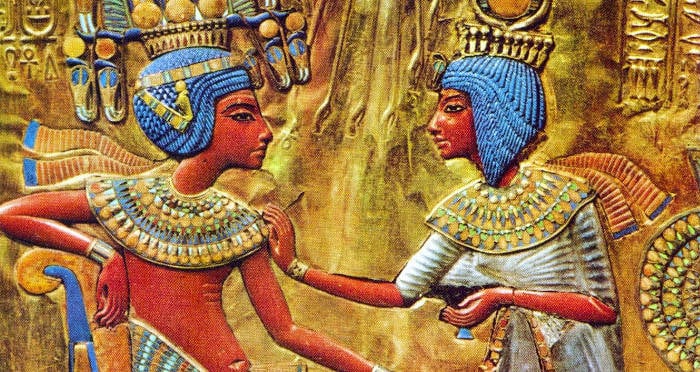
Tutankhamun, the boy king of ancient Egypt, continues to fascinate us centuries later. His tomb, discovered almost entirely intact in 1922, offered a glimpse into the opulent world he inhabited and sparked endless fascination with his life and reign. However, one question that has lingered through the ages is: did King Tut marry his sister?
The answer lies in the intriguing story of Ankhesenamun, who became Queen of Egypt by marrying her half-brother, Tutankhamun. Their union was not unusual for the time. In ancient Egypt, incestuous relationships within the ruling class were common. The practice aimed to maintain a “sacred bloodline” and concentrate power within the family.
The story of Tutankhamun’s queen is one of intrigue, tragedy, and historical mystery. Her life was intertwined with her husband’s turbulent reign, marked by religious upheaval and political instability. While their marriage may seem shocking to modern sensibilities, it was a reflection of the cultural norms and beliefs of ancient Egypt.
The Reign of Tutankhamun and Ankhesenamun
Tutankhamun ascended to the throne at a young age, around nine years old, following the death of his father, Akhenaten. Akhenaten’s reign had been marked by religious upheaval as he promoted Aten, the sun disk, as the sole god and abandoned traditional Egyptian deities. Ankhesenamun, Tutankhamun’s wife, was also a daughter of Akhenaten. Together, they reversed their father’s policies, restoring the old gods to their rightful place in Egyptian religion.
This restoration wasn’t just a shift in faith; it represented a return to normalcy after a period of significant upheaval. The people of Egypt were relieved to see familiar practices and beliefs re-established. Tutankhamun’s reign, while brief, proved crucial in stabilizing the kingdom after years of religious and political turmoil. They worked together to rebuild temples dedicated to the traditional gods and appease the priests who had been sidelined during Akhenaten’s rule.
Despite their efforts, Tutankhamun faced numerous challenges. There were ongoing issues with maintaining control over territories on Egypt’s borders, and his own health was a constant concern. He suffered from various ailments throughout his reign, possibly stemming from the practice of incest prevalent among royal families at the time. Sadly, he died young, around 19 years old, likely due to an infection complicated by a leg fracture.
Royal Incest in Ancient Egypt
Tutankhamun’s marriage to his sister, Ankhesenamun, wasn’t unique in ancient Egypt. Incestuous relationships between siblings, particularly among royalty, were surprisingly common practice for centuries. It seems paradoxical to us now, but there were complex reasons behind this tradition.
One key factor was the belief that marrying within the family preserved a “pure” and divine bloodline. The pharaohs were considered living embodiments of the gods, and rulers believed their lineage needed to remain untainted by outside influences. This idea helped solidify their claim to divinity and power. Another reason for royal incest was practical: it helped consolidate political control within families. Marriages between close relatives prevented outside factions from gaining influence through alliances with the royal family.
Of course, this practice came with its own set of consequences. The risk of genetic defects due to inbreeding was high, which likely contributed to health issues among some pharaohs. However, despite these potential drawbacks, royal incest remained a deeply ingrained part of ancient Egyptian society for centuries.
 Atlantic City Slums: A History of Decline and Resilience
The End of a Dynasty: Akhenaten’s Legacy
Akhenaten’s reign was a period of radical change and upheaval in ancient Egypt. His religious revolution, centered around the worship of Aten, the sun disk, proved to be both ambitious and ultimately unsustainable. He abandoned traditional Egyptian deities, closed countless temples, and imposed a new form of worship that focused solely on Aten.
This dramatic shift caused widespread confusion and resistance among the people, who were accustomed to honoring their familiar gods. The priesthood, once powerful figures in Egyptian society, lost influence and support under Akhenaten’s rule. Even though he aimed to create a more unified and centralized religion, his policies ultimately divided the kingdom.
The consequences of Akhenaten’s legacy were felt far beyond his short reign. His successors, including Tutankhamun, spent considerable energy undoing many of his religious reforms and restoring traditional Egyptian beliefs. Akhenaten’s family was ultimately erased from official records by later pharaohs who sought to distance themselves from this controversial period in Egyptian history.
A Mysterious Disappearance
Following Tutankhamun’s death, Ankhesenamun’s fate remains shrouded in mystery. Historical records offer few clues about her life after the young king’s passing. It seems she may have married Ay, a powerful advisor to Tutankhamun, but there is no definitive proof of this union.
Perhaps seeking a more suitable match and heir, Ankhesenamun took a daring step: she sent a letter to the Hittite King Suppiluliumas requesting a new husband. The letter revealed her desperation for a male heir and underscored her precarious position as queen without children. The Hittites responded favorably, sending a prince to Egypt. However, Egyptian forces intercepted the prince at the border, killing him before he could reach Ankhesenamun. This tragic turn of events left Ankhesenamun’s future uncertain.
Her complete disappearance from historical records sometime between 1325 and 1321 B.C. adds to the intrigue surrounding her life. Some scholars refer to her as “Egypt’s Lost Princess,” a poignant reminder of the many unanswered questions that remain about this fascinating woman who walked in the shadow of Egyptian royalty. Her story serves as a testament to the complexities and tragedies that often unfolded behind the gilded facade of ancient Egyptian power.
Ankhesenamun: Lost in Time?
Ankhesenamun’s fate remains one of history’s most enduring mysteries. We know she was young, ambitious, and determined to secure a future for herself and her kingdom. Her audacious request for a Hittite husband speaks volumes about her strength and resourcefulness in the face of adversity. However, the sudden disappearance of Tutankhamun’s wife from historical records leaves us with more questions than answers.
Did she die young, perhaps meeting an untimely end? Was she forced into hiding by political rivals who sought to eliminate any potential threat to their power? Did she manage to escape Egypt entirely, seeking a new life far away from the turmoil of her homeland? The lack of concrete evidence has fueled endless speculation and debate among historians.
Despite the passage of centuries, Ankhesenamun continues to captivate our imaginations. Her story serves as a reminder that even the most famous historical figures can vanish into obscurity, leaving behind only tantalizing whispers and fragments of their past. She remains an enigma, a symbol of the enduring power of mystery and the limitations of our knowledge about the ancient world.