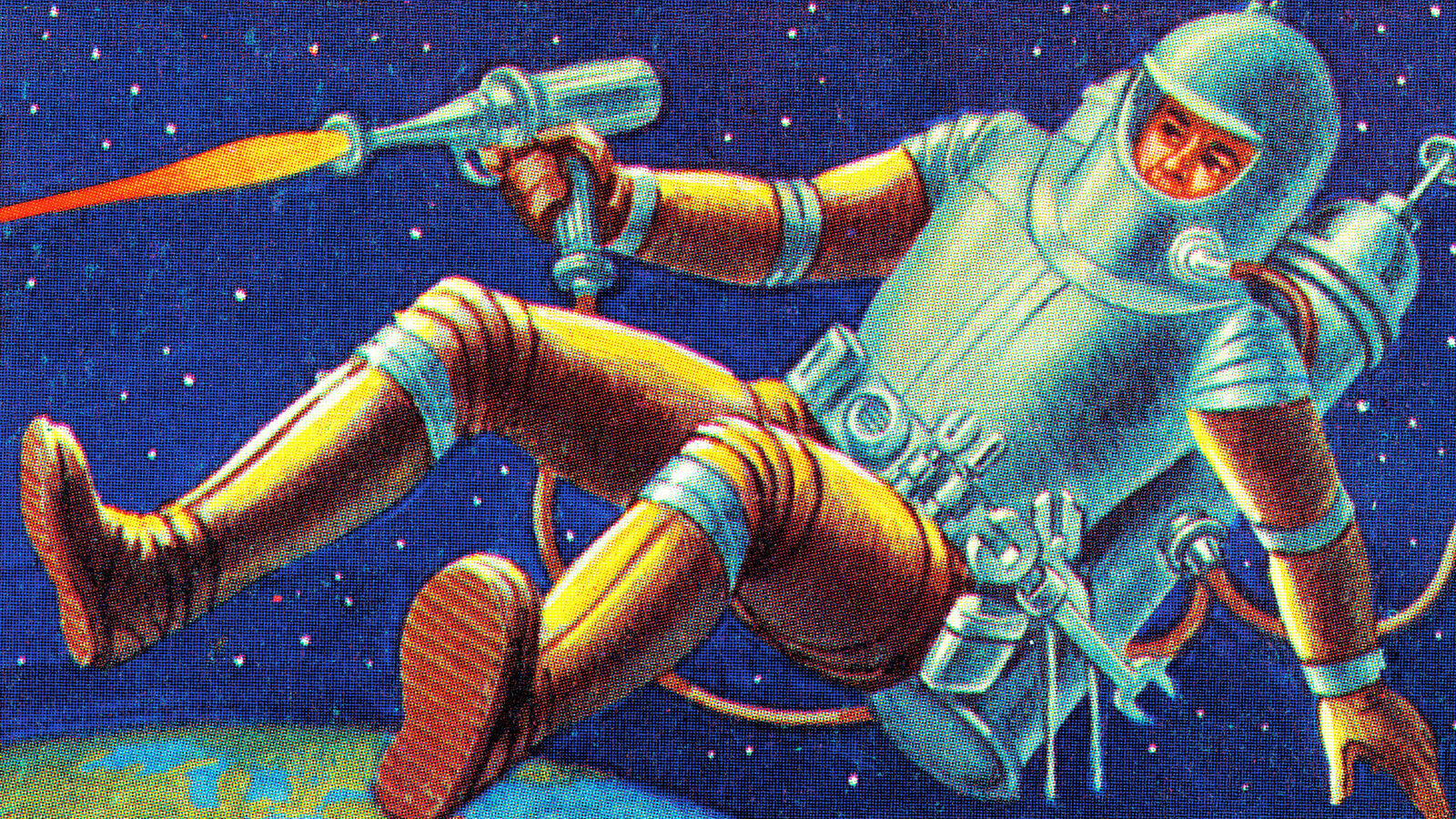
Have you ever wondered what would happen if you fired a gun in the vast emptiness of space? It’s a scenario often portrayed in science fiction but rarely explained with scientific accuracy. In this exploration, we will dive into the fascinating physics behind firearm operation in space, uncovering the misconceptions and realities surrounding this intriguing question.
From the absence of sound to the effects of recoil, the implications are both intriguing and unsettling. Understanding these principles not only sheds light on the nature of physics but also sparks the imagination about the myriad possibilities of life beyond Earth.
The soundless void: what happens when you fire a gun in space?
When a gun is fired, the first thing you would notice is the complete absence of sound. On Earth, gunshots create loud bangs due to sound waves traveling through the air, but in space, sound cannot travel because there is no medium to carry it. In the vacuum of space, the silence would be profound. This absence of noise is just one of the many differences that come into play when firing a weapon in space.
Moreover, the bullet fired in space would not move any faster than it would on Earth, but it would travel much farther. On our planet, gravity pulls the bullet down, causing it to lose altitude quickly. In contrast, in the low-gravity environment of space, a bullet could theoretically travel indefinitely until it encounters an obstacle or is influenced by gravitational forces from nearby celestial bodies.
- The bullet could continue moving for billions of years due to minimal resistance.
- In a vacuum, a bullet could theoretically travel more than 100 trillion miles before losing all its momentum.
- The universe’s ongoing expansion means that there might always be some distance left for the bullet to cover.
Given the vastness of space and its limited matter, a bullet, once fired, could remain in motion for an unimaginable duration, raising the question of what might happen if such a projectile were to collide with an object in its path.
Why modern bullets can fire in a vacuum
One common misconception is that guns cannot be fired in space due to the lack of oxygen. While older gun designs relied on atmospheric oxygen to ignite gunpowder, modern ammunition contains oxidizers that facilitate combustion without needing external oxygen. This means that, in theory, you could fire a modern firearm in space.
However, several factors could affect the functionality of a gun in outer space:
- Extreme Temperatures: Some regions of space are incredibly cold, potentially causing components to freeze and jam.
- Solar Radiation: In areas with intense solar radiation, bullets could heat up and even explode before being fired.
- Vacuum Effects: The absence of air pressure might alter the behavior of the gun’s mechanical parts.
Even if conditions were favorable for firing a weapon, the consequences of doing so in space would be markedly different from those on Earth.
The consequences of firing a gun in space
When a bullet is fired in space, the implications extend beyond just the projectile itself. The shooter would also experience a significant effect due to Newton’s third law of motion: for every action, there is an equal and opposite reaction. This means that:
- When the bullet is propelled forward, the shooter would be pushed backward with equal force.
- While the bullet might travel at speeds of approximately 1,000 meters per second, the shooter would move backward at a much slower rate—just a few centimeters per second.
- Without any gravitational force to anchor the shooter, they would continue to drift away indefinitely unless stopped by an object or force.
This dynamic creates a precarious situation for anyone firing a weapon in space. The potential for injury or even death could be severe if proper precautions are not taken.
Defying gravity: the bizarre possibilities of orbital shooting
Imagine being in a stable orbit around a planet and firing a gun. If aimed correctly, it’s theoretically possible for the bullet to enter an orbital path that circles the planet and comes back around to hit the shooter. This requires extreme precision and timing, but the physics allows for such a bizarre scenario.
This highlights not only the peculiarities of motion in space but also the intricate gravitational mechanics at play. The interaction between the bullet’s velocity and the planet’s gravitational pull could create a complex dance of trajectories that could be both fascinating and fatal.
Future implications: what does this mean for space exploration?
As humanity embarks on more ambitious space exploration missions, understanding the physics of firearms in space becomes increasingly relevant. Whether for scientific research, defense against potential threats, or even recreational activities, the principles of how firearms operate in microgravity will need thorough consideration.
In conclusion, while the portrayal of gunfights in space remains largely fictional, the underlying physics is grounded in real scientific principles. As we venture into the cosmos, these insights will help shape our approach to safety, weaponry, and the broader implications of human activity beyond Earth.