When we watch science fiction movies, our imaginations take flight as we witness the dazzling displays of laser beams slicing through the darkness of space. However, Hollywood often misrepresents how lasers work, leading us to believe in a fantastical version of reality. Let’s delve into the science behind lasers and uncover the truths that cinematic portrayals often overlook.
The fascination with lasers is deeply rooted in their unique functionality. Unlike conventional lights that emit light in all directions, lasers produce highly concentrated beams that can travel vast distances. Yet, the conditions required for these beams to be visible are not always met, especially in the vastness of space.
Understanding the science of laser beams
Lasers emit light through a process known as stimulated emission. This occurs when atoms are energized, allowing their electrons to transition to a higher energy state. When these electrons return to their original state, they release energy in the form of photons. These photons move in a coherent manner, creating a focused beam of light that is characteristic of lasers. The name “laser” itself is an acronym for “light amplification by stimulated emission of radiation.”
In contrast to standard light sources, which emit a broad spectrum of wavelengths, lasers emit light at specific wavelengths. This results in the characteristic color of laser beams, often seen in various applications ranging from medical devices to industrial cutting tools.
- Coherency: Laser light waves are in phase, meaning they travel together in harmony.
- Monochromaticity: Lasers emit light of a single wavelength, giving them specific colors.
- Collimation: Laser beams are highly parallel and do not spread out like regular light.
These attributes make lasers incredibly powerful and useful in many fields, but they also contribute to the misconceptions propagated by movies.
Why do we see laser beams in movies?
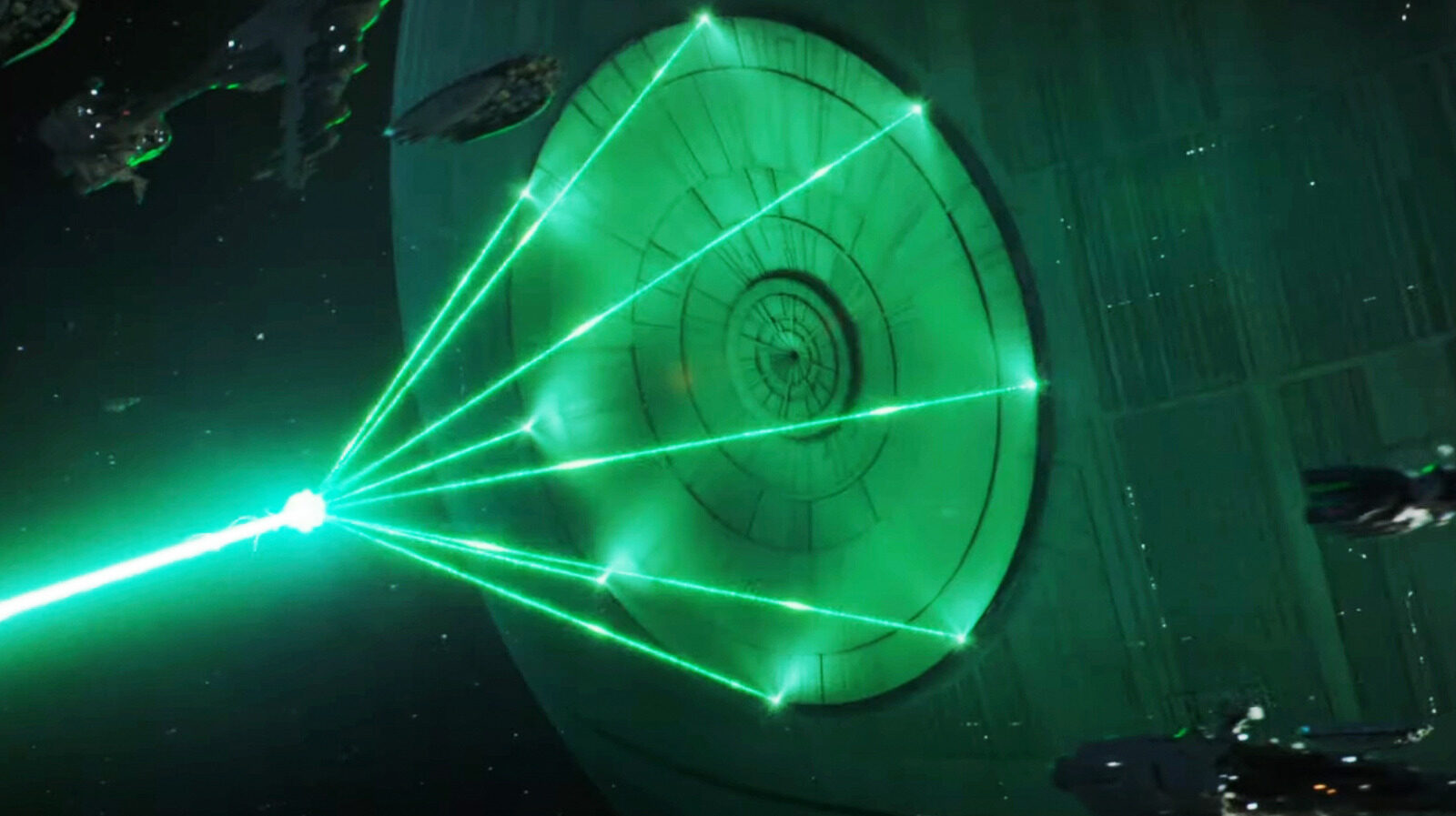
In films, lasers are often depicted as visible beams that light up the surrounding environment. This is primarily a visual choice made by filmmakers to enhance drama and excitement. In reality, the visibility of a laser beam depends on external factors, particularly the presence of particles in the air.
When photons emitted by a laser interact with dust, moisture, or other particles, they scatter light, resulting in a visible beam. However, in clean environments or vacuum conditions, such as those found in space, there are insufficient particles for this scattering to occur. This leads to the portrayal of lasers in movies being a significant deviation from actual physics.
Laser beams come from light bouncing off particles in the air
The visibility of laser beams is fundamentally linked to the particles within an environment. On Earth, common factors that enhance the visibility of laser beams include:
- Dust: Tiny particles in the air can scatter light effectively.
- Humidity: Water droplets in the air can reflect and refract light.
- Atmospheric conditions: Fog or smoke can enhance visibility as they contain numerous particles.
A practical example occurred in 2022 when a NASA satellite used green lasers to measure ice thickness. Although the lasers were not typically visible from the ground, cloud cover allowed for the scattering of light, making the beams detectable. This illustrates how environmental factors can influence the visibility of laser beams.
 Uninhabited Islands: Exploring Worlds Without People
Lasers don’t produce beams in space
Despite the abundance of science fiction narratives featuring lasers in outer space, the truth is that the vacuum of space does not support the visibility of laser beams. The lack of matter means there are no particles for the laser light to interact with, rendering the beams invisible.
To understand this better, consider the following facts about space:
- Vacuum conditions: Space is mostly empty, with very few atoms per cubic meter.
- Distance from Earth: The end of Earth’s atmosphere is about 400 miles above the surface, leading into a near-perfect vacuum.
- Cosmic dust: While space does contain some particles, it is insufficient for scattering light in most regions.
Even when lasers are fired in a dense area of space, such as near a planet or a star, the beams would only be visible if they interacted with enough matter. For example, if a laser were to be fired on a spacecraft surrounded by debris, some scattering could occur, but this is far from the scenarios depicted in movies.
Advancements in laser technology and visibility
Interestingly, there have been recent developments in laser technology that challenge our understanding of visibility in a vacuum. In 2021, researchers at the University of Bonn created a method that allows laser beams to become visible even in low-density environments. This groundbreaking research could pave the way for advancements in various fields, including quantum computing.
These advancements demonstrate that while science fiction may not accurately portray the reality of lasers in space, ongoing research continues to push the boundaries of what is possible.
Impact of cinematic representations on public perception
The portrayal of lasers in movies significantly influences public perception, creating misconceptions about their capabilities. This can have practical implications, especially in educational contexts and the understanding of scientific principles.
By recognizing the difference between cinematic fantasy and scientific reality, we can foster a more accurate understanding of lasers and their applications. Here are some key takeaways:
- Realism in science education: Educators must clarify the distinctions between movie depictions and actual science.
- Scientific literacy: Public awareness of scientific principles can lead to better-informed discussions about technology.
- Future innovations: Understanding the limitations of current technology can inspire future advancements in laser applications.
As we continue to explore the fascinating world of lasers, it is essential to separate fact from fiction. While Hollywood may entertain us with dazzling visuals, the reality of how lasers work is equally intriguing—and far more complex.