Astrophysics continually pushes the boundaries of human understanding, often revealing phenomena that challenge our fundamental notions of the universe. Among these mysteries are runaway black holes, a concept that has been floating in the realm of theory for decades. Recent advancements in observational technology are finally allowing scientists to validate these theories and uncover the secrets of these elusive cosmic entities.
The journey from theoretical predictions to empirical evidence is a cornerstone of scientific progress. With the deployment of powerful telescopes like the James Webb Space Telescope, researchers are gaining unprecedented insights into the cosmos, transforming what was once speculative into tangible knowledge.
Understanding runaway black holes and their implications
Runaway black holes are fascinating cosmic phenomena, defined as black holes that travel through space at incredible speeds, unbound by the gravitational pull of their home galaxies. They can be likened to interstellar comets, which traverse vast distances in the universe. However, unlike comets that are made of ice and dust, runaway black holes are massive and dense, exerting an immense gravitational force that can influence surrounding stellar bodies.
These black holes are believed to form during the merger of two supermassive black holes or as a result of gravitational interactions within dense star clusters. The key characteristics of runaway black holes include:
- Speed: They can travel at velocities reaching millions of miles per hour.
- Origins: Typically born from the violent cosmic events, such as black hole mergers.
- Impact: Their presence can disrupt the formation and stability of nearby stars.
Understanding these extraordinary objects not only sheds light on the mechanics of the universe but also helps us comprehend the formation and evolution of galaxies. The study of runaway black holes can illuminate the complexities of gravitational interactions and the lifecycle of massive stars, contributing to our broader understanding of cosmic evolution.
From blurry shots in the dark to high-resolution imaging
The journey to observe runaway black holes has been long and arduous. The first hints of their existence came from theoretical models proposed in the 1970s. However, the lack of observational evidence left many questions unanswered. It wasn’t until the James Webb Space Telescope became operational that scientists could capture high-quality images revealing the trails left by these elusive objects.
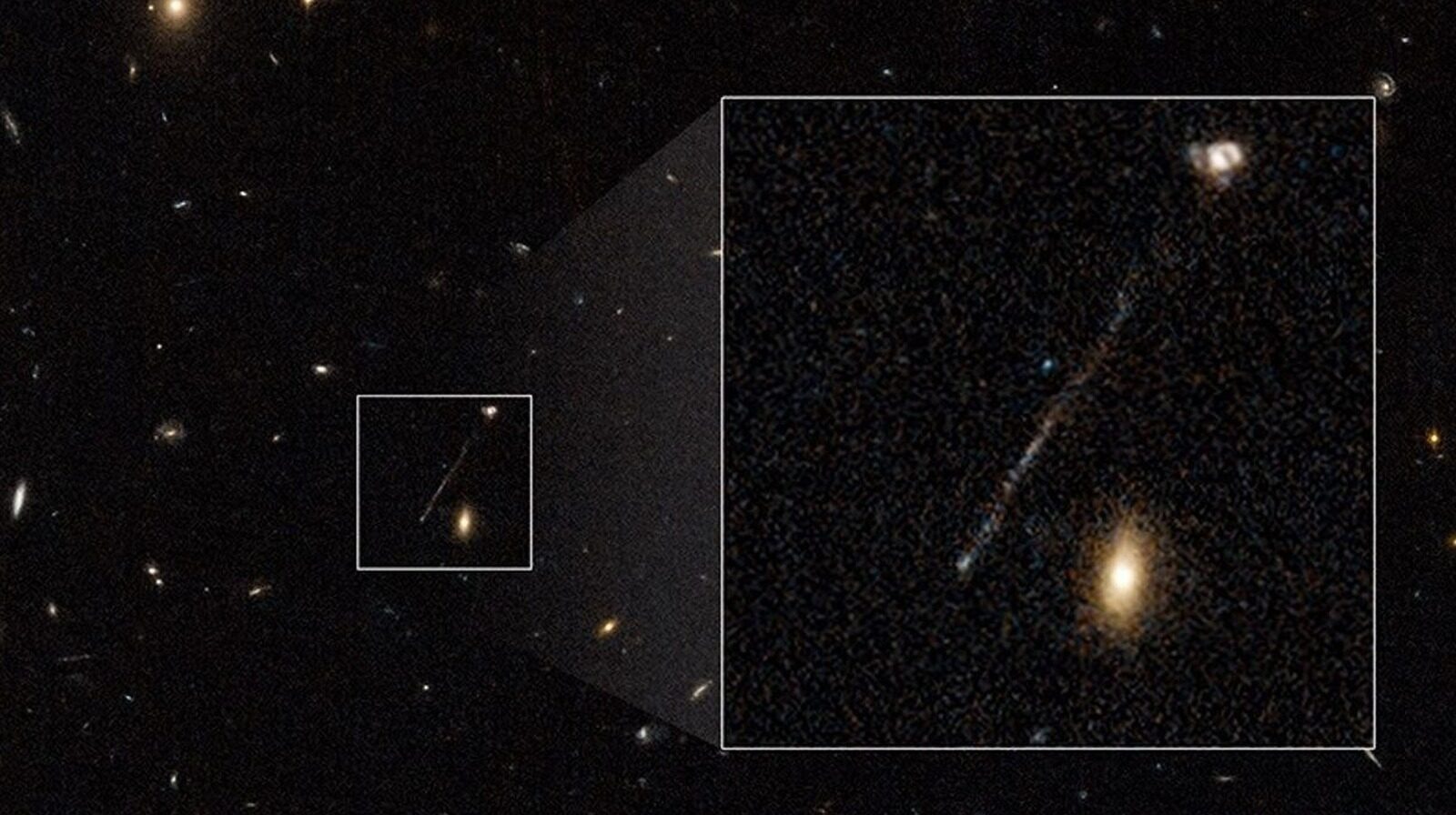
In 2023, a team of astronomers led by Pieter van Dokkum from Yale University made a breakthrough. They began by analyzing archival images from the Hubble Space Telescope, where they discovered a faint, blurry image that hinted at a contrail of stars. This initial discovery resembled a mere streak of light rather than a collection of distinct stars. Upon utilizing the more advanced James Webb Space Telescope, the team could discern the structure more clearly, revealing a complex formation that aligns with theoretical predictions.
The contrail observed is a staggering 200,000 light-years long and appears to be caused by a runaway black hole moving at a staggering speed of 2 million miles per hour. This discovery underscores the importance of advanced technology in astrophysical research. Some critical aspects of this imaging process include:
- Technological evolution: The transition from Hubble’s capabilities to those of Webb allowed for clearer imaging.
- Cosmic bow shock: The observed contrail reflects a cosmic bow shock, similar to how boats leave trails in water.
- Significance of the findings: These observations provide crucial evidence supporting the existence of runaway black holes.
The mechanics behind cosmic bow shocks
The phenomenon of a cosmic bow shock is analogous to the way a boat moves through water. As a boat cuts through the water, it creates a displacement that forms a wake, with water flowing around the vessel. In the cosmos, a runaway black hole produces a similar effect, but instead of water, it’s the gravitational influence on surrounding stars that shapes the trail.
As the runaway black hole speeds through space, its gravitational pull clusters stars in its vicinity, forming a “bow” at the front of the black hole, while other stars are pushed away into the “wake.” This process can be summarized in the following steps:
- The black hole approaches a star cluster at high velocity.
- Its gravity distorts the orbits of nearby stars, clustering them together.
- Stars not captured by the black hole are expelled into the surrounding space.
- A visible trail of star formation is left behind, creating a contrail.
Understanding this mechanism clarifies how runaway black holes interact with their environments, providing insight into the dynamic nature of galactic structures and the potential fate of stars within their gravitational reach.
Future research directions and implications
The recent discoveries regarding runaway black holes are only the beginning of a new chapter in astrophysics. As researchers delve deeper into this phenomenon, several key areas of focus are emerging:
- Further observations: Scientists are actively searching for more evidence of runaway black holes using advanced telescopes.
- Theoretical modeling: Ongoing work aims to refine theoretical models predicting the behavior and formation of these black holes.
- Interdisciplinary collaboration: Collaboration among astrophysicists, mathematicians, and computer scientists is crucial for simulating complex gravitational interactions.
As our observational tools improve, we can expect to uncover more about the nature of the universe and the role runaway black holes play in the cosmic tapestry. The implications reach far beyond academic curiosity; they may influence our understanding of fundamental physics and the evolution of galaxies.