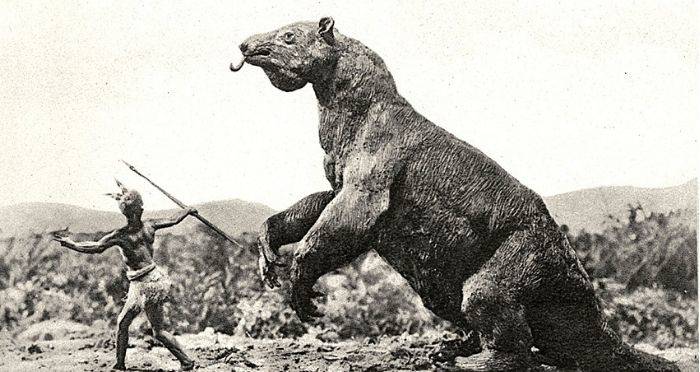
The prehistoric world was home to a truly remarkable creature: the Megatherium, a giant ground sloth that ruled South America for millions of years. Reaching up to four tons in weight, this massive herbivore lumbered across the landscape, its powerful claws digging into the earth as it sought out vegetation and perhaps even scavenging carcasses.
The story of the Megatherium is one of grandeur and ultimately, extinction. While these fascinating giants roamed freely for over 5 million years, they vanished around 8,500 B.C., coinciding with a period known as the Quaternary extinction event. This mass die-off impacted numerous large mammals, likely due to a combination of climate change and human activity. Evidence suggests that early humans hunted these sloths, as cut marks have been found on fossilized remains.
Despite their disappearance from the fossil record, tales persist of a creature resembling the Megatherium lurking in the depths of the Amazon rainforest. Known as the mapinguari, this mythical beast is said to be a giant sloth still alive, inspiring both fascination and fear among locals. While some believe these stories are exaggerated accounts of surviving Megatheriums, others propose that the mapinguari represents an entirely distinct entity, shrouded in mystery and possibly holding clues to undiscovered corners of our planet.
The Megatherium: Anatomy and Behavior
The Megatherium was a truly impressive creature, built for life on the ground rather than in the trees. Unlike its tree-dwelling relatives, this giant sloth had powerful limbs and massive claws designed for digging and moving through dense vegetation. Its thick fur likely provided insulation against the elements, while its enormous size helped it to regulate body temperature in the relatively cool climate of South America during its reign.
Scientists like Georges Cuvier, who studied Megatherium remains discovered in Argentina, pieced together a picture of this gentle giant’s behavior. They believe that these herbivores lived in social groups, foraging for food and likely communicating through various vocalizations and displays. Their diet consisted mainly of plants, though evidence suggests they may have also scavenged carcasses when available. This opportunistic feeding strategy further highlights their adaptability and resilience as a species.
Though the Megatherium vanished from the Earth thousands of years ago, its legacy lives on in the fossil record and in the enduring fascination with these prehistoric giants. Giant sloth sightings, often attributed to the mythical mapinguari, continue to capture the imagination, reminding us that there are still mysteries waiting to be uncovered in our world.
Extinction and the Quaternary Event
The Megatherium’s reign came to an end around 8,500 B.C., marking the end of an era for these magnificent creatures. Their extinction coincided with a period known as the Quaternary extinction event, a time when numerous large mammal species disappeared from across the globe. This mass die-off was likely triggered by a combination of factors, including significant climate changes and increased human activity.
The Earth’s climate underwent dramatic shifts during the late Pleistocene epoch, leading to drastic fluctuations in temperature and precipitation patterns. These changes likely disrupted the Megatherium’s habitat and food sources, making survival increasingly difficult. Simultaneously, early humans were expanding their range and engaging in hunting activities. Evidence suggests that some human populations actively hunted Megatheriums, as butchering marks have been found on fossilized remains.
The complex interplay of these environmental and anthropogenic factors ultimately led to the Megatherium’s demise. While their disappearance serves as a stark reminder of the fragility of life on Earth, it also highlights the interconnectedness of all species within an ecosystem and the profound impact human activity can have on the natural world.
 Stephen Hawking’s Warning on the Dangers of Artificial Intelligence
Mapinguari: Sightings in the Amazon
Deep within the Amazon rainforest, where ancient trees tower over emerald canopies and mysteries whisper on the wind, legends persist of a creature known as the mapinguari. This elusive beast is said to resemble a giant sloth, covered in thick fur and possessing powerful claws that can tear through vegetation with ease. While some dismiss these tales as mere folklore, others believe that giant sloth sightings in the Amazon could be evidence of this mythical creature’s survival.
Reports of mapinguari encounters often come from indigenous communities who have long lived in harmony with the rainforest. They describe a massive, hairy beast that lurks in the shadows, leaving behind tracks that are too large to belong to any known animal. Some accounts even suggest that the mapinguari emits a deafening roar that echoes through the dense undergrowth, sending shivers down the spines of those who hear it.
Despite numerous expeditions and searches, concrete evidence of the mapinguari remains elusive. Its habitat, the vast and unforgiving Amazon rainforest, poses significant challenges to researchers seeking to uncover its secrets. However, the enduring belief in this creature serves as a reminder of the mysteries that still lie hidden within our world, waiting to be discovered by those brave enough to explore them.
Fact or Fiction? Examining the Evidence
The question of whether the mapinguari is a real creature or simply an elaborate myth continues to spark debate among scientists, cryptozoologists, and curious individuals alike. While there have been numerous reports of giant sloth sightings in the Amazon, none have been conclusively verified. Many accounts can be attributed to misidentification of known animals, exaggerated stories passed down through generations, or even hoaxes intended to capitalize on public fascination with the unknown.
Analyzing the available evidence requires a critical and discerning approach. Eyewitness testimonies, while often compelling, can be subjective and prone to error. Physical evidence, such as footprints, scat, or hair samples, is crucial but often lacking in detail or authenticity. Scientific investigation requires rigorous analysis and verification to distinguish genuine findings from misinterpretations or fabrication.
Ultimately, the mystery surrounding the mapinguari remains unsolved. Until concrete evidence emerges to support its existence, it will continue to occupy a place in the realm of folklore and speculation. However, the enduring fascination with this enigmatic creature serves as a reminder that there are still unexplored corners of our world, waiting to reveal their secrets to those willing to search for them.
Mysteries of the Unknown
The enduring mystery of the mapinguari highlights a fundamental aspect of our existence: the unknown stretches far beyond what we can readily observe and comprehend. While science has made remarkable strides in understanding the world around us, countless mysteries remain unsolved, tantalizing our curiosity and igniting our imagination.
Perhaps the most captivating element of these uncharted territories is their ability to spark wonder and inspire exploration. Whether it’s the vast expanse of the Amazon rainforest or the depths of the ocean floor, the possibility of encountering something extraordinary continues to drive us forward. Each unsolved puzzle serves as a reminder that there is always more to discover, more to learn, and more to marvel at in the tapestry of life on Earth.
Even if concrete evidence of the mapinguari eludes us, its presence in our collective consciousness speaks volumes about our innate desire to unravel the mysteries that surround us. It reminds us that sometimes, the most compelling stories are those that remain open-ended, leaving room for speculation, imagination, and a healthy dose of wonder.