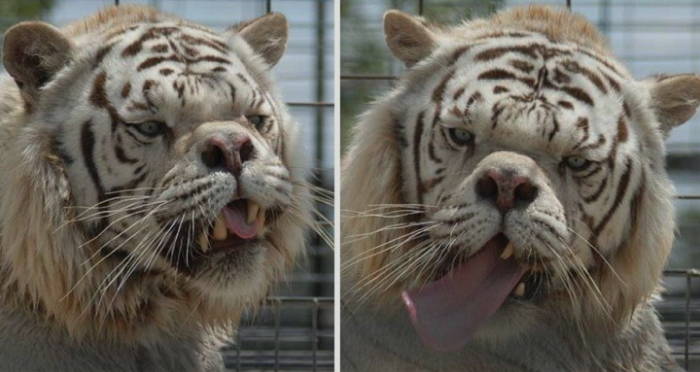
The internet is a fascinating place, brimming with information and often blurring the lines between fact and fiction. This is especially true when it comes to animal health and welfare. Numerous online posts claim to showcase animals with Down syndrome, featuring heartwarming stories about individuals like Kenny the tiger or Otto the kitten. These narratives often depict these animals as facing unique challenges due to their condition, garnering sympathy and raising awareness.
However, it’s crucial to approach such claims with a healthy dose of skepticism. While the intention behind these posts may be well-meaning, they frequently misrepresent animal health for sensationalism. The deformities observed in these animals, often attributed to Down syndrome, are more likely the result of inbreeding or other genetic mutations unique to their species. This is a common misconception that stems from a lack of understanding about how genetics and chromosomal structures differ between humans and animals.
For instance, while humans have three copies of chromosome 21 causing Down syndrome, animals lack this specific chromosomal structure or its equivalent. Kenny’s wide-set eyes and short snout were likely caused by inbreeding within his tiger lineage, while Otto’s facial abnormalities remain unexplained but could be due to a genetic mutation or hormone deficiency. This highlights the importance of relying on credible scientific sources and veterinary expertise when evaluating animal health claims rather than jumping to conclusions based on internet posts.
Debunking Animal “Down Syndrome”
It’s important to remember that while we might see similarities in certain physical characteristics between animals and humans with Down syndrome, these are often superficial and not indicative of the same underlying genetic condition. Animals don’t experience Down syndrome in the same way humans do because their chromosomes and genetic makeup differ significantly.
For example, apes are the only animals known to sometimes exhibit a condition similar to human Down syndrome. Some chimpanzees have been diagnosed with an extra copy of chromosome 22, leading to growth defects and heart problems analogous to those seen in humans with Down syndrome. However, even in these cases, the specific genetic mechanisms and clinical presentations can vary considerably between species.
Therefore, it’s crucial to avoid generalizations and recognize that attributing human medical conditions to animals based solely on outward appearances can be misleading and potentially harmful. Instead, we should focus on understanding the unique biological complexities of each species and rely on expert veterinarians for accurate diagnoses and information.
The Genetics of Down Syndrome in Humans
In humans, Down syndrome is a genetic disorder caused by the presence of an extra copy of chromosome 21. Usually, each cell in our body has 23 pairs of chromosomes, with one set inherited from our mother and the other from our father. However, individuals with Down syndrome have three copies of chromosome 21 instead of two.
This extra genetic material disrupts the normal course of development, leading to the characteristic physical traits and intellectual challenges associated with Down syndrome. The severity of these symptoms can vary widely among individuals, as the expression of genes on chromosome 21 is complex and influenced by numerous factors. Understanding this underlying genetic cause helps us appreciate the unique biological basis of Down syndrome in humans and distinguishes it from similar-appearing conditions in other species.
It’s important to note that Down syndrome is not a contagious illness or the result of any wrongdoing on the part of the parents. It occurs randomly during the formation of reproductive cells (eggs or sperm) or early in fetal development. While advancements in genetic testing and prenatal screening allow for earlier detection, there is currently no cure for Down syndrome.
Inbreeding and Genetic Mutations in Animals
While genetic disorders like Down syndrome exist in humans, animals often experience health issues due to different factors. One significant contributor is inbreeding, a practice where closely related individuals reproduce. This can lead to an increased expression of harmful recessive genes, resulting in various physical deformities and health problems. Many cases of animals appearing to have Down syndrome are likely due to inbreeding within captive populations or isolated wild communities.
Another factor affecting animal health is genetic mutations. These spontaneous changes in DNA sequence can occur randomly during cell division and may result in diverse physical traits, some of which might resemble human conditions. However, it’s crucial to remember that these mutations are often species-specific and don’t necessarily map onto the same genetic pathways as human disorders. Scientists continue to research the intricate ways genetics influence animal health and diversity.
Understanding these factors helps us appreciate the complexity of animal biology and recognize that attributing human conditions to animals solely based on appearance can be misleading.
Apes and a Chimpanzee Condition Resembling Down Syndrome
While Down syndrome is uniquely human, there are instances in the animal kingdom where conditions bear striking similarities to this genetic disorder. Apes, particularly chimpanzees, have been observed with a condition resembling human Down syndrome. In these cases, some chimpanzees possess an extra copy of chromosome 22, analogous to the extra chromosome 21 found in humans with Down syndrome.
This chromosomal anomaly can lead to developmental delays, growth defects, and heart problems in chimpanzees, mirroring some clinical features observed in humans with Down syndrome. However, it’s crucial to emphasize that this condition in apes is not identical to human Down syndrome and likely has distinct genetic mechanisms at play. Further research is needed to fully understand the complexities of this condition in chimpanzees and its relationship to human Down syndrome.
This observation highlights the fascinating parallels and divergences between genetics across species, reminding us that while biology shares fundamental principles, variations exist within the animal kingdom, shaping unique health conditions and evolutionary adaptations.
Understanding the Distinction: Human vs Animal Conditions
While it’s natural to draw comparisons between animals and humans due to our shared experiences and emotions, it’s crucial to remember that our biological makeup differs significantly. This distinction extends to the way we develop and experience health conditions. While some animal conditions might superficially resemble human disorders like Down syndrome, they often stem from unique genetic and environmental factors specific to their species.
For example, a condition appearing similar to Down syndrome in a lion could be due to inbreeding within a captive population or a rare genetic mutation affecting that particular lineage. Conversely, human Down syndrome arises from the presence of an extra chromosome 21, a chromosomal structure absent in lions. Therefore, attributing human medical diagnoses to animals solely based on visual resemblance can lead to misunderstanding and misrepresentation.
Adopting a nuanced approach that acknowledges the complexities of animal biology and genetic diversity is essential for accurate understanding and ethical treatment of our animal counterparts. Let’s strive to appreciate the unique adaptations and challenges faced by different species while recognizing the distinct nature of human health conditions.