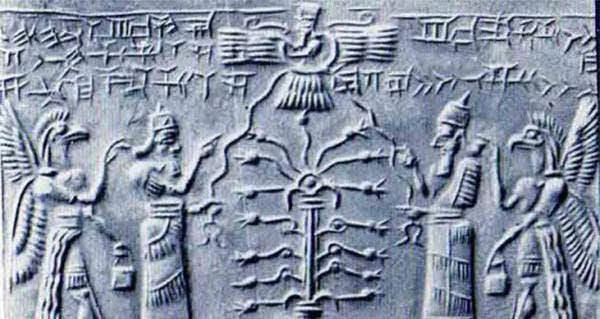
The ancient world is brimming with mysteries, and few are as captivating as the tales of the Anunnaki. Revered by the Sumerians as powerful deities who shaped human destiny, these beings are woven into a rich tapestry of mythology and legend. Their influence is said to extend from the very foundations of civilization – writing, mathematics, city planning – all attributed to their divine guidance.
But what if the Anunnaki were more than just mythical figures? Some theorists, most notably Zecharia Sitchin, propose a radical idea: that these deities were actually extraterrestrials who journeyed from a distant planet called Nibiru. According to Sitchin’s interpretation of ancient Sumerian texts, the Anunnaki arrived on Earth over 500,000 years ago seeking gold. Their need for this precious metal led them to genetically engineer humans as a workforce, tasked with mining and extracting it from the depths of our planet.
This theory, while intriguing, is met with skepticism by mainstream historians and archaeologists who argue that Sitchin’s interpretations are based on misinterpretations or misunderstandings of ancient Sumerian texts. The debate continues to rage, fueled by proponents pointing to the Sumerians’ surprisingly advanced astronomical calculations and seemingly futuristic references in their writings. Could there be hidden truths buried within these ancient scripts?
The Anunnaki: Mesopotamian Deities and Extraterrestrial Theories
The Anunnaki were a prominent part of the Mesopotamian pantheon, revered by the Sumerians as powerful deities who held dominion over various aspects of life and the cosmos. They were depicted as majestic beings with advanced knowledge and abilities, often associated with celestial events, natural phenomena, and the fate of humanity. Each Anunnaki deity had specific roles and responsibilities, contributing to the cosmic order according to Sumerian beliefs.
However, these ancient deities take on a different dimension when viewed through the lens of extraterrestrial theories. Proponents of this idea see the Anunnaki not as mere mythological figures but as advanced beings who visited Earth from another planet. Zecharia Sitchin, in his widely discussed works, argues that these celestial visitors were responsible for shaping human civilization, imparting knowledge, and even genetically engineering us to serve their needs. He bases his claims on a meticulous analysis of ancient Sumerian texts, particularly those describing the Anunnaki’s arrival on Earth and their interactions with humans.
Sitchin’s interpretation suggests that the anunnaki hieroglyphs, found etched on ancient Sumerian artifacts, could hold hidden clues about these extraterrestrial encounters. These enigmatic symbols, he contends, contain encoded messages revealing the true nature of these celestial beings and their involvement in human history.
Zecharia Sitchin’s Interpretation of Sumerian Texts
Zecharia Sitchin, an Azerbaijani-American author and researcher, dedicated much of his life to deciphering ancient Sumerian texts, proposing a controversial interpretation that has captivated the imagination of many. Sitchin believed that these cuneiform inscriptions held hidden secrets about extraterrestrial visitation to Earth, revealing the Anunnaki as beings from another planet named Nibiru. His most renowned work, “The Twelfth Planet,” sparked widespread interest and debate within both academic circles and popular culture.
Central to Sitchin’s theory is his belief that Sumerian mythology wasn’t merely folklore but a record of historical events involving extraterrestrial interference. He meticulously analyzed ancient Sumerian writings, focusing on descriptions of celestial bodies, advanced technologies, and the creation of humanity. According to Sitchin, these texts pointed to a scenario where the Anunnaki arrived on Earth seeking gold, eventually creating humans as a workforce to mine this precious resource. He believed that their interventions shaped human civilization, influencing our development of writing, mathematics, and social structures.
Sitchin’s interpretation has been met with both fervent support and fierce criticism. While his meticulous research and thought-provoking ideas have inspired countless individuals to delve deeper into ancient history, mainstream scholars generally dismiss his claims as misinterpretations or imaginative reconstructions of ancient texts. Nevertheless, Sitchin’s legacy continues to fascinate, prompting ongoing discussions about the potential for extraterrestrial influence on human history.
Ancient Evidence and the Alien Hypothesis
Proponents of the extraterrestrial theory often point to certain ancient artifacts and archaeological findings as evidence supporting their claims. Intricate carvings on stone tablets and colossal statues depicting beings with seemingly advanced technology fuel speculation about contact with a more technologically sophisticated civilization. Some argue that these depictions could be attempts to record encounters with the Anunnaki, hinting at a transfer of knowledge from extraterrestrials to early humans.
Others point to astronomical observations recorded by ancient civilizations as potential clues. The Sumerians, for example, possessed remarkable astronomical knowledge, accurately tracking celestial movements and predicting eclipses centuries before modern astronomy developed. Could this advanced understanding have been inherited from the Anunnaki, who may have possessed superior cosmological knowledge? While these interpretations remain controversial, they demonstrate how certain findings continue to spark debate and fuel imaginations within the realm of ancient alien theories.
The lack of conclusive proof, however, remains a significant hurdle for proponents of the extraterrestrial hypothesis. Skeptics argue that these “clues” often rely on subjective interpretation and leaps of logic. They contend that advancements in archaeology and history continue to provide more plausible explanations for ancient artifacts and astronomical observations, grounding them within the context of human ingenuity and cultural development.
Mainstream Perspectives and Historical Context
While the idea of ancient aliens captivating the public imagination, mainstream historians and archaeologists generally view these theories with skepticism. They argue that interpretations of ancient texts often lack rigorous academic backing and frequently rely on selective evidence to support predetermined conclusions. They emphasize the importance of contextualizing ancient artifacts within their historical and cultural settings, recognizing that many seemingly “advanced” technologies or concepts can be explained by human ingenuity and innovation within their own time periods.
Scholars point out that ancient civilizations possessed sophisticated knowledge systems and complex belief structures that often incorporated celestial observations, mythology, and symbolism. These varied interpretations of reality were not necessarily intended to be literal accounts of extraterrestrial encounters but rather expressions of cultural understanding and philosophical perspectives. Therefore, attributing ancient myths or artifacts directly to alien influence requires substantial evidence beyond mere speculation or symbolic interpretation.
Ultimately, the debate surrounding ancient aliens continues to be a fascinating exploration into the intersection of history, science, and human imagination. While mainstream perspectives remain grounded in empirical evidence and rigorous analysis, the enduring allure of these theories reflects our innate curiosity about the unknown and our desire to seek answers beyond conventional explanations.
Unlocking the Secrets of Ancient Civilizations
The quest to unravel the mysteries of ancient civilizations continues to captivate scholars and enthusiasts alike. Each unearthed artifact, deciphered inscription, and reconstructed temple offers a tantalizing glimpse into the lives, beliefs, and achievements of our ancestors. Understanding their complex societies, advanced technologies, and unique cultural expressions provides invaluable insights into the human experience across time.
While the debate surrounding ancient aliens adds an extra layer of intrigue, it’s essential to remember that the pursuit of knowledge should be grounded in rigorous research, critical analysis, and open-mindedness. Whether or not we find definitive proof of extraterrestrial involvement, exploring these ancient cultures and their legacies enriches our understanding of human history and our place within the grand narrative of existence.
Through ongoing archaeological excavations, linguistic studies, and interdisciplinary collaborations, archaeologists and historians are constantly piecing together the intricate tapestry of ancient civilizations. Every new discovery has the potential to shed light on previously unknown aspects of their world, revealing fascinating connections between different cultures, innovative technologies, and enduring human aspirations.