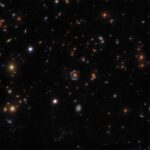
In recent years, our understanding of the universe has expanded dramatically, thanks in large part to advanced technologies like the James Webb Space Telescope. This remarkable instrument has not only captured stunning images of distant galaxies but has also confirmed theories that have shaped modern physics. Among these theories is the concept of gravitational lensing, a phenomenon predicted by Albert Einstein over a century ago, which we can now observe in breathtaking detail.
Gravitational lensing reveals the intricate dance of light and gravity, allowing us to glimpse objects that would otherwise remain hidden. As we delve into this fascinating topic, we’ll explore the principles of gravitational lensing, Einstein’s groundbreaking theories, and the implications of these discoveries for our understanding of the cosmos.
Understanding gravitational lensing
Gravitational lensing is a phenomenon that occurs when a massive object, such as a galaxy or black hole, lies between a distant observer and a background object, like another galaxy or a star. The gravitational field of the foreground object bends the light coming from the background object, distorting its image. This effect can create multiple images, arcs, or rings of the background object, making it appear larger and more luminous than it actually is.
- Types of gravitational lensing: There are three main types: strong lensing, weak lensing, and micro-lensing.
- Strong lensing occurs when the alignment between the observer, lensing object, and background object is nearly perfect, resulting in dramatic arcs or multiple images.
- Weak lensing is more subtle and requires statistical analysis to detect slight distortions in the shapes of background galaxies caused by foreground mass distributions.
- Micro-lensing involves the temporary magnification of a distant star as a result of a foreground star passing in front of it, useful for detecting exoplanets.
Gravitational lensing not only allows astronomers to study distant galaxies and the distribution of dark matter but also opens a window into the early universe, offering insights into the formation and evolution of cosmic structures.
Einstein’s revolutionary ideas on gravity
In 1915, Albert Einstein published his theory of general relativity, fundamentally altering our understanding of gravity. Unlike Isaac Newton’s earlier model, which described gravity as a force acting at a distance, Einstein proposed that gravity is the result of the curvature of spacetime caused by mass. He likened this curvature to a bowling ball placed on a trampoline, where the surface bends under the weight of the ball, affecting the motion of other objects on the trampoline.
This idea was groundbreaking because it suggested that even light, which has no mass, could be influenced by gravitational fields. According to Einstein, light takes the shortest path through curved spacetime, which means its trajectory can be altered by the presence of massive objects. This prediction was a radical departure from classical physics and set the stage for understanding phenomena like gravitational lensing.
The pivotal 1919 solar eclipse experiment
On May 29, 1919, British astronomers conducted a daring experiment to test Einstein’s theory during a solar eclipse. With the moon blocking the sun’s light, they aimed their telescopes at stars near the sun’s corona. What they observed was nothing short of astonishing. The positions of the stars appeared shifted from where they were expected to be, confirming that their light was bent by the sun’s gravitational field.
This observation marked the first empirical validation of general relativity and catapulted Einstein into the global spotlight. The significance of this event cannot be overstated; it not only confirmed Einstein’s revolutionary ideas but also shifted the paradigm of physics towards a more comprehensive understanding of the universe.
Modern observations and technology
Today, telescopes like the James Webb Space Telescope have taken the study of gravitational lensing to new heights. Launched in December 2021, this state-of-the-art instrument captures data in infrared wavelengths, revealing details of the universe that were previously obscured. The telescope’s capabilities allow scientists to observe gravitational lensing effects in unprecedented detail.
 Uninhabited Islands: Exploring Worlds Without People
For instance, in 2025, the James Webb Space Telescope released images showcasing myriad rings and arcs of light, the result of gravitational lensing caused by massive galaxies. These images provide not only stunning visuals but also valuable data for astrophysical research.
- Benefits of modern telescopes:
- Higher resolution images of distant galaxies.
- Enhanced ability to detect dark matter and study its distribution.
- Insights into the early universe and galaxy formation.
As we continue to explore the cosmos with advanced technology, Einstein’s predictions about gravity and the nature of light remain central to our understanding of the universe. Gravitational lensing serves as a powerful tool for astronomers, offering a glimpse into the intricate workings of celestial bodies and the fabric of spacetime itself.
Implications for cosmology and future research
The exploration of gravitational lensing has vast implications for cosmology. It enables scientists to probe the distribution of dark matter, which constitutes a significant portion of the universe’s mass yet remains undetectable through traditional means. By studying how light is bent around massive structures, researchers can infer the presence and distribution of this elusive substance.
Moreover, gravitational lensing allows for the observation of distant galaxies as they were billions of years ago. By analyzing the light from these ancient objects, astronomers can piece together the history of cosmic evolution, including galaxy formation and the expansion of the universe.
The continuing legacy of Einstein’s predictions
As we stand on the shoulders of giants like Albert Einstein, the advancements made in astrophysics and cosmology are a testament to the power of scientific inquiry. The ability to observe and understand gravitational lensing has not only validated Einstein’s theories but has also inspired a new generation of scientists to explore the cosmos.
The legacy of Einstein’s work continues to unfold as we develop more sophisticated tools to probe the universe’s mysteries. Each discovery reaffirms the brilliance of his ideas and propels us further into the depths of space, where new challenges and revelations await.