
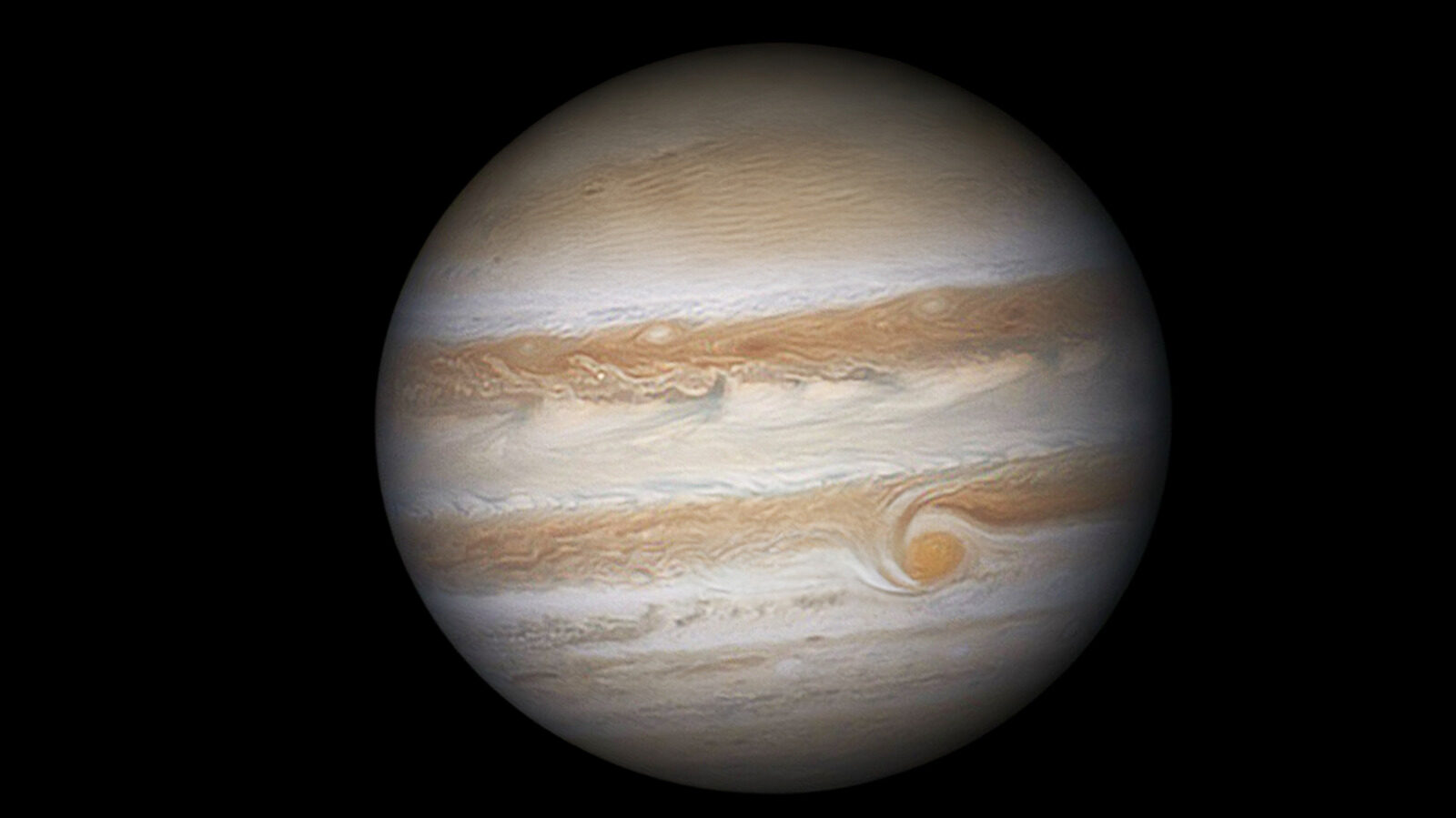
Jupiter’s Great Red Spot is not just an astronomical phenomenon; it’s a captivating storm that has intrigued scientists and casual observers alike for centuries. This massive storm, larger than Earth, serves as a reminder of the dynamic and ever-changing nature of our solar system. As we delve into its fascinating characteristics, prepare to be amazed by what this colossal storm reveals about planetary atmospheres.
Changing wind speeds reveal storm dynamics
Jupiter’s Great Red Spot is renowned as the largest permanent storm in our solar system, persisting for more than 190 years. This anti-cyclonic storm rotates in a counterclockwise direction, a stark contrast to cyclones on Earth, due to the high-pressure zones that drive air outward.
Interestingly, the storm’s wind speeds are not static. Measurements from the Hubble Space Telescope indicate that wind speeds in the Great Red Spot reach up to 400 miles per hour. Recently, researchers noted that the winds on the storm’s outer edge are actually increasing, while the inner section may be slowing down. This phenomenon suggests a calmer “eye,” similar to hurricanes on Earth, thus indicating a complex interplay within the storm’s dynamics.
- Wind speeds reach up to 400 mph.
- Outer winds are increasing, while the inner section may be slowing.
- Similarities to Earth’s hurricanes indicate complex dynamics.
Tracking these changes is challenging, requiring extensive data analysis over the past decade to understand the evolution of this storm and predict its future behavior.
The mystery behind its red appearance
The Great Red Spot’s striking hue has long puzzled scientists. Why does it appear red? Recent research suggests that this color may arise from sunlight interacting with gases in the storm’s upper layers. In laboratory experiments, sunlight was shown to create a reddish glow when it struck ammonia and acetylene, two gases prevalent on Jupiter.
Kevin Baines, a scientist involved in the research, noted that beneath the bright red exterior, the storm might be more bland in color. “Our models suggest most of the Great Red Spot is actually pretty bland in color,” he stated. This revelation challenges previous assumptions that the storm was uniformly red.
- Sunlight scatters through gases, creating a reddish hue.
- Laboratory tests support this theory using ammonia and acetylene.
- The underlying color may be more neutral than previously thought.
Understanding the color dynamics of the Great Red Spot not only sheds light on this specific storm but also informs broader studies about atmospheric conditions on gas giants.
A storm that is shrinking
Interestingly, the Great Red Spot is undergoing significant changes in size. Historically, it was estimated to be three times the width of Earth, but it’s now shrunk to a mere 1.3 times Earth’s diameter, measuring about 10,250 miles across. This reduction is not merely a statistical anomaly; it’s been quantified, revealing that the storm shrinks at an average rate of 580 miles per year.
Multiple data sources, including the Voyager missions and the Hubble Telescope, have contributed to this understanding. Scientists speculate that interactions with smaller storms nearby could be draining energy from the Great Red Spot, contributing to its diminishing size. However, the precise reasons for this behavior remain an area of active research.
 Uninhabited Islands: Exploring Worlds Without People
- Once measured at 25,500 miles, now only 10,250 miles.
- Shrinking at a rate of 580 miles per year.
- Possible interactions with nearby storms are being studied.
The implications of this shrinkage extend beyond mere interest; they prompt questions about the stability of planetary weather systems and their long-term behavior.
Wobbling behavior reveals instability
Monitoring of the Great Red Spot has unveiled a surprising characteristic: the storm appears to be wobbling. Observations from the Hubble Space Telescope have indicated that the storm’s center oscillates, described metaphorically as “jiggling like a bowl of gelatin.” This instability has been attributed to fluctuations in wind speeds and interactions with surrounding jet streams.
Despite extensive observation over the years, this newly discovered behavior sheds light on the complexity of the storm’s dynamics. Understanding the causes and implications of its wobbling remains a challenge, but it hints at deeper atmospheric processes at play.
- New observations show the storm center is oscillating.
- Described as “jiggling” due to its instability.
- Further research is necessary to understand its causes.
Historical observations: a glimpse into the past
The Great Red Spot holds a rich history, with claims that it may have been observed as early as the 17th century. Notable scientists like Robert Hooke and Giovanni Cassini documented their sightings of a spot on Jupiter’s surface. However, it’s still debated whether these early observations pertain to the Great Red Spot we recognize today.
Hooke’s accounts could have been misinterpretations of shadows cast by Jupiter’s moons, while Cassini’s descriptions align more closely with the current storm—though they lacked the defining detail of its red color. This historical context enriches our understanding of the Great Red Spot, suggesting it may have been a recognizable feature of Jupiter long before modern astronomy.
- Possibly observed in the 17th century by Hooke and Cassini.
- Debates exist regarding the accuracy of these historical accounts.
- Indicates the storm may have been stable much longer than records suggest.
Dynamic changes in shape and color
As the Great Red Spot continues to evolve, it’s not just shrinking; it’s also changing in shape and color. Data from Voyager missions and the Hubble Telescope indicate that while the storm’s diameter decreases, its height appears to increase, causing the clouds to rise.
Accompanying this height increase is a shift in color from dark red to a more orange hue. This transformation ties back to the previously discussed interaction of sunlight with atmospheric gases, suggesting that as the storm’s structure changes, so too do its observable characteristics. This long-term monitoring provides valuable insights into the evolving nature of the Great Red Spot.
- The storm’s height is increasing as its diameter decreases.
- Color shifting from dark red to orange is being observed.
- Insights into the storm’s evolution can assist future predictions.
Red Spot Jr.: a smaller companion
Interestingly, Jupiter is home to another storm known as Red Spot Jr. This smaller storm, which formed from a combination of three different storms in the late 1990s, was originally identified as White Oval BA due to its color before it transitioned to red. Positioned about 2,000 miles from the Great Red Spot, Red Spot Jr. provides a fascinating contrast to its larger counterpart.
Research has indicated that this smaller storm may also be interacting with higher atmospheric layers, similar to the Great Red Spot. Its prominent visibility at near-infrared wavelengths has led scientists to ponder whether Jupiter’s climate is undergoing significant changes, as both storms exhibit dynamic characteristics influenced by the planet’s atmospheric behavior.
- Red Spot Jr. formed from three smaller storms in the late 1990s.
- Initially known as White Oval BA before changing to red.
- Location and dynamics provide insights into Jupiter’s atmospheric conditions.
The Great Red Spot remains a captivating subject for research, unveiling more mysteries with each observation. As scientists continue to study its dynamics, colors, and interactions with other atmospheric phenomena, we are reminded of the vast complexities that exist within our solar system. Jupiter, with its iconic storm, stands as a testament to the dynamic processes that govern planetary atmospheres.