The concept of ley lines has captivated the imagination of many for decades, weaving a tapestry of mystery and wonder around ancient monuments and sites scattered across the globe. Introduced by Alfred Watkins in 1921, the idea stemmed from his observation that certain landmarks in Britain seemed to be aligned along straight paths, suggestive of a deliberate design. While Watkins initially proposed these way lines as potential trade routes or communication channels, later theorists embraced more esoteric interpretations, ascribing mystical properties and energetic significance to them.
These interpretations often suggest that ley lines act as conduits for supernatural energy, channeling cosmic forces and connecting Earth energies at their intersecting points. Proponents envision them as vibrant pathways pulsating with unseen power, linking sacred sites and serving as focal points for spiritual practices or even extraterrestrial communication. The allure of ley lines lies in their ability to bridge the gap between the tangible world and the realm of the unknown, offering a tantalizing glimpse into hidden dimensions and ancient mysteries.
Despite the lack of rigorous scientific evidence supporting these claims, the fascination with ley lines persists within various communities who view them as real pathways for spiritual energy and exploration. Whether seen as physical routes or energetic networks, they continue to inspire curiosity and debate, reminding us that there are still many unanswered questions about our planet’s past and the forces that may shape it.
Alfred Watkins and the Origins of Ley Lines
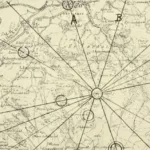
Alfred Watkins, a British antiquarian and amateur archaeologist, is widely credited with first introducing the concept of ley lines in his 1921 book, “The Old Straight Track.” His interest stemmed from observing seemingly unconnected ancient monuments and sites in Britain that appeared to align along straight paths. Intrigued by this pattern, Watkins began meticulously mapping these alignments, ultimately concluding they formed a network of invisible lines crisscrossing the landscape.
Watkins initially proposed these way lines as potential trade routes or communication pathways used by prehistoric societies. He argued that these lines facilitated movement and interaction between distant settlements, connecting religious centers, burial sites, and important resource locations. While his work sparked considerable interest and debate, it was primarily viewed within the confines of historical and archaeological circles.
However, Watkins’ ideas soon resonated with a wider audience captivated by alternative theories and spiritual explorations. The concept of ley lines as conduits for mystical energy or cosmic forces gained traction, propelling them into popular culture and folklore. Despite criticism from mainstream science, Watkins’ pioneering work laid the foundation for the enduring fascination with ley lines that continues to this day.
Mystical Interpretations and Earth Energies
As interest in ley lines grew beyond historical circles, they were increasingly interpreted through a mystical lens. Theories emerged suggesting that these alignments served as conduits for Earth energies or even cosmic forces, acting as vibrant pathways pulsing with unseen power. Proponents envisioned them connecting sacred sites and natural energy points, amplifying spiritual vibrations and facilitating communication with other dimensions.
This perspective often associates ley lines with the concept of “earth chakras,” believed to be energetic centers within the planet that influence various aspects of life. Intersections of ley lines were seen as particularly potent locations, where energies converged and manifested in potent ways. Ritual practices, meditations, and even physical healings were thought to be enhanced at these power spots, drawing individuals seeking spiritual awakening or connection to a greater cosmic force.
These mystical interpretations continue to resonate with many who see ley lines as tangible expressions of unseen realms interacting with our world. Whether viewed as energetic pathways or metaphysical bridges, they offer a framework for understanding the interconnectedness of all things and the potential for accessing hidden dimensions within ourselves and the environment.
 The intriguing history of the discovery of X-rays
Criticisms and Coincidences
Despite the enduring fascination with ley lines, they face significant criticism from the scientific community. Critics argue that the perceived alignments often emerge from coincidences and selective data analysis, pointing to instances where seemingly random locations can be connected to form triangles or patterns simply by drawing lines on a map. The human brain is naturally inclined to find patterns even in randomness, leading to confirmation bias where individuals focus on evidence supporting their beliefs while overlooking contradictory information.
Furthermore, the lack of any physical or geological basis for ley lines raises questions about their existence beyond subjective interpretation. There’s no demonstrable energy field or force associated with these alignments, and attempts to measure or detect them have yielded inconclusive results. Critics emphasize the need for rigorous scientific evidence and repeatable experiments to validate such extraordinary claims.
The tendency to connect seemingly unrelated locations, including mundane places like Woolworths stores, to form ley line patterns highlights the subjective nature of these interpretations. While the idea of interconnected energy lines is appealing to some, it often relies on anecdotal evidence and personal experiences rather than objective data and verifiable phenomena.
Belief in Ley Lines Today
Despite the lack of scientific consensus, belief in ley lines persists within certain communities and continues to inspire exploration and wonder. For some, they represent tangible pathways for spiritual energy and connection to unseen realms, serving as focal points for meditation, ritual practices, and personal journeys of self-discovery.
These individuals often view ley lines as energetic grids connecting sacred sites and natural power spots, amplifying intentions and facilitating communication with higher beings or ancestral spirits. Whether seeking spiritual guidance, healing, or a deeper understanding of their place in the universe, many find meaning and purpose within this framework. The enduring appeal of ley lines speaks to our innate desire to connect with something greater than ourselves and explore the mysteries that lie beyond the realm of the tangible.
Moreover, the concept has permeated popular culture, appearing in literature, film, and television shows that often portray ley lines as conduits for supernatural phenomena or gateways to other dimensions. This continued representation reinforces the enduring fascination with these enigmatic alignments, keeping them alive in the collective imagination.
Ancient Pathways, Modern Mysteries
The enduring mystery surrounding ley lines lies in their potential to bridge the gap between ancient history and modern consciousness. While mainstream archaeology continues to explore their possible practical applications as trade routes or communication systems, the mystical interpretations offer a glimpse into the profound spiritual beliefs held by our ancestors. These alignments may have served as sacred pathways for rituals, processions, or astronomical observations, reflecting a deep understanding of celestial cycles and earth energies.
Even if we never uncover definitive proof of their energetic significance, the very concept of way lines challenges us to consider alternative perspectives on history and the interconnectedness of all things. They invite us to look beyond the tangible world and contemplate the unseen forces that may shape our reality. Ultimately, whether viewed as ancient pathways or modern mysteries, ley lines continue to fascinate and inspire, reminding us of the enduring power of human curiosity and the endless quest to unravel the secrets of our past, present, and future.