Deep within the heart of Thailand, nestled amidst verdant landscapes and ancient temples, lies a remarkable story shrouded in mystery and faith. This is the tale of Luang Pho Daeng, a Thai monk whose life and legacy have captivated generations both within and beyond Buddhist circles.
Over four decades ago, Luang Pho Daeng peacefully passed away at Wat Khunaram temple, leaving behind a profound impact on those who knew him. What sets his story apart is the extraordinary way in which his remains are now preserved – upright and seemingly untouched by time. His mummified body has become a revered site of pilgrimage for Buddhists seeking spiritual enlightenment and a source of fascination for those intrigued by the mysteries surrounding death and the afterlife.
Luang Pho Daeng’s journey to this unique state was marked by profound dedication to his Buddhist teachings. He embraced monastic life later in life, having already raised six children, dedicating himself fully to meditation and spiritual practice. His decision to undergo self-mummification, a testament to his unwavering commitment to enlightenment, resulted in an extraordinary phenomenon that continues to inspire awe and wonder.
The Life and Teachings of Luang Pho Daeng
Before becoming a revered monk, Luang Pho Daeng lived a life many would consider ordinary. He raised a family of six children and dedicated himself to his community. It wasn’t until later in life that he felt the strong pull towards Buddhist teachings. Sensing a deeper calling, he decided to leave behind his former life and embark on the path of enlightenment. This decision transformed him into Luang Pho Daeng, a name synonymous with wisdom and compassion.
His time at Wat Khunaram was marked by unwavering dedication to his spiritual practice. He immersed himself in meditation, studied scriptures meticulously, and shared his newfound wisdom with earnest disciples. Luang Pho Daeng believed in the power of simplicity and humility, often encouraging his followers to find peace within themselves rather than seeking external validation. His teachings emphasized compassion, mindfulness, and the interconnectedness of all living beings.
He was known for his gentle demeanor and unwavering patience, always willing to lend an ear and offer guidance to those seeking solace or direction. Despite his later entry into monastic life, Luang Pho Daeng quickly became a beloved figure within the temple community, respected for his profound understanding of Buddhist principles and his genuine care for others. His legacy continues to inspire countless individuals who seek spiritual growth and inner peace.
The Practice of Self-Mummification
Luang Pho Daeng’s decision to undergo self-mummification was a testament to his profound commitment to Buddhist teachings and enlightenment. This ancient practice, often referred to as “sokushinbutsu,” involves intentionally inducing dehydration and preserving the body through strict asceticism. It is a path requiring immense mental fortitude and discipline, a journey undertaken by those seeking transcendence and becoming living embodiments of their spiritual aspirations.
The process begins long before death, with practitioners gradually reducing their food intake, eventually abstaining from all sustenance completely. They immerse themselves in meditation and rigorous physical practices, strengthening their bodies and minds to withstand the rigors of deprivation. Their bodies slowly dehydrate, ultimately leading to mummification as the fluids within them are absorbed. The end result is a remarkably preserved body, often appearing eerily serene and untouched by decay.
This practice is not without its challenges and controversies. Critics argue that it is a form of self-inflicted suffering, while proponents view it as a testament to human resilience and spiritual dedication. Regardless of one’s perspective, self-mummification remains a deeply fascinating and complex tradition, shedding light on the diverse ways cultures across time have sought to understand death and the afterlife.
 The intriguing history of the discovery of X-rays
The Mummified Remains at Wat Khunaram Temple
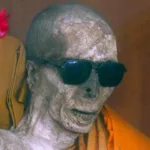
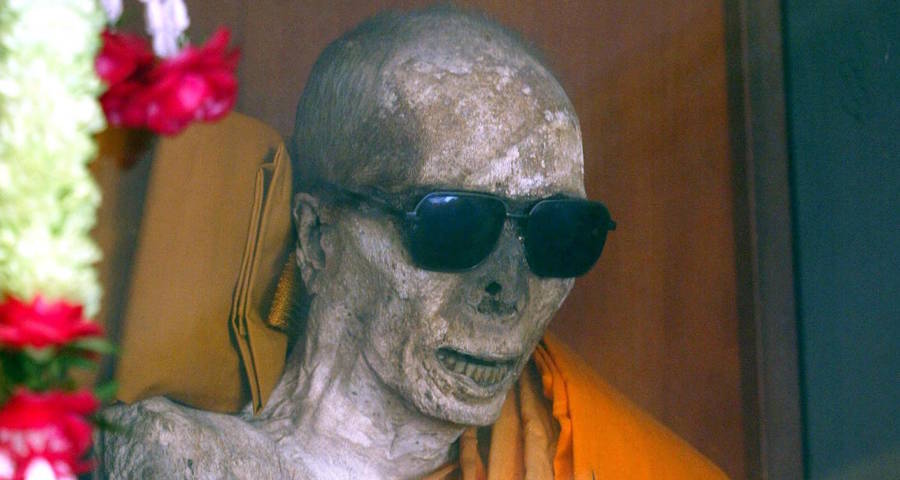
Today, Luang Pho Daeng’s mummified remains rest in a glass case at Wat Khunaram temple, drawing thousands of visitors each year. His body is displayed upright, seemingly frozen in time, wearing saffron robes and sporting a pair of sunglasses to cover his empty eye sockets. This unusual sight has become a popular tourist attraction, a testament to the enduring fascination surrounding death and the afterlife.
Despite the passage of time, the mummified remains appear remarkably well-preserved. Radiological surveys have even revealed that Luang Pho Daeng’s dentures are still intact within his mouth, providing further evidence of the remarkable process of self-preservation. The temple itself is a serene oasis dedicated to Buddhist practice and reflection, offering visitors a chance to meditate, learn about Thai Buddhism, and pay their respects to this enigmatic figure.
The sight of Luang Pho Daeng’s mummified body can be both awe-inspiring and unsettling, prompting contemplation about the nature of life, death, and the mysteries that lie beyond our earthly existence. For many visitors, it serves as a potent reminder of the impermanence of all things, encouraging them to live in the present moment and embrace the beauty of their own fleeting lives.
Scientific Discoveries and Public Perception
The phenomenon of Luang Pho Daeng’s mummified remains has sparked both scientific curiosity and public fascination. Scholars and researchers have conducted studies to understand the intricate biological processes that led to his remarkable preservation.
Radiological examinations have revealed astonishing details about his body, including the presence of his dentures still in place, a testament to the durability of human tissues under specific conditions. The discovery that a native gecko species has been laying eggs under Luang Pho Daeng’s skin further underscores the complex interplay between life and death within this unique environment.
These scientific findings have shed light on the principles behind self-mummification while also raising ethical questions about the preservation of human remains for public display. Public perception of Luang Pho Daeng’s mummified body remains divided, with some viewing it as a sacred relic worthy of reverence and others questioning its appropriateness as a tourist attraction. This ongoing debate highlights the complex relationship between science, faith, and cultural norms in our modern world.
A Lasting Legacy of Buddhist Devotion
Luang Pho Daeng’s story transcends the boundaries of time and place, resonating deeply with believers and non-believers alike. His unwavering commitment to Buddhist teachings and his extraordinary journey towards mummification have cemented his legacy as a revered figure within Thai Buddhism and beyond.
The enduring pilgrimage to Wat Khunaram temple stands as a testament to his profound impact on countless lives. Visitors from all walks of life come seeking spiritual guidance, solace, or simply a glimpse into this enigmatic world of self-preservation and faith. His story continues to inspire awe and contemplation, reminding us of the power of human resilience and the enduring search for meaning in life and death.
Luang Pho Daeng’s message of compassion, mindfulness, and inner peace resonates across cultures and generations. His legacy serves as a powerful reminder that true enlightenment lies not in material possessions or external validation but in cultivating a deep connection with ourselves and the world around us. He remains an enduring symbol of faith, devotion, and the transformative power of spirituality.