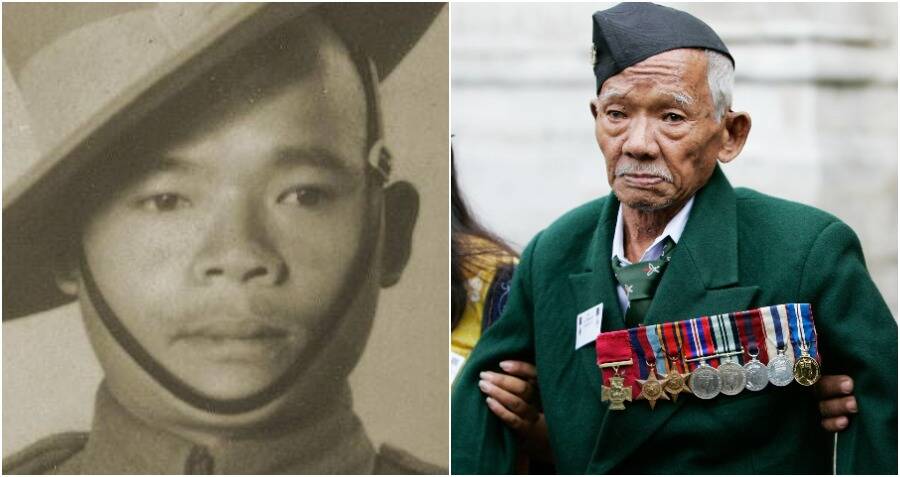
The story of Lachhiman Gurung is a testament to the extraordinary courage and resilience that defined many soldiers during World War II. A Nepalese Gurkha, he chose to serve with the British forces, joining the 8th Gurkha Rifles despite being slightly below the required height due to the urgent wartime needs. What began as a seemingly ordinary posting in Burma quickly transformed into an unforgettable test of human spirit.
Gurung’s platoon found themselves facing a daunting situation in April 1945 near Taungdaw when they were surrounded by hundreds of Japanese troops. During a surprise attack, fate dealt Gurung a cruel blow – a grenade blast that shattered his right hand and left him blind in one eye. Despite these crippling injuries, he refused to succumb to despair.
Alone with two other wounded comrades, Lachhiman Gurung demonstrated an unwavering determination to hold the line against overwhelming odds.
A Gurkha Hero’s Journey
For four grueling hours over two days, Gurung fought with astonishing bravery, repelling wave after wave of Japanese assaults. His indomitable spirit inspired his comrades and confounded the enemy. Armed with a rifle and sheer grit, he became a lone bastion of resistance against an onslaught that seemed impossible to withstand. Every bullet fired, every grenade hurled, was a testament to Gurung’s unwavering commitment to his duty and his fellow soldiers.
His actions ultimately thwarted the Japanese advance, buying precious time for reinforcements to arrive and turn the tide of battle. Though grievously wounded, Gurung managed to hold out until his comrades could reach him. His incredible feat of arms not only saved lives but also demonstrated the unparalleled courage that defines the Gurkha fighting spirit.
News of Gurung’s heroism quickly spread through the ranks, and his name became synonymous with bravery and resilience in the face of adversity.
The Burma Campaign and the Siege of Taungdaw
The Burma Campaign was a brutal and protracted theater of World War II, marked by intense fighting in the dense jungles and treacherous terrain of Southeast Asia. British and Allied forces faced formidable challenges against the Japanese army, who were renowned for their tenacity and adaptability. The campaign saw numerous fierce battles, with both sides suffering heavy casualties.
Within this context, the Siege of Taungdaw emerged as a particularly desperate struggle. In April 1945, Gurung’s platoon found themselves entrapped near Taungdaw, a strategically important town in Burma. Hundreds of Japanese troops had surrounded their position, determined to cut off British supply lines and disrupt Allied operations. The siege transformed into a nightmare for the defenders, who were outnumbered and facing relentless attacks.
This was the setting where Lachhiman Gurung’s extraordinary story unfolded. He and his comrades found themselves amidst a chaotic and bloody fight for survival.
 How Many Deaths at Lake Lanier? A Tragic History
Acts of Extraordinary Bravery
Despite being critically wounded and facing overwhelming odds, Gurung refused to surrender or retreat. With a single hand and unwavering determination, he fought back against the Japanese onslaught with incredible ferocity. He used his limited mobility to his advantage, maneuvering around his position and delivering precise shots that neutralized enemy soldiers.
His bravery inspired those around him, boosting their morale even in the darkest hours of the siege. Gurung’s actions were not merely acts of courage, but calculated strategies that disrupted Japanese attacks and inflicted significant casualties. He became a thorn in the side of the enemy, forcing them to expend valuable resources and manpower to neutralize his threat.
His extraordinary resilience under fire cemented his place as a hero amongst his comrades and solidified his legacy as one of the bravest soldiers to ever serve in the British Army.
Recognition and Legacy
In recognition of his unparalleled courage and sacrifice, Gurung was awarded the Victoria Cross, the highest military decoration for gallantry in the British Armed Forces. This prestigious honor was bestowed upon him in December 1945, solidifying his place as a national hero in both Nepal and Britain. The citation for his VC praised his “extraordinary heroism and tenacity” and described how he “single-handedly repelled wave after wave of Japanese attacks.”
Gurung’s story continued to inspire generations after the war. He became a symbol of courage, resilience, and unwavering commitment to duty. Upon retiring from military service, he dedicated himself to advocating for Gurkha veterans and their families, tirelessly fighting for their recognition and benefits.
His legacy extended far beyond the battlefield; he became a respected figure who championed the rights and well-being of fellow soldiers. His enduring story serves as a powerful reminder of the human capacity for bravery and selflessness in the face of adversity.
Remembering Lachhiman Gurung
Lachhiman Gurung passed away in London in 2010 at the age of 93, leaving behind a remarkable legacy of courage and service. His life was a testament to the extraordinary sacrifices made by soldiers during World War II, and his story continues to inspire awe and admiration around the world.
Even after his death, Lachhiman Gurung’s memory remains vibrant. He is commemorated in various memorials and institutions dedicated to honoring war heroes. His name is etched in the annals of military history as a symbol of unwavering bravery and dedication to duty.
Gurung’s life serves as a powerful reminder that true heroism lies not only in acts of physical courage but also in the indomitable spirit that allows individuals to overcome seemingly insurmountable challenges.