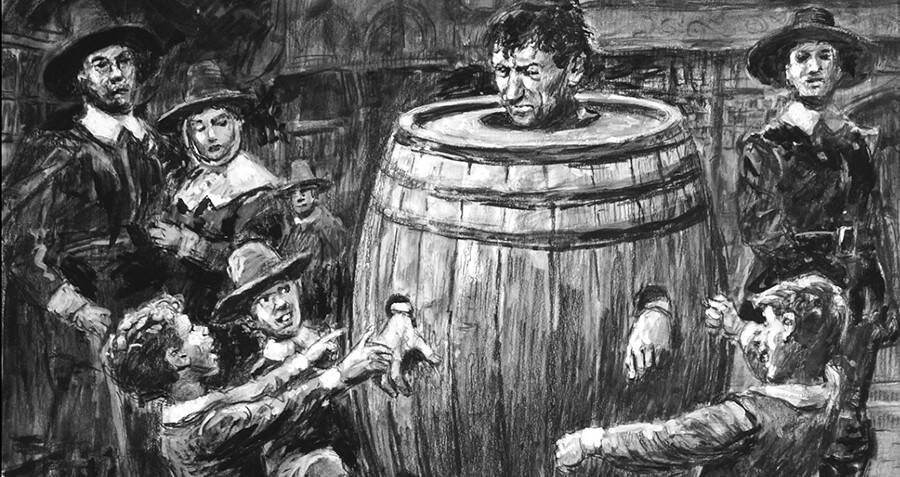
Imagine a bustling marketplace in 16th-century England. Merchants hawk their wares, children chase pigeons, and the air is thick with the scent of ale and freshly baked bread. But amidst this lively scene lurks a peculiar sight: a figure clad in an unwieldy, hollowed-out beer barrel, with holes cut out for head and arms. This unfortunate soul is not merely enjoying a bit too much cheer; they are enduring the ignominious punishment known as the drunkard’s cloak.
The drunkard’s cloak, a truly unique form of public shaming, originated in Newcastle upon Tyne, a city renowned for its robust drinking culture fueled by its coal mining and shipbuilding industries. Over time, Parliament sought to curb excessive alcohol consumption through various means, including fines and increasingly severe punishments like the drunkard’s cloak for repeat offenders. This practice, also known as the “Schandmantel” in Germany or “Spanish Mantle” in Denmark, aimed to deter drunken behavior not through physical force but through the sheer embarrassment of parading a culprit through town.
The effectiveness of this peculiar punishment lay in its public humiliation aspect. Picture the scornful glances, the hushed whispers, and the inevitable laughter that would greet a person forced to wear this cumbersome barrel. The shame associated with the drunkard’s cloak served as a potent deterrent for many, reminding them of the social consequences of their actions and discouraging future bouts of excessive drinking.
The Medieval Origins of Public Intoxication Punishments
The practice of punishing public intoxication isn’t a modern invention; it has roots that stretch back centuries into the medieval period. In those times, with limited legal systems and social structures, communities often relied on informal methods to maintain order and deter harmful behavior. Excessive drinking was seen as disruptive and even dangerous, leading to instances of violence, property damage, and general chaos.
Public shaming served as a common tool for dealing with various societal transgressions, including drunkenness. Imagine a medieval village square where a drunkard might be forced to wear a humiliating costume, walk around the village while being ridiculed, or even have cold water poured over their head. These public displays of shame aimed to not only punish the individual but also serve as a warning to others, discouraging them from engaging in similar behavior.
These early forms of punishment foreshadowed the later development of more formalized methods, like the drunkard’s cloak, which aimed to combine public humiliation with a more tangible symbol of transgression. The desire to curb excessive drinking and maintain social order remained a constant throughout history, evolving through various cultural practices and legal frameworks.
Newcastle Upon Tyne: A City of Drinking Culture
Newcastle upon Tyne, a vibrant city nestled on the banks of the River Tyne in northern England, has long held a reputation for its robust drinking culture. This historical fondness for ale and spirits can be traced back to the city’s economic foundations: coal mining and shipbuilding.
The arduous work involved in these industries demanded physical strength and endurance, often fueled by copious amounts of alcohol. Coal mines, particularly notorious for their demanding conditions, provided miners with a daily ration of beer as a way to maintain energy levels and cope with the harsh realities of their jobs. Shipbuilding yards, too, became hubs of social activity, with workers enjoying pints at the end of a long day, forging camaraderie and celebrating completed vessels.
This deeply ingrained drinking culture inevitably contributed to instances of public intoxication. It was within this context that Newcastle upon Tyne gave birth to the drunkard’s cloak, a unique punishment designed to address the issue of excessive drinking while acknowledging the city’s complex relationship with alcohol. The cloak became a symbol of both the challenges and social norms prevalent in 16th-century Newcastle, reflecting a time when work, leisure, and community life were intertwined with the rhythms of consumption and celebration.
 Real War Dogs Guys: The True Story Beyond the Movie
The Drunkards Cloak: Shame and Deterrence
The drunkard’s cloak, more than just a bizarre piece of clothing, was a carefully designed tool for social control and deterrence. Imagine the sense of humiliation that someone must have felt, paraded through their town in this unwieldy, beer-barrel costume, exposed to the stares and jeers of their fellow citizens. This public shaming was intended to be a potent reminder of the consequences of excessive drinking, serving as a warning to both individuals and the wider community.
The effectiveness of the cloak, however, lay not only in its visual absurdity but also in its ability to tap into deeply ingrained social norms. In medieval and early modern societies, shame acted as a powerful motivator, influencing behavior through fear of public ridicule and ostracization. A person subjected to such public humiliation would likely be eager to avoid repeating their transgression, striving to maintain their standing within the community.
The drunkard’s cloak, therefore, became a potent symbol of social order, reminding individuals that their actions had consequences that extended beyond personal boundaries. It served as a reminder that even in a society increasingly defined by individual freedoms, certain behaviors could not be tolerated and would be met with swift and public consequences.
Evolution and Spread of the Punishment
While the drunkard’s cloak originated in Newcastle upon Tyne, its influence spread beyond English borders, becoming a peculiar symbol of social control in various parts of Europe and even reaching American shores during the Civil War.
It is believed that similar punishments, often with variations in design and implementation, existed in Germany, where it was known as the “Schandmantel,” and Denmark, where it was called the “Spanish Mantle.” These variations highlight how local customs and practices influenced the specific details of these public shaming rituals, demonstrating a shared interest in deterring excessive drinking across different cultures.
The spread of the drunkard’s cloak also reflects the historical interconnectedness of European societies through trade, migration, and cultural exchange. Ideas and practices often traveled alongside goods and people, leading to the adoption and adaptation of various customs, including those related to social control and public order.
Social Norms and Alcohol Control
The drunkard’s cloak, while a peculiar artifact of the past, offers a glimpse into the complex relationship between social norms and alcohol control throughout history. Public drunkenness was often viewed as a transgression not only against individual well-being but also against the established order of society.
Excessive drinking could disrupt community life, lead to violence and property damage, and even undermine religious and moral values. As such, societies developed various methods to regulate alcohol consumption, ranging from sumptuary laws that restricted access to certain types of beverages to more informal practices like public shaming and social ostracism. The drunkard’s cloak, with its emphasis on public humiliation, clearly aimed to reinforce existing social norms and discourage behavior deemed unacceptable within the community.
It highlights how cultural attitudes towards alcohol consumption have evolved over time, influenced by factors such as economic conditions, religious beliefs, and shifting social values. While formal punishments like the drunkard’s cloak may seem archaic today, they serve as a reminder that the challenge of managing alcohol consumption remains a persistent societal concern across cultures and throughout history.