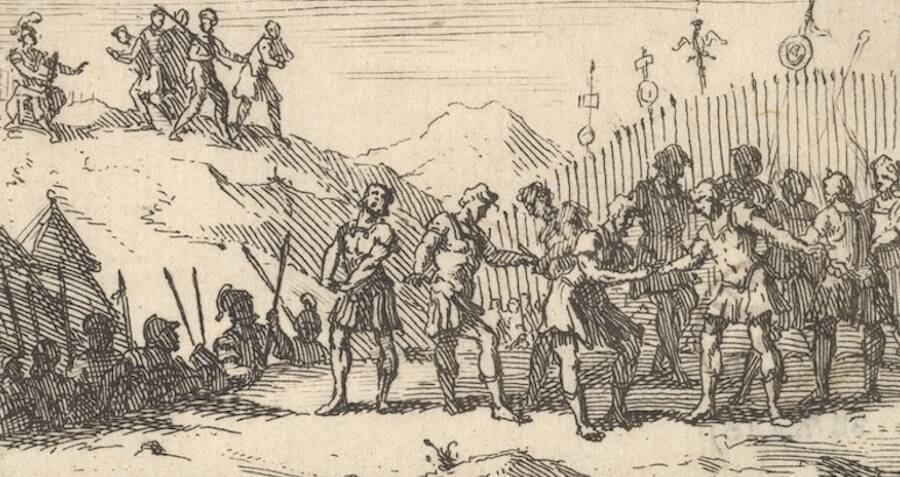
The ancient Roman world was a place of strict discipline and unwavering order, especially within its formidable military machine. To maintain this tight control, the Romans employed a range of punishments, some remarkably harsh by modern standards. Among these, decimation stands out as a particularly brutal form of retribution reserved for serious breaches of military conduct.
This barbaric practice involved the execution of one-tenth of a disobedient unit, serving as a terrifying deterrent against cowardice and insubordination. The condemned soldiers were often subjected to a macabre lottery system, with each group of ten drawing lots to determine their fate. Those deemed unlucky were then killed by their fellow comrades, leaving a chilling legacy of fear and resentment within the ranks. While its application was infrequent, decimation left an indelible mark on Roman military history, shaping the harsh realities faced by those who served under the eagle standard.
It’s important to remember that decimation wasn’t simply a random act of violence. It was a calculated strategy designed to instill fear and obedience within the legions. By punishing entire units, the Romans aimed to create an atmosphere of collective responsibility, where soldiers were keenly aware that their actions could have dire consequences for themselves and their comrades. This psychological pressure served as a powerful tool for maintaining discipline and ensuring unwavering loyalty to the Roman state.
The Decimation Process
The process of decimation was as chillingly methodical as it was brutal. Imagine a Roman legion, its ranks shaken by a perceived act of cowardice or insubordination. The punishment for such transgressions wouldn’t be swift and individual; instead, it would fall upon the entire unit. Each soldier understood that if their comrades faltered, they, too, could face unimaginable consequences.
To carry out this horrifying punishment, the legionary commander would divide his ranks into groups of ten men. These groups were then tasked with drawing lots, essentially deciding who amongst them would face death at the hands of their fellow soldiers. The brutality wasn’t limited to the execution itself; surviving soldiers faced a further ordeal – exile from their encampment and reduced rations for several days, a grueling reminder of the price of disobedience. This meticulously planned process served as a stark reminder that within the Roman army, loyalty and obedience were paramount, enforced through fear and a chilling display of collective punishment known as decimation.
The psychological impact on those who witnessed or participated in decimation must have been profound. The act itself would have instilled a deep sense of terror, highlighting the precariousness of life within the ranks. It’s hard to imagine the emotional toll on those forced to participate in such a barbaric ritual, witnessing their comrades drawn into a gruesome lottery and executed by their own hands. The legacy of decimation wasn’t simply about military discipline; it was about creating a culture of fear and unquestioning obedience.
Historical Examples of Roman Decimation
The chilling practice of decimation wasn’t confined to the annals of history; it was a stark reality for Roman soldiers throughout the empire’s existence. Several historical accounts paint a vivid picture of this brutal punishment being meted out in various instances. One such example is the tale of Appius Claudius Sabinus, who in 471 B.C.E., ordered the decimation of his defeated army after their disastrous performance on the battlefield. This act served as a grim reminder to any soldier contemplating disobedience – defying orders could lead to unimaginable consequences.
Fast forward to 315 B.C.E., and we encounter another instance of decimation employed by Fabius Rullianus, who, following a series of setbacks, ordered the execution of two legions deemed responsible for their failure. This harsh punishment underscored the Roman belief in collective responsibility, where individuals were held accountable for the actions of the entire unit. Even during peacetime, the threat of decimation loomed large over any soldier suspected of disloyalty or misconduct. Mark Antony, a renowned Roman general, faced his own version of this disciplinary measure in 35 B.C.E., when he was forced to order the decimation of soldiers who had deserted him during a crucial battle against the Parthians.
These historical examples demonstrate how decimation wasn’t merely a sporadic punishment but rather a recurring feature throughout Roman military history, employed at various stages and for diverse reasons. It served as a testament to the Romans’ unwavering commitment to discipline and control within their legions, albeit through a method that remains profoundly disturbing even today.
 Drunkards Cloak: History & Punishment for Public Intoxication
Effectiveness and Impact
While undeniably brutal, decimation proved surprisingly effective in maintaining order within the Roman army. The sheer terror associated with this punishment served as a potent deterrent against any form of dissent or disobedience. Soldiers knew that even minor infractions could result in the execution of their comrades, creating an atmosphere of constant vigilance and unwavering loyalty to their commanders.
The effectiveness of decimation wasn’t merely psychological; it also instilled a sense of collective responsibility within the ranks. Knowing that they were all accountable for the actions of their unit, soldiers were more likely to carefully consider their decisions and act in unison to avoid any potential punishment. This fostered a culture of discipline and cooperation essential for the success of the Roman legions on the battlefield. However, despite its effectiveness, decimation also had a profound impact on the morale and psychological well-being of Roman soldiers. The constant threat of this barbaric punishment undoubtedly created an environment of fear and anxiety, potentially undermining the esprit de corps that was so vital to Roman military success.
It’s important to remember that while decimation undoubtedly served its purpose in maintaining order within the ranks, it came at a significant human cost. The psychological trauma inflicted upon those who witnessed or participated in this practice undoubtedly left lasting scars on the soldiers involved.
Echoes of Decimation Through History
Though the Roman Empire ultimately crumbled, the chilling specter of decimation cast a long shadow throughout history, resurfacing in various conflicts throughout the centuries. The Thirty Years’ War (1618-1648) saw instances of decimation employed by both sides, highlighting how this brutal practice could endure even in seemingly enlightened eras. During the War of the Triple Alliance (1864-1870), Prussian forces were accused of using decimation against Austrian troops, showcasing the persistence of this outdated and inhumane tactic.
Even into the 20th century, echoes of Roman brutality reverberated across battlefields. During World War I, Italian General Luigi Cadorna allegedly ordered the execution of 750 men from the 141st Catanzaro Infantry Brigade in 1917 as punishment for a perceived lack of progress during an offensive. This chilling act served as a stark reminder that even in modern warfare, the allure of extreme punishments persisted, despite their inherent ethical and practical flaws.
These historical echoes demonstrate that decimation wasn’t merely a relic of ancient Rome; it represented a recurring phenomenon throughout history, reflecting a persistent belief in utilizing fear and brutality to maintain order and discipline within armed forces. It serves as a sobering reminder of how easily humanity can resort to barbarity, even when confronted with the horrors such practices inevitably unleash.
Legacy and Modern Relevance
The legacy of decimation extends far beyond the ancient Roman battlefield, serving as a cautionary tale about the limits of military discipline and the dangers of unchecked power. While it undoubtedly served its purpose in maintaining order within the legions, the practice’s brutality and psychological impact cannot be ignored.
Even today, the term “decimation” carries with it a heavy weight of meaning, symbolizing extreme violence and collective punishment. It serves as a reminder that while discipline is essential for any functioning military force, resorting to brutal methods like decimation ultimately undermines the very foundations of trust and cooperation crucial for success on the battlefield.
The Roman example offers valuable lessons about the delicate balance between order and humanity within armed forces. While the need for discipline is undeniable, employing such barbaric practices as decimation inevitably leads to a culture of fear and resentment, ultimately hindering rather than promoting effective military performance. Modern armies recognize this inherent danger, prioritizing alternative methods of discipline and training designed to foster respect, cooperation, and a sense of shared purpose among their ranks.