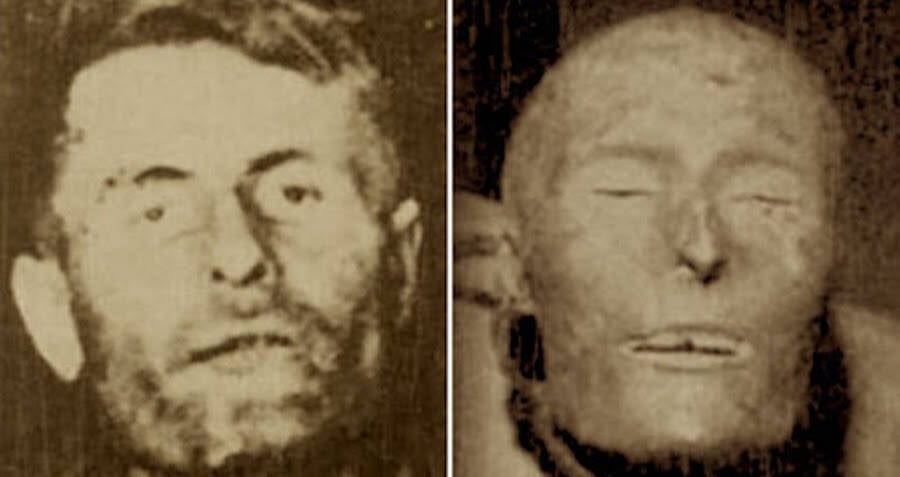
Elmer McCurdy wasn’t your typical outlaw. In fact, his criminal career was a rather short and unsuccessful saga filled with botched bank robberies and failed train heists involving explosives that often seemed to work against him. He lived a life of fleeting crime until his final encounter with the law in Oklahoma back in 1911. What happened next turned McCurdy from a forgotten petty criminal into an infamous sideshow attraction, a story that would unfold over six decades and leave a lasting mark on American history.
Despite his brief stint as an outlaw, McCurdy’s corpse became a captivating spectacle for audiences across the country. His preserved remains, treated with arsenic after his death, were transformed into “The Bandit Who Wouldn’t Give Up,” a moniker that fueled public curiosity and morbid fascination. From traveling carnivals to wax museums, McCurdy’s body made its way through various attractions, becoming a macabre symbol of both criminal ambition and the enduring allure of the unknown.
But how did a failed outlaw become a sideshow sensation? And what ultimately led to his long journey from exhibition to burial?
A Criminal Career Cut Short
Elmer McCurdy’s legacy as a criminal might be summed up as “promising but ultimately underwhelming.” His exploits were more audacious in ambition than successful in execution. He aimed for big scores—bank robberies and train heists that involved explosives, which, it seems, had a mind of their own. His attempts often went awry, resulting in explosions that did more harm to his plans than anything else. Imagine trying to pull off a sophisticated heist and ending up with more smoke than loot!
This pattern persisted throughout McCurdy’s brief criminal career. He seemed to be one step behind the law, constantly dodging capture but never quite managing to pull off a truly successful crime. Perhaps he lacked the finesse required for such intricate endeavors or maybe his luck just ran out. Whatever the reason, his criminal activities were ultimately short-lived and largely ineffective. This failure to achieve real success in the criminal world would ironically pave the way for McCurdy’s unexpected afterlife as a sideshow attraction.
Little did he know that his failed attempts at grand theft would be overshadowed by a much different kind of notoriety – one that would last far longer than any robbery ever could.
From Outlaw to Sideshow Attraction
After McCurdy’s demise at the hands of Oklahoma lawmen in 1911, his story took a truly peculiar turn. His remains were preserved with arsenic, a common practice back then for embalming and delaying decomposition. But this preservation wasn’t intended to honor his memory; rather, it inadvertently set the stage for McCurdy’s corpse to become a spectacle. When no one claimed his body, a local undertaker decided to display him for a fee, essentially turning McCurdy into an early version of a morbid tourist attraction.
This macabre exhibition caught the attention of carnival owners who saw a unique opportunity in McCurdy’s preserved form. He was quickly transformed into “The Bandit Who Wouldn’t Give Up,” a sensationalized persona that played on his short-lived criminal past. His body, posed dramatically with props and costumes, became part of traveling carnivals, where audiences paid to gawk at the once-aspiring outlaw turned permanent exhibit.
McCurdy’s journey from deceased outlaw to sideshow attraction was a strange twist of fate, highlighting the public’s fascination with death and the macabre, even in the form of an unsuccessful criminal.
 Famous Gangsters 1920: Notorious Figures of the Prohibition Era
The Bandit Who Wouldn’t Give Up
The carnival barkers had a knack for spinning a tale, and McCurdy’s story was ripe with dramatic possibilities. They christened him “The Bandit Who Wouldn’t Give Up,” a moniker that captured the public imagination and fueled their morbid curiosity. His preserved body, often posed in a dynamic stance as if mid-heist, became a visual representation of this relentless outlaw persona.
Imagine strolling into a dimly lit tent filled with the scent of popcorn and cotton candy, only to be greeted by McCurdy’s imposing figure. He was dressed in typical bandit garb – a hat pulled low, a bandana covering his face, perhaps even clutching a toy gun. The carnival showmen would weave tales of his daring escapes and audacious exploits, exaggerating his criminal escapades for dramatic effect.
Of course, the reality of McCurdy’s life as an outlaw was far less glamorous than the persona created by the carnival barkers. But that didn’t seem to matter much to audiences who were drawn to the spectacle, the mystery, and the morbid fascination with death presented in such a unique and unsettling way.
McCurdy’s Curious Journey Through Time
McCurdy’s travels as a sideshow attraction weren’t confined to dusty carnival grounds. His preserved remains found themselves in various locations across America, changing hands and morphing into different exhibits over time. He graced amusement parks, wax museums, and even haunted houses, always drawing crowds with his eerie presence and the promise of a glimpse into a macabre world. Imagine the shock of encountering McCurdy’s stiff figure amidst a seemingly innocent carnival midway, or stumbling upon him in a dimly lit corner of a museum dedicated to the bizarre!
This constant relocation added another layer to McCurdy’s strange story. He became a symbol of fleeting fame, a reminder that even death couldn’t escape the fickle nature of public interest. There was always a new location, a new audience eager to witness the spectacle of McCurdy’s corpse.
He traveled through time itself, existing as a frozen moment in history while the world around him changed dramatically. From the bustling boomtowns of the early 20th century to the post-war era of consumerism and entertainment, McCurdy remained a constant, a morbid anchor to a bygone era.
Rest in Peace, Elmer
After decades of traveling from one attraction to another, McCurdy’s bizarre journey finally came to an end in 1976. A film crew shooting at a California amusement park stumbled upon his body during filming and discovered the truth behind his identity. It turned out that for all those years, viewers had been marveling at a real human being, not merely a prop or a cleverly crafted illusion.
The revelation sparked public outrage and a wave of calls to give McCurdy a proper burial. Finally, after so many years as a sideshow sensation, his remains were returned to Oklahoma, his home state. There, in an unassuming cemetery far removed from the bright lights and clamor of carnivals, Elmer McCurdy was laid to rest with dignity and respect.
Perhaps it’s fitting that a man whose life was marked by both ambition and failure found his final resting place in quiet anonymity. His story, however, serves as a reminder of the lengths people will go to for entertainment and the enduring power of morbid fascination.