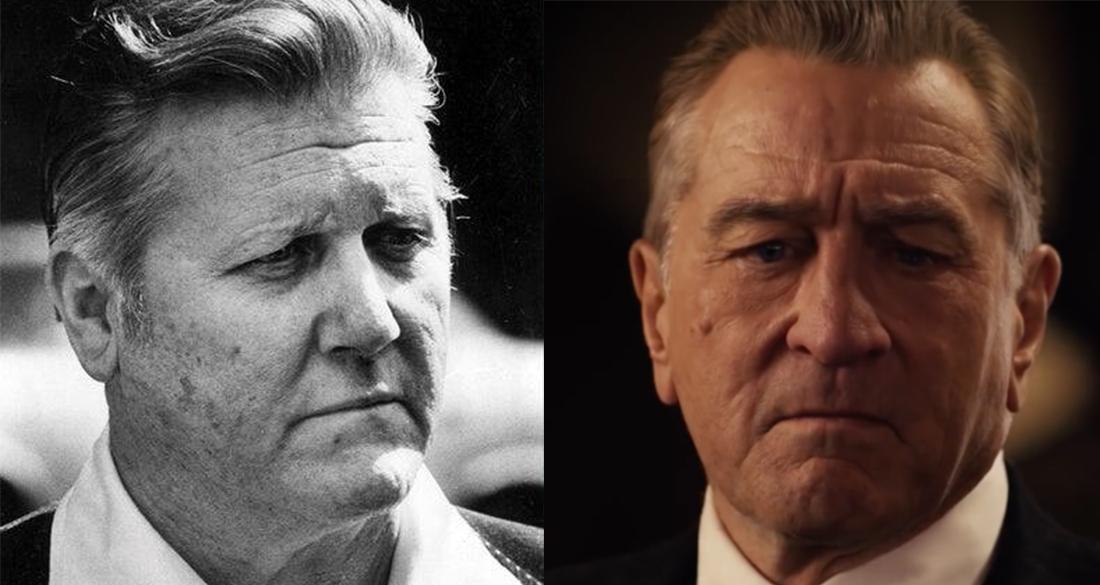
The story of Frank Sheeran is a captivating blend of fact and fiction, leaving audiences to grapple with the truth behind his alleged crimes. He was a man shrouded in mystery, a World War II veteran turned hitman for the Philadelphia Mafia, whose name became inextricably linked to one of America’s most infamous unsolved cases: the disappearance of Jimmy Hoffa.
Sheeran’s story came to light through his own account in the book “I Heard You Paint Houses,” where he confessed to a multitude of murders, including that of Jimmy Hoffa in 1975. According to Sheeran, he carried out this hit on orders from Russell Bufalino, another powerful mob boss, as Hoffa’s attempts to regain control of the Teamsters Union threatened the Mafia’s interests.
This brazen claim, coupled with Sheeran’s alleged involvement in other high-profile killings like that of Crazy Joe Gallo at Umberto’s in New York City, sparked intense public interest and debate. Many questioned what happened to Frank Sheeran, as his story seemed too outlandish to be true. Some even wondered, was Frank Sheeran a real person? While the truth remains elusive, Sheeran’s account has become woven into the fabric of Hoffa’s disappearance, leaving us with more questions than answers.
The Irishman’s Story
Sheeran’s story, as recounted in his book and later brought to life in the Martin Scorsese film “The Irishman,” is a chilling tale of organized crime and ruthless violence. He described himself as a loyal soldier within the Philadelphia Mafia, carrying out assignments with chilling efficiency. His alleged involvement in Hoffa’s disappearance was presented as a pivotal moment in Sheeran’s life, a consequence of Hoffa’s ambition clashing with the mafia’s interests.
Sheeran claimed to have lured Hoffa to a secluded location under the pretense of a meeting, ultimately killing him and disposing of his body. He provided gruesome details, painting a vivid picture of the crime scene and its aftermath. However, these accounts were met with skepticism from law enforcement and the public alike. Without concrete evidence or corroborating witnesses, Sheeran’s story remained largely unproven, leaving many to wonder if he was embellishing the truth for personal gain.
Despite the lack of physical proof, “The Irishman” brought Sheeran’s narrative into the mainstream consciousness, prompting renewed interest in Hoffa’s fate and the shadowy world of organized crime. Sheeran’s story, while potentially exaggerated or fabricated, served as a reminder of the enduring power of true crime narratives and the fascination they hold over audiences even decades later.
Frank Sheeran: Hitman or Fabricator?
The question of whether Frank Sheeran was a cold-blooded hitman or a cunning fabricator has remained unanswered for decades. His own account in “I Heard You Paint Houses” paints a picture of a ruthless killer, willing to carry out his orders without hesitation. He described the details of his alleged crimes with chilling precision, leaving some to believe he was truly capable of such acts.
However, many find it hard to accept Sheeran’s confessions at face value. There is a lack of physical evidence to corroborate his claims, and several inconsistencies in his story have emerged over time. Some accounts from individuals connected to the case contradict Sheeran’s version of events, raising further doubts about his credibility.
Ultimately, the truth about Frank Sheeran remains shrouded in mystery. Was he a hardened criminal who lived a life of violence? Or was he a master manipulator who spun a tale for personal gain? Perhaps somewhere between these two extremes lies the reality, a complex and nuanced story that continues to fascinate and bewilder us.
 What Killed Frank Sinatra: Cause of Death & Legacy
Unraveling the Hoffa Mystery
The disappearance of Jimmy Hoffa in 1975 remains one of the most enduring unsolved cases in American history. Hoffa, a powerful labor leader who headed the Teamsters Union, vanished without a trace after a meeting at a Michigan restaurant. Despite numerous investigations and countless theories, his body has never been found, leaving the circumstances surrounding his disappearance a source of endless speculation.
Frank Sheeran’s account in “I Heard You Paint Houses” offered a chilling account of Hoffa’s demise, alleging that he was killed on orders from Russell Bufalino, another powerful mob boss. According to Sheeran, Hoffa’s attempts to regain control of the Teamsters Union threatened the Mafia’s interests, leading to his murder. While many dismiss Sheeran’s confession as a fabrication or an attempt to shift blame, it has nevertheless become intertwined with the Hoffa mystery, adding another layer of complexity to an already perplexing case.
The Hoffa disappearance continues to captivate the public imagination, fueled by numerous books, documentaries, and even Hollywood films that have attempted to shed light on what truly happened. While definitive answers may never be found, the enduring nature of this unsolved case serves as a reminder of the power of unanswered questions and the allure of the unknown.
Conflicting Accounts and Evidence
Sheeran’s claims have been met with considerable skepticism due to the lack of concrete evidence to support his story. While he provided detailed accounts of his alleged crimes, including the murder of Jimmy Hoffa, these accounts were largely based on his own testimony and lacked physical proof or corroborating witness statements. This absence of tangible evidence has led many to question the veracity of Sheeran’s confessions, casting doubt on the entire narrative surrounding what happened to Frank Sheeran.
Adding further fuel to the fire are conflicting accounts from other individuals involved in the case. Some witnesses have disputed Sheeran’s version of events, offering alternative explanations for Hoffa’s disappearance. These discrepancies in testimonies create a tangled web of information, making it difficult to discern truth from fabrication and leaving investigators with more questions than answers.
Ultimately, the absence of solid evidence and the presence of conflicting accounts have hindered any definitive conclusions about Sheeran’s role in these high-profile crimes. The weight of unanswered questions continues to surround the case, leaving us to grapple with the complexities of untangling truth from deception.
The Legacy of a Murderous Legend
Whether a hardened criminal or a cunning fabricator, Frank Sheeran’s story has left an undeniable mark on popular culture. His alleged involvement in high-profile crimes like the murder of Jimmy Hoffa and Crazy Joe Gallo has cemented him as a figure of both fascination and revulsion. His narrative, brought to life through books and films like “The Irishman,” has captivated audiences worldwide, sparking ongoing debates about the truth behind his claims.
Sheeran’s legacy is a complex one, intertwined with questions of morality, power, and the seductive allure of a life lived on the fringes of society. He has become a symbol of the darker side of the American Dream, a cautionary tale of ambition unchecked by ethics. Despite the controversies surrounding his story, Sheeran’s name continues to be synonymous with organized crime, forever etched in the annals of infamous figures who blurred the lines between truth and fiction.
The enduring fascination with Frank Sheeran suggests that we are drawn to stories of violence and mystery, perhaps seeking answers to questions about good and evil, justice and redemption. Even if we never fully unravel the enigma surrounding Frank Sheeran, his story serves as a reminder of the power of storytelling to captivate our imaginations and leave us pondering the complexities of human nature.