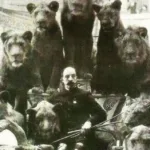
The story of Dina Sanichar is one that has captivated people for decades, blurring the lines between myth and reality. Discovered in 1867 deep within the Indian jungles, Sanichar was a young boy who had been raised entirely by wolves. He walked on all fours, communicated through growls and howls, and subsisted on raw meat – behaviors that painted a picture of a child truly integrated into the wild. This tale, often compared to Rudyard Kipling’s The Jungle Book, brought to light the possibility of humans adapting to a completely different way of life, raising questions about nature versus nurture.
Sanichar’s story became intertwined with the legend of Mowgli, a character who captured imaginations with his adventures in the jungle and his unique bond with animals. While Kipling drew inspiration from real-life accounts like Sanichar’s, it’s important to remember that The Jungle Book is ultimately a work of fiction. Yet, Sanichar’s existence serves as a fascinating reminder that the world can hold unexpected truths, stories that challenge our perceptions of human nature and the wild.
His story highlights the enduring fascination with the idea of feral children, individuals raised outside of human society who develop unique abilities and behaviors. While some accounts of feral children have been met with skepticism due to potential exaggeration or misinterpretations, Sanichar’s case remains a captivating testament to the adaptability of the human spirit.
Dina Sanichar: A Real-Life Mowgli
Dina Sanichar’s life was a stark contrast to the lives of most children. Found as a young boy in 1867 by British soldiers deep within the forests of India, he exhibited traits that made him seem more like an animal than a human. He walked on all fours, his body lean and muscular from a life spent running and climbing trees. His diet consisted mainly of raw meat, and his communication was limited to growls, howls, and the occasional bark.
The details surrounding Sanichar’s early years remain shrouded in mystery, but it is believed that he was abandoned as an infant and taken in by a pack of wolves. They raised him like one of their own, teaching him the ways of the jungle and protecting him from harm. When discovered, Sanichar’s behavior was so primal that many questioned whether he could ever truly be integrated back into human society. This made him a captivating subject for both scientists and the public alike, who were fascinated by his unique experiences.
Despite the best efforts of missionaries at the Sikandra Mission Orphanage to teach Sanichar language and human customs, he never fully adapted. He struggled to learn any language beyond his animalistic calls and remained wary of human interaction. Sanichar’s story serves as a powerful reminder of the profound impact that early environment can have on shaping an individual, highlighting the incredible resilience and adaptability of the human spirit even in the face of such extraordinary circumstances.
Life in the Jungle
While the exact details of Sanichar’s life in the jungle remain a mystery, his story provides us with glimpses into a world far removed from our own. He likely roamed freely through dense forests, relying on his instincts to find food and shelter. The wolves, who raised him as one of their own, would have taught him essential survival skills like hunting, tracking prey, and defending himself against predators.
As he grew older, Sanichar would have learned the intricate social dynamics of the wolf pack, understanding their communication signals and hierarchy. He may have even participated in hunts alongside them, learning to cooperate and strategize for success. Imagine him running alongside them, his senses heightened, his movements agile and swift as they stalked their prey through the underbrush. The jungle became his home, a place where he thrived despite lacking human interaction.
This upbringing undoubtedly shaped Sanichar’s physical and mental development, leaving him with unique abilities and behaviors that set him apart from humans who had lived sheltered lives. He could navigate the dense forest with ease, understand animal language, and survive on his own without relying on tools or technology – a testament to the adaptability of the human spirit in the face of extraordinary circumstances.
 Eduard Einstein, Son Schizophrenia & Tragic Death
Attempts at Integration
Upon being discovered, Sanichar was taken to the Sikandra Mission Orphanage, where missionaries hoped to teach him human behavior and language. This marked a dramatic shift in his life, transitioning from a world of wild instincts and animal companionship to one of structured rules and unfamiliar customs. Despite their best efforts, integrating Sanichar into society proved to be a monumental challenge.
He struggled to grasp human language, his attempts at communication often reduced to growls, howls, and gestures. He resisted wearing clothes, preferring the comfort of his animalistic ways. His diet remained primarily meat-based, and he exhibited discomfort around large groups of people. While some progress was made, Sanichar never truly shed his wild nature. He remained wary and unpredictable, forever caught between two worlds that seemed fundamentally incompatible.
The missionaries’ attempts at integration highlight the complex nature of human development and the profound impact that early environment can have on shaping an individual. While Sanichar’s story is ultimately a tragic one, it underscores the resilience of the human spirit and its capacity for adaptation, even in the face of extraordinary adversity.
Other Cases of Feral Children
Sanichar’s story isn’t unique. Throughout history, there have been numerous accounts of feral children, individuals raised outside of human society who exhibit behaviors and abilities seemingly more aligned with animals. These tales often spark debate and intrigue, prompting us to question the boundaries between nature and nurture.
One such case is that of Oxana Malaya from Ukraine, a young girl found living in a dog pack in 2012. She had exhibited similar traits to Sanichar, walking on all fours, barking at people, and lacking basic human social skills. While she eventually learned to communicate and function within society, her early experiences left lasting impacts. Similarly, Shamdeo from India was raised by monkeys after being abandoned as a child. He could climb trees with ease, communicate with the monkeys through calls, and even forage for food in the wild. His story, like Sanichar’s, demonstrates the remarkable adaptability of the human mind and body when exposed to unconventional environments.
These cases, though often shrouded in mystery or disputed by skeptics, offer a glimpse into the complex nature of human development and the profound influence that early experiences can have on shaping an individual’s life trajectory. They remind us that while humans are inherently social creatures, our capacity for adaptation is truly remarkable, allowing us to thrive even in the most extraordinary circumstances.
The Enduring Mystery
Despite the efforts made to understand Dina Sanichar’s life and experiences, his story remains shrouded in a certain mystery. While we have documented accounts of his behavior and attempts at integration, many questions about his early years in the jungle remain unanswered. What were his exact interactions with the wolf pack? Did he develop any specific bonds with individual wolves? How did he navigate the challenges of surviving in such a harsh environment?
Even today, Sanichar’s case continues to fascinate researchers and the public alike, prompting ongoing discussions about human nature, animal behavior, and the very definition of what it means to be human. His story serves as a reminder that there are still many unexplored corners of our world, both literal and figurative, where mysteries persist and inspire our imagination.
Perhaps the most enduring mystery surrounding Sanichar’s life is his ultimate fate. While he died at a relatively young age due to tuberculosis, his legacy continues to live on through the captivating tale of a real-life Mowgli, forever blurring the line between myth and reality. He embodies the enduring human fascination with the wild, the unknown, and the extraordinary resilience of the human spirit in the face of adversity.