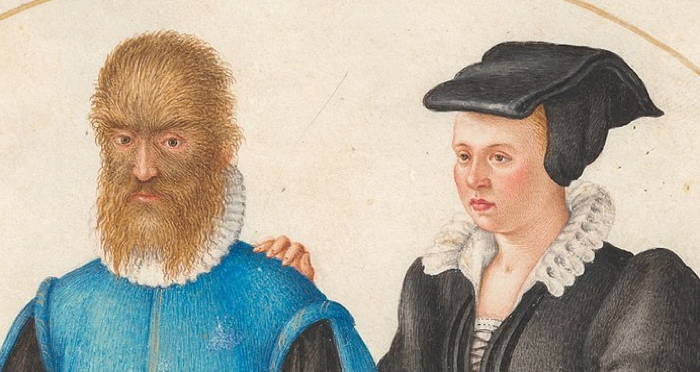
The 16th century witnessed a captivating tale of love and acceptance amidst the extraordinary circumstances of Petrus Gonsalvus and his bride-to-be Catherine. Petrus, hailing from the Canary Islands, was born with hypertrichosis, a rare condition causing excessive hair growth throughout his body. This unusual trait thrust him into the spotlight, attracting attention far beyond his humble origins.
At the tender age of ten, Petrus was presented as a gift to King Henri II of France. His arrival at the French court sparked curiosity and fascination, transforming him from an individual with a unique condition into a subject of royal interest. The king, known for his patronage of the arts and sciences, recognized the uniqueness of Petrus’s case and saw an opportunity to provide him with education and opportunities beyond his initial circumstances.
Petrus’s story wasn’t merely one of physical peculiarity; it was a testament to love, acceptance, and the triumph of the human spirit in overcoming societal norms.
Petrus Gonsalvus: A Life Marked by Hypertrichosis
Life for Petrus Gonsalvus was undeniably shaped by his hypertrichosis, a condition that bestowed upon him a distinctive appearance. From a young age, he stood out from his peers due to the dense hair covering his entire body. This unique trait became both a source of wonder and, at times, prejudice in the societies he encountered. Despite the challenges it presented, Petrus never allowed his condition to define him.
He embraced his individuality with grace and resilience, proving that inner strength and character transcend physical appearances. While some viewed him with curiosity or even fear, others recognized his inherent dignity and worth. It was this acceptance, particularly within aristocratic circles, that allowed Petrus to flourish despite the societal norms of his time. His story serves as a powerful reminder that true beauty lies not in conformity but in the courage to embrace one’s uniqueness.
From Canary Islands to French Court
Petrus Gonsalvus’s journey began in the Canary Islands, a remote archipelago known for its volcanic landscapes and diverse flora and fauna. Little is known about his early life there, but it’s likely that he experienced a childhood marked by both wonder and isolation due to his unique condition. The world beyond his island home remained largely unknown until fate intervened in a dramatic fashion.
At the age of ten, Petrus found himself at the center of a historical event that would forever alter the course of his life. He was presented as a gift to King Henri II of France, embarking on a voyage across the Atlantic that transformed him from an anonymous island boy into a subject of royal fascination. This unexpected turn of events thrust him into a world of political intrigue, artistic patronage, and unprecedented opportunities.
The French court, known for its grandeur and sophistication, became Petrus’s new reality. He was immersed in a culture vastly different from his own, encountering individuals from diverse backgrounds and experiencing customs that both intrigued and challenged him. His arrival at the French court marked the beginning of a remarkable chapter in Petrus Gonsalvus’s life.
Love and Family in a Time of Difference
Despite the extraordinary circumstances of his life, Petrus Gonsalvus found love and companionship within the confines of the French court. He married Catherine, a woman who defied societal expectations by choosing to embrace him for who he truly was. Their union transcended physical appearances, showcasing the power of love to bridge divides and foster genuine connections.
Together, they built a family, welcoming several children into their world. These little ones, born amidst the grandeur of the French court, inherited some of Petrus’s unique traits, further blurring the lines between normalcy and difference. Their existence challenged prevailing notions of beauty and accepted diversity as an inherent part of life. The Gonsalvus family became a testament to the enduring power of love in overcoming societal barriers and creating a haven of acceptance amidst a world that often struggled to comprehend their unconventional reality.
Patronage and Artistic Representation
As their fame spread throughout Europe, the Gonsalvus family’s unique condition attracted the attention of various patrons and artists eager to capture their essence in visual form. Their story transcended mere curiosity; it became a subject of fascination that resonated with audiences across social strata. After a period of instability within the French court, the family found refuge and patronage under the Duke of Parma’s widow in Italy. This newfound support provided them with a stable environment to flourish and continue their journey together.
It was during their time in Italy that Petrus Gonsalvus and his family became subjects of numerous portraits by prominent artists like Lavinia Fontana. These paintings, rendered with remarkable detail and sensitivity, sought not only to depict their physical appearance but also to capture the humanity and dignity that resided within them. They became iconic representations of difference embraced amidst a world grappling with its own perceptions of beauty and acceptance.
These artistic depictions played a crucial role in shaping public perception of the Gonsalvus family. They transformed them from objects of curiosity into subjects deserving of respect and admiration, showcasing their unique condition as an integral part of their identity rather than a defining flaw.
The Beast Within Beauty?
The tale of Petrus Gonsalvus and his bride-to-be Catherine has captivated audiences for centuries, prompting comparisons to classic fairy tales like Beauty and the Beast. While the origins of these stories predate the 16th century, the striking similarities between their narratives are undeniable. Both feature protagonists who defy conventional notions of beauty, captivating the hearts of those who look beyond superficial appearances.
The visual depictions of the hairy beast in illustrations often align with the portrayal of the Gonsalvus family, particularly in artistic representations that emphasized Petrus’s unique condition. This has led some scholars to speculate that the story of Petrus Gonsalvus and his acceptance within aristocratic circles might have served as an inspiration for later iterations of the Beauty and the Beast tale.
Whether a direct influence or a parallel narrative driven by universal themes, the Gonsalvus family’s story resonates with the timeless message embedded in Beauty and the Beast: true love transcends physical appearances and finds beauty in the heart rather than the outward shell.