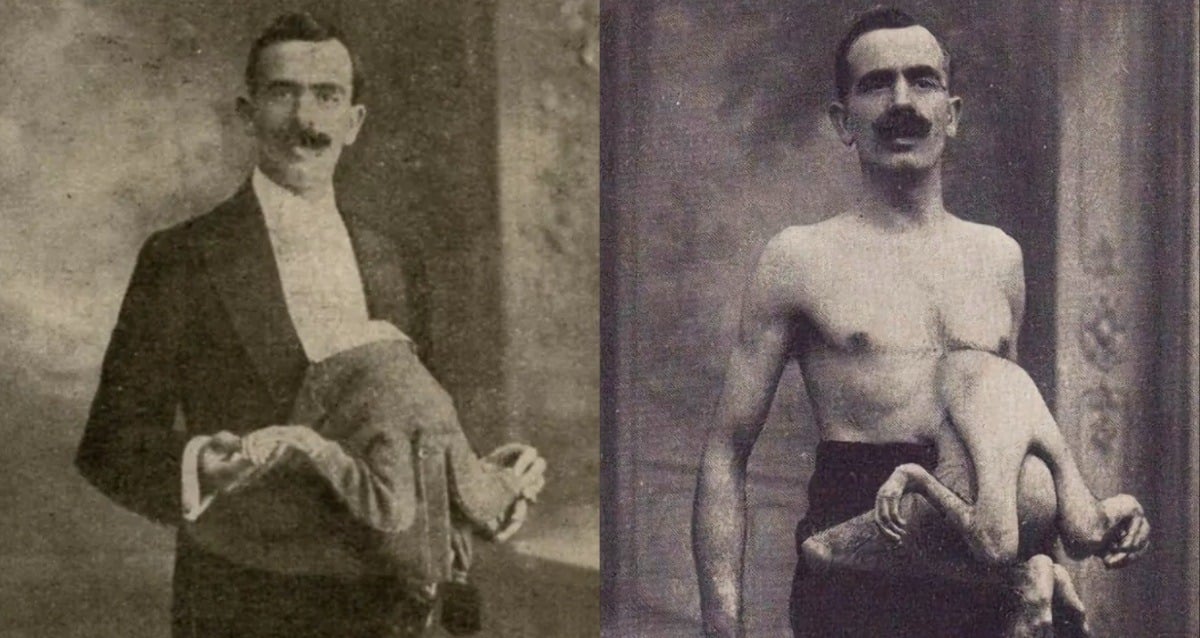
Have you ever heard a story so bizarre it sounds like fiction? Well, buckle up because the tale of Jean and Jacques Libbera is truly one for the books. Born in 1884, Jean entered the world with a unique companion – his parasitic twin Jacques, attached to his abdomen. Jacques had two arms, two legs, and a partially formed head nestled within Jean’s stomach, completely reliant on Jean for survival.
Imagine growing up with someone literally part of you! Jean, despite this extraordinary circumstance, managed to live a relatively ordinary life. He married, had four children, and even found work performing as the “Double-Bodied Man” in circuses and sideshows throughout the early 20th century. Think about that for a moment – two people sharing one body, captivating audiences with their unusual bond. Jean and Jacques would often coordinate outfits, sporting matching suits during performances. Jacques even had his own dapper patent leather shoes and diapers! It’s a fascinating glimpse into a bygone era when physical differences were often exploited for entertainment.
But the story of Jean and Jacques Libbera is more than just a spectacle. It serves as a reminder of the complex ethical issues surrounding the display of human oddities in the past. While Jean seemed to navigate his double life with resilience, it begs the question: what was it like for him to be both a performer and an individual living with such a unique condition?
A Life Shared: The Story of Jean and Jacques Libbera
You might wonder what daily life was like for Jean and Jacques. While we know they performed together, their shared existence went beyond the stage. Imagine two individuals, intertwined physically yet striving for individual experiences within that unity. Jean managed to lead a relatively normal life outside of show business. He married and raised four children, indicating the normalcy he sought outside of his unique circumstance.
However, Jacques was entirely dependent on Jean for survival. It’s hard to comprehend the complexities of their relationship – the constant physical connection, the shared experiences, and the potential for both interdependence and individuality. While we lack detailed accounts from either Jean or Jacques, we can imagine the challenges and triumphs they faced together. What were their unspoken agreements? How did they navigate the world with two distinct personalities sharing one body?
Their story raises profound questions about identity, connection, and the human capacity to adapt to extraordinary circumstances. Though shrouded in some mystery, Jean and Jacques Libbera offer a glimpse into a life unlike any other – a testament to the enduring power of the human spirit to find meaning and purpose even amidst the most unusual conditions.
Conjoined Existence: Physical Condition and Dependence
The physical connection between Jean and Jacques was truly remarkable. Jacques’s torso, with his two arms and legs, was fully attached to Jean’s abdomen. A partially formed head was embedded within Jean’s stomach, highlighting the intricate and complex nature of their shared existence. This parasitic twinning meant that Jacques was entirely dependent on Jean for survival. He lacked a functioning digestive system or organs necessary for independent life.
Imagine the implications of this constant physical union – the shared blood supply, the dependence on Jean for nourishment and oxygen. While we can only speculate about the sensations and experiences they both endured, it’s clear that their connection went beyond a mere physical anomaly. It was a fundamental part of their being, shaping their lives in profound ways.
Jean and Jacques Libbera serve as a poignant reminder of the diverse ways life unfolds. Their story invites us to consider the complexities of human existence, the boundaries of identity, and the extraordinary resilience of the human spirit in the face of unique challenges.
 Carol Burnett Ear Tug: A Loving Tribute to Her Grandmother
Performing the Double-Bodied Man Act
Think about the spectacle of performers in circuses and sideshows – a world that often celebrated the unusual and extraordinary. It was within this context that Jean and Jacques found their stage, captivating audiences with their unique bond as the “Double-Bodied Man.” Imagine them dressed in matching suits, performing coordinated routines, showcasing their synchronized movements to gasps and applause.
Their act wasn’t simply about the visual spectacle; it involved a sense of personality and storytelling. We know they often wore matching outfits, highlighting their unity while still allowing for individual expression. Jacques even had his own patent leather shoes and diapers! They weren’t just two bodies connected – they were performers crafting a narrative around their shared existence.
The Double-Bodied Man act offered the audience a glimpse into a world beyond their comprehension, blurring the lines between reality and imagination. While their performances undoubtedly entertained audiences, it also raises important ethical questions about the exploitation of individuals with physical differences for profit in that era.
Exploitation in Entertainment: The Dark Side of Show Business
While Jean and Jacques’s story might seem captivating on the surface, it’s essential to remember the context of their time. The early 20th century saw a rise in sideshows and circuses that often exploited individuals with physical differences for entertainment. Think about the sad reality – these shows capitalized on people’s curiosity and sometimes even prejudice, treating them as objects of spectacle rather than human beings with feelings and aspirations.
The exploitation within this industry was widespread. Performers were often paid poorly, subjected to grueling schedules, and lacked basic rights and protections. Their stories highlight a dark side of show business where the pursuit of profit overshadowed ethical considerations. It’s important to acknowledge these historical injustices and learn from them to ensure that such exploitation never happens again.
Looking back at the story of Jean and Jacques Libbera, we see a complex intersection of human connection, desire for acceptance, and the sometimes-harsh realities of show business. Their legacy reminds us to approach history with a critical eye, understanding the context within which these events unfolded and striving for a more equitable and compassionate world.
Beyond the Stage: Legacy and Ethical Reflections
The story of Jean and Jacques Libbera transcends the realm of entertainment; it invites us to reflect on broader ethical questions about representation, exploitation, and the human condition. While their performances captivated audiences, it’s crucial to acknowledge the complexities surrounding their situation.
Their legacy serves as a reminder of the importance of treating individuals with respect and dignity, regardless of their physical differences. It compels us to examine how history has often marginalized and exploited those who deviate from societal norms. Looking back, we can see that Jean and Jacques’s story is ultimately one of both resilience and vulnerability – a testament to the enduring human spirit in the face of extraordinary circumstances.
Jean and Jacques Libbera offer a valuable lens through which to explore themes of identity, connection, and the responsibility we have towards each other. Their story prompts us to continue conversations about diversity, inclusion, and the importance of creating a more equitable world for all individuals.