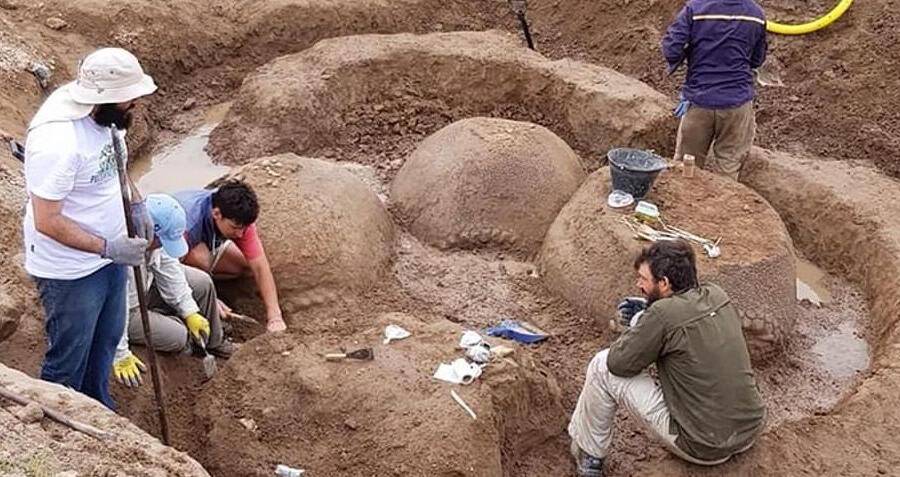
Deep in the heart of Argentina, an unbelievable discovery was made that has sent ripples through the paleontological community. Juan de Dios Sota, a local farmer, stumbled upon something extraordinary while tending his land near a dried-up riverbed: the fossilized remains of four giant armadillos, also known as glyptodon argentina. These ancient creatures, with their massive armored shells and club-like tails, roamed South America millions of years ago.
This find is particularly remarkable because it marks the first time that four glyptodon have been unearthed in such close proximity. Imagine the scene: these incredible animals, possibly a family group consisting of a male and female parent with their young, seemingly frozen in time as they faced the same direction. Their fossilized remains offer a glimpse into a prehistoric world teeming with fascinating creatures.
This remarkable discovery has piqued the curiosity of paleontologists who are eager to unravel the secrets held within these ancient bones. What can this unique family group tell us about the social structures and behaviors of these magnificent creatures? Could their close proximity shed light on their mating rituals or parental care? The possibilities for new discoveries are endless, and this find promises to be a treasure trove of information about these fascinating giants that once ruled the South American landscape.
Giant Armadillo Discovery in Argentina
The discovery of these fossilized glyptodon argentina has sent shockwaves through the scientific community. It’s like finding a lost piece of a giant puzzle, offering an incredibly rare and valuable glimpse into the past. These creatures were truly massive, with shells reaching up to five feet in length and two inches thick – imagine trying to sneak past that! They roamed South America for millions of years, shaping the landscape with their immense size and grazing habits.
But what makes this find so extraordinary is not just the sheer scale of these ancient armadillos, but also their potential social significance. The fact that they were found together, seemingly facing the same direction, suggests a strong familial bond. Were they a family unit – parents protecting their young? This discovery could rewrite our understanding of how these giant creatures interacted within their prehistoric world.
Paleontologists are now meticulously studying these fossils, hoping to unravel the secrets they hold. Analyzing tooth wear patterns, bone structures, and even the arrangement of the fossilized remains might reveal clues about their diet, habitat preferences, and perhaps even their social behaviors. This is a golden opportunity for researchers to piece together a more complete picture of these fascinating creatures that once roamed our planet.
Family Group Speculation
The sight of these four fossilized glyptodon, seemingly positioned as a family unit, has sparked intense speculation among paleontologists. Could this be more than just a random occurrence? Perhaps they represented a breeding pair and their offspring, tragically united in death after an unforeseen event. Imagine the tenderness of a maternal figure shielding her young behind her formidable shell – a scene that could have played out millions of years ago.
However, it’s important to remember that these are still just hypotheses. Further research is needed to confirm whether this truly was a family group or if their shared location was simply a coincidence. Analyzing the size and skeletal structure of each individual could shed light on their potential familial relationships. Were they truly parent and offspring, or could there be other explanations? This tantalizing puzzle continues to intrigue scientists eager to uncover the secrets behind this extraordinary find.
Regardless of the ultimate conclusion, this discovery has ignited our imaginations and reminded us of the rich tapestry of life that existed millions of years ago. It’s a powerful testament to the enduring legacy of these remarkable creatures and the mysteries that still remain hidden within the Earth’s crust.
Significance for Understanding Glyptodon Behavior
This remarkable find offers a unique window into the lives of these ancient armadillos. The potential for understanding glyptodon behavior is immense. For years, paleontologists have pieced together information from scattered fossil remains to paint a picture of their existence. This discovery, with its possible family group dynamic, provides an unprecedented opportunity to delve deeper into their social structures and interactions.
Imagine the insights we could gain! Did these creatures live in tight-knit family units, or were they solitary wanderers? How did they communicate and interact within their groups? Perhaps we’ll even be able to determine if there were specific roles within a family unit – a dominant male, a nurturing female, playful youngsters. This discovery has the potential to revolutionize our understanding of these fascinating creatures and their place in the prehistoric ecosystem.
The implications extend beyond just glyptodon behavior. By studying their social structures, we can gain valuable insights into broader evolutionary trends, particularly within extinct species with limited fossil records. This discovery is a reminder that every fossil holds a story waiting to be told, and each new finding has the potential to reshape our understanding of the past.
Fossil Evidence of Evolutionary History
This incredible find doesn’t just offer a snapshot of glyptodon life in a specific moment; it also provides valuable clues about their evolutionary history. Fossils are like time capsules, preserving fragments of ancient lives and revealing how species have adapted and changed over millions of years. By carefully studying the skeletal structure of these fossilized glyptodon, scientists can trace their lineage back through time, identifying key evolutionary milestones and understanding how they diversified into different forms.
The discovery also highlights the remarkable resilience of these creatures. They thrived in South America for an astonishing 30 million years before eventually going extinct around 10,000 years ago. What factors led to their eventual demise? Perhaps environmental changes, competition with other species, or even the arrival of humans played a role. This discovery offers a unique opportunity to explore the complex interplay of forces that shaped the fate of these magnificent creatures.
Through careful analysis and comparison with other fossil records, scientists can piece together a detailed narrative of glyptodon evolution – their origins, adaptations, and ultimate extinction. It’s like solving a giant puzzle, where each piece adds another layer of understanding to this fascinating prehistoric world.
Unlocking the Mysteries of Ancient Armadillos
This extraordinary discovery in Argentina isn’t just about unearthing ancient fossils; it’s about unlocking the mysteries of these fascinating creatures that once roamed our planet. Imagine the countless stories locked within their fossilized remains – tales of survival, adaptation, and ultimately, extinction. This find offers a tantalizing glimpse into a world we can only dream of, allowing us to peer back in time and connect with life as it existed millions of years ago.
Scientists are now working tirelessly to piece together the puzzle of glyptodon life. Analyzing their fossilized remains, understanding their diet and habitat preferences, and even reconstructing their social structures – each piece of information adds another layer to our understanding of these remarkable creatures. This discovery is a reminder that every fossil holds a story waiting to be told, and with each new finding, we inch closer to unraveling the secrets of Earth’s ancient past.
The journey of discovery is far from over. This incredible find has ignited a surge of excitement within the scientific community, inspiring further exploration and research. Who knows what other hidden treasures await us beneath the surface? With each excavation, each fossil unearthed, we inch closer to a more complete picture of the tapestry of life that has unfolded over millions of years – a testament to the enduring power of discovery and the relentless pursuit of knowledge.